


The collector car market in 2026 operates at a scale that commands attention from anyone interested in tangible assets and aesthetic value. Auctions and online sales surged ten percent in 2025 to $4.8 billion according to Hagerty, the classic car insurance company and collector platform. Online classic car sales alone reached $2.5 billion, with online-only seven-figure sales numbering over 53 in 2025 and predictions suggesting the count will crest 70 in 2026—with the possibility of the first eight-figure online sale as auction companies compete for increasingly impressive offerings.
This expansion reflects generational transition reshaping the entire collector landscape. As baby boomers age out of active collecting and downsize their holdings, members of Generation X, millennials, and even Gen Z are redefining what constitutes a collectible car. The average model year of million-dollar vehicles sold at auction has climbed from 1972 in 2020 to 1984 in 2025, with six of the top ten sales in 2025 built after 1990. Hagerty predicts seven of 2026's top ten sales will be post-1990 vehicles, confirming the definitive shift toward what collectors call "modern classics" and "youngtimers."
Discover how automotive aesthetics intersect with contemporary art collecting at Artestial, where collectors find works that reward the same appreciation for design, craftsmanship, and cultural significance that drives enthusiasm for collector cars.
The 2026 Auction Landscape
Record-Breaking March Results
The March 2026 auction season delivered results that exceeded even optimistic projections. Broad Arrow achieved a 92 percent sell-through rate and $111 million in total sales at Amelia Island—the most successful auction in the company's history. Gooding Christie's hit 94 percent sell-through and $71.8 million in total sales, the auction house's best Amelia result since its inaugural sale there in 2010. Million-dollar cars based on their low estimates achieved a 90 percent sell-through rate across both venues.
The standout results came from modern supercars and hypercars, which accounted for nearly one-third of Broad Arrow's total sales volume. Five out of six modern supercar offerings at Broad Arrow sold for records. The Gulf Blue Porsche Carrera GT's $6.7 million result more than doubled the previous model record of $3.3 million set just one week earlier at RM Sotheby's Miami. The 1988 Porsche 959 Sport, one of only 29 lightweight U.S.-market examples, established a new model record at $5.5 million. A 2015 Porsche 918 Spyder sold for $2.975 million, setting a new record for non-Weissach models of the hybrid hypercar.
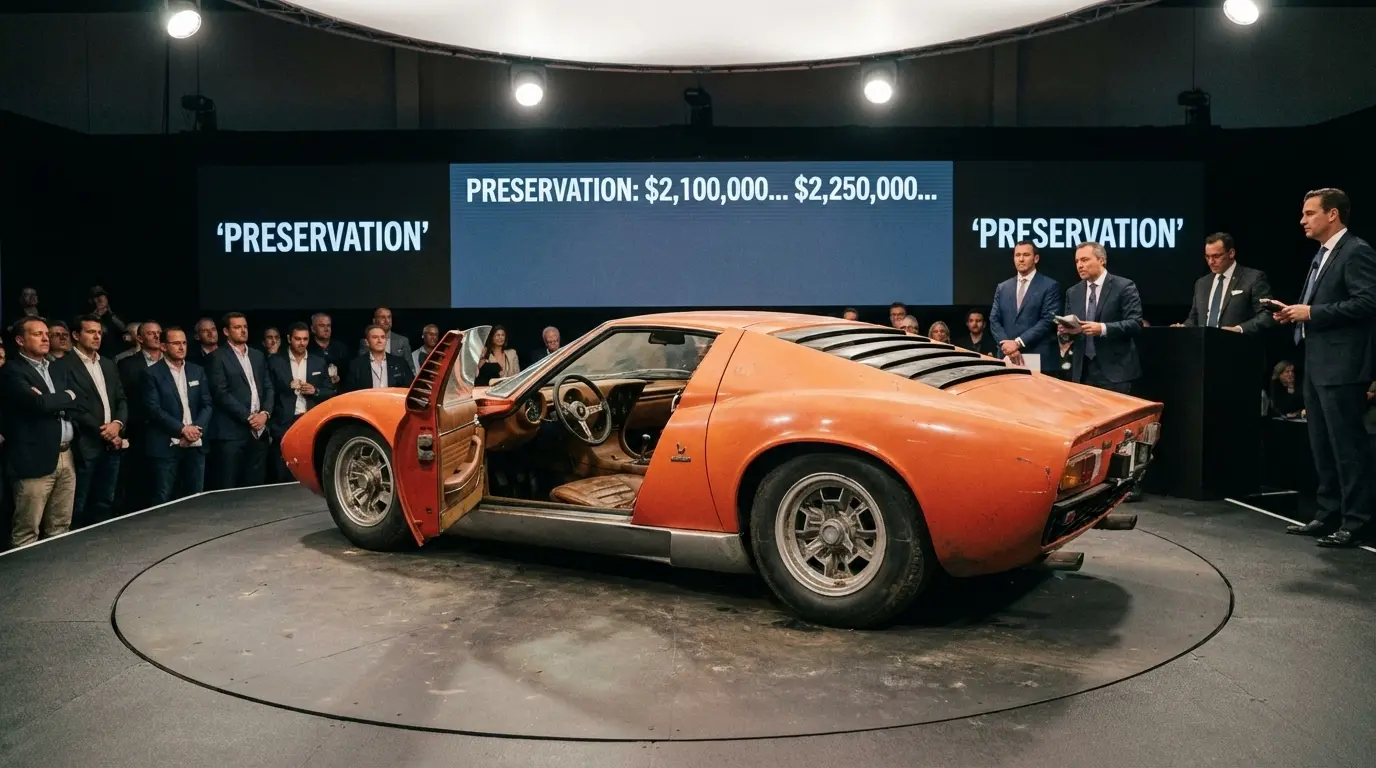
Blue-chip classics performed strongly alongside the modern machinery. A 1960 Ferrari 250 GT SWB California Spider topped sales at $16.5 million. A 1972 Lamborghini Miura SV set a new model record at $6.7 million despite less-than-perfect condition, beating the previous record by approximately $1.7 million. The Miura had remained in a single collection for over fifty years, its unrestored originality adding provenance value that restoration might have diminished.
Mecum Kissimmee: The Bachman Effect
January's Mecum Kissimmee auction demonstrated the extraordinary premiums that provenance, condition, and collector passion can command. The Phil and Martha Bachman Collection of Ferraris, offered largely without reserve, rewrote multiple model records as two highly motivated buyers competed aggressively for standout examples.
The unique white 1962 Ferrari 250 GTO "Bianco Speciale" sold for $38.5 million, the most expensive car at the sale though below some market speculation that had placed its value even higher. The Bachman Ferraris generated even more striking results: a 2003 Ferrari Enzo achieved a new world record at $17.875 million, while a second Enzo brought $11.11 million. A 1995 Ferrari F50 sold for a new model record of $12.21 million—the car showed only 251 miles on the clock. A 2017 Ferrari LaFerrari Aperta set a new model record at $11 million.
Among the Bachman Collection, perhaps the most surprising result was a British Racing Green 2004 Ferrari 360 Challenge Stradale achieving $1.87 million. This testified to collector appetite for rare, lightly used examples in unusual colors—the same factors driving premiums throughout the modern supercar segment. Mecum's overall Kissimmee results reached $441 million, including $259 million on the Saturday when the GTO and Bachman Collection sold.
Understanding the Generational Shift
The Rise of Modern Classics
The 1950s and 1960s sports cars that long dominated the classic car market are being replaced at the highest price levels by high-performance supercars of the 1990s and later. Ferrari F40s and F50s, Bugatti Veyrons and Chirons, McLaren F1s, Paganis, and Koenigseggs represent the most sought-after contemporary prizes. The Porsche Carrera GT has emerged as perhaps the defining collectible of this transition—a car that analysts describe as one of the last purely analog halo machines, combining carbon-intensive construction with a manual-shift V10.
Hagerty's price indexes track this transformation quantitatively. Values for vintage trucks, Japanese classics, 1980s-90s "RADwood" era cars, and modern supercars have climbed 42 to 73 percent over the past five years, outpacing traditional segments like 1950s blue-chip classics or even Ferraris, which remained flat or declined over the same period. Bring a Trailer reported that 2000s-era vehicles were the most frequently listed in 2024, with model years 2004 through 2008 topping the charts.
This represents more than generational nostalgia. Younger collectors gravitate toward cars they grew up dreaming about—whether a 1980s Lamborghini Countach, a 1995 Acura NSX, or a 2000s BMW M3. But they also recognize these vehicles as the final chapter of the analog era, machines combining modern speed and technology with manual transmissions and limited electronic interference. As electric and autonomous vehicles reshape daily transportation, purely mechanical driving experiences become increasingly rare and, therefore, increasingly valuable.
The 2026 Bull Market List
Hagerty's annual Bull Market List identifies vehicles positioned for near-term appreciation, drawing on analysis of public and private sales, historic trends, insurance valuations, and buyer behavior. The 2026 edition reflects the market's continued pivot toward 1990s and 2000s machinery while acknowledging enduring appeal of certain classics.
The list spans price points from under $10,000 to over $1 million. At the accessible end, the 1999-2005 Mazda MX-5 NB Miata (typically $9,000 to $26,000) and the 1995-1998 Volkswagen Golf GTI VR6 (around $20,000) represent vehicles where younger collectors can enter the market. The 2006-2013 Chevrolet Corvette Z06 (approximately $55,900) offers 505-horsepower LS7 performance at prices that continue to represent significant value, though Hagerty believes that window is closing.
The 1995-1998 Nissan Skyline GT-R (approximately $82,350) reflects continued strength in Japanese performance cars—a segment that has delivered exceptional returns since Hagerty began tracking it. The R33 may lack the meme fame of the R34, but it carries the full "Godzilla" aura while remaining relatively attainable. At the top end, the 2004-2007 Porsche Carrera GT (over $1 million) remains positioned for continued appreciation as the market absorbs its status as a definitive analog hypercar.
Among classics, the 1968-1970 Dodge Charger (approximately $91,450 for condition #2 examples) maintains cross-generational appeal, with 52 percent of owners being Gen X or younger. The 1969-1972 Alfa Romeo GTV (approximately $105,000) has benefited from rising prices for contemporary European sports cars, particularly air-cooled Porsches, pushing buyers toward alternatives with similar character at lower entry points.
Cars as Sculptural Objects
Design as Artistic Expression
The collector car market has always operated at the intersection of engineering and aesthetics, but 2026's results suggest this relationship has intensified. Cars commanding the highest premiums share qualities that transcend mechanical specification: distinctive design languages, exceptional craftsmanship, limited production, and cultural significance that resonates across generations.
Consider the factors driving Porsche Carrera GT premiums. Beyond its V10 engine and manual transmission, the car represents a particular moment in automotive design when aerodynamic necessity produced forms of genuine beauty. Its exposed carbon fiber construction, visible through the engine bay and throughout the chassis, demonstrates material honesty that resonates with collectors who appreciate craft in any medium. The Gulf Blue example that achieved $6.7 million commanded its premium partly because the color itself—a paint-to-sample specification—transformed the car into a singular aesthetic object.
The same principles apply throughout the market. The Ferrari 250 GTO remains valuable not merely because few exist but because Sergio Scaglietti's coachwork achieved proportions and surfacing that designers still study. The Lamborghini Miura's mid-engine layout forced Marcello Gandini to invent forms that appeared impossible, creating what many consider the first supercar and one of the most beautiful automotive shapes ever produced. These cars function as sculpture that happens to be drivable.
This is not collector rationalization—major museums have long recognized automotive design as legitimate artistic practice. MoMA's permanent collection includes a 1946 Cisitalia 202 GT and a 1963 Jaguar E-Type, acquired as design objects of enduring significance. The V&A in London mounted "Cars: Accelerating the Modern World" examining automobiles as cultural artifacts. The Guggenheim Bilbao hosted "Motion: Autos, Art, Architecture," curated by Norman Foster. When institutions of this caliber treat automobiles as worthy of scholarly attention alongside Picasso and Pollock, the collector who approaches cars as three-dimensional art objects operates with institutional precedent.
Automotive Art and Collectibles
The crossover between automotive enthusiasm and art collecting has spawned its own ecosystem of related objects. Automotive sculptures, race trophies, vintage posters, and period accessories command serious collector attention, often appearing alongside cars at the same auctions. Artcurial, the French auction house, maintains dedicated departments for both automobiles and decorative arts, recognizing that collectors often pursue both categories with equal passion.
Original factory design sketches, particularly from legendary studios like Pininfarina, Bertone, and Zagato, have achieved significant prices at auction. These drawings reveal the creative process behind iconic forms, offering insight into how designers translated ideas into three-dimensional reality. For collectors who appreciate both cars and contemporary art, these objects bridge the categories—tangible evidence of creative vision executed at the highest level.
The relationship extends to contemporary art practice. Artists from Alexander Calder to Andy Warhol have engaged with automotive subjects, while manufacturers have commissioned artists to create "art cars" that blur boundaries between vehicle and canvas. For collectors building holdings that span traditional art and automotive design, these intersections offer opportunities to create coherent collections united by aesthetic rather than categorical concerns.

Market Dynamics and Collector Strategy
Wealth Creation and Tangible Assets
The collector car market correlates closely with broader wealth dynamics. As Hagerty CEO McKeel Hagerty told CNBC, collectors are "feeling pretty good about their personal balance sheets" after stock markets posted their third year of double-digit growth. This wealth effect, combined with falling interest rates, provides fuel for continued acquisition activity. Art and classic car auctions combined topped $600 million in March 2026 despite regional conflicts that might have dampened confidence in other circumstances.
The great wealth transfer will continue reshaping the market as an estimated $100 trillion passes to spouses and families by 2048, according to Cerulli Associates. This transfer includes real estate, collectibles, and other hard assets. Families inheriting significant car collections will face decisions about keeping, storing, or selling—introducing supply that may create opportunities for strategic buyers while potentially pressuring certain market segments.
Younger collectors demonstrate what analysts describe as "rational discernment" compared to the speculative frenzies that characterized portions of the previous decade. They seek quality over quantity, prioritizing vehicles they genuinely want to own and drive rather than treating the market as a trading platform. This orientation toward authentic enthusiasm rather than financial speculation suggests sustainable demand rather than bubble dynamics.
Entry Points and Considerations
For collectors approaching the market, entry points span from accessible enthusiasm to serious capital commitment. The Bull Market List's inclusion of vehicles from under $10,000 to over $1 million reflects genuine opportunities across the spectrum. A well-preserved Mazda Miata offers legitimate collector car experience without significant financial risk. A Porsche 911 from the impact bumper era (1974-1989) or the 964-993 generation (1990-1998) provides entry into the marque at more accessible prices than earlier air-cooled models.
Condition matters enormously, with premium examples commanding multiples of driver-quality prices. Documentation including service records, original purchase paperwork, and ownership history adds value that grows proportionally with a car's significance. Matching numbers—meaning engine, transmission, and body components correspond to factory records—can double or triple values for certain models.
Storage and maintenance requirements deserve consideration before acquisition. Climate-controlled storage, appropriate insurance, and access to qualified service specialists represent ongoing costs that vary significantly by marque and era. A 1990s Japanese performance car may prove far more practical to own than a 1960s Italian exotic requiring specialized maintenance available only from a handful of shops worldwide.
Explore how serious collectors approach acquisitions across categories at Artestial, where the platform connects collectors with works that reward the same careful research and appreciation for provenance that defines successful car collecting.
The Auction Experience
Major Auction Houses and Platforms
The collector car auction landscape in 2026 features several major players with distinct positioning. RM Sotheby's remains the leader in high-end collector car auctions, achieving over $887 million in global sales in 2024 with a 96 percent sell-through rate across live, online, and private platforms. Their association with Sotheby's provides access to collectors whose interests span art, wine, jewelry, and automobiles.
Gooding & Company, now Gooding Christie's following acquisition by the art auction house, specializes in blue-chip collectibles at the highest quality levels. Their Amelia Island and Pebble Beach auctions attract the most significant consignments and the most sophisticated bidding. The Christie's partnership signals confidence in the collector car segment and may bring global reach exceeding the company's previous footprint.
Broad Arrow Auctions, backed by Hagerty, has grown rapidly by targeting younger collectors with curated catalogs emphasizing the "younger segment" of cars—modern Porsches, AMG Hammers, and similar vehicles. Their data-driven approach, leveraging Hagerty's insurance and valuation insights, positions them to capitalize on generational market shifts.
Mecum Auctions operates at enormous scale, with Kissimmee alone offering over 4,000 vehicles. Their approach emphasizes volume and accessibility alongside headline-grabbing consignments like the Bachman Collection. For buyers seeking specific vehicles at fair prices rather than trophy acquisitions, Mecum's scale provides opportunities that more curated sales cannot match.
Online platforms including Bring a Trailer and Hagerty Marketplace have transformed accessibility, with online sales surging 12 percent in 2025. These platforms enable global participation in sales that previously required physical presence, democratizing access while creating new dynamics around bidding psychology and information transparency.
Bidding and Due Diligence
Successful auction participation requires preparation that extends well beyond available capital. Examine condition reports carefully, understanding that auction house descriptions aim to be accurate but cannot substitute for personal inspection. Arrange pre-sale inspection for significant acquisitions, ideally by an independent specialist familiar with the specific marque and model.
Understand all-in costs before bidding. Buyer's premiums typically range from 10 to 15 percent at major houses, adding significantly to hammer prices. Transportation from auction site to ultimate destination may cost thousands depending on distance and handling requirements. Title and registration procedures vary by jurisdiction, with certain states imposing additional fees or complications for out-of-state purchases.
Set firm limits before bidding begins. Auction environments generate competitive dynamics that can push bidders beyond rational valuations. The same car available privately or at a different sale may cost significantly less without the psychological pressure of competing paddles. Walking away represents a legitimate strategy that preserves capital for superior opportunities.

Future Directions
Market Predictions for 2026 and Beyond
Hagerty's analysts offer several predictions for the year ahead. Seven of 2026's top ten sales are expected to be post-1990 vehicles, confirming the continued rise of modern classics. The count of million-dollar-plus online sales will likely crest 70, with the possibility of the first eight-figure online transaction as platforms compete for premium consignments. A Lexus LFA may achieve a record price as the model's return focuses attention on the original.
The definition of "classic" continues evolving. By 2030, a 1990 vehicle will be forty years old, qualifying as vintage by traditional definitions. Auction houses are already curating sales for the "next generation," with dedicated events focusing on specific eras or themes. The distinction between collector cars and secondhand performance cars blurs as vehicles from the 2000s and 2010s begin appearing at established auctions.
Manual transmission vehicles across all segments show strengthening demand as automatic transmissions and dual-clutch systems dominate new production. This applies from accessible sports cars through exotics, suggesting that stick-shift capability may become a defining characteristic of collectibility for vehicles from the internal combustion era.
Regional Market Developments
RM Sotheby's expansion into Dubai and other regions reflects growing collector activity in the Middle East and Asia. Gulf states have developed significant automotive collections, with Dubai Police famously incorporating supercars into their fleet and private collectors assembling holdings that rival European and American collections in depth and quality. Abu Dhabi's Ferrari World and the region's annual automotive events create cultural infrastructure supporting collector activity.
Asian markets, particularly Japan, continue influencing global prices for vehicles with domestic significance. The 25-year import exemption in the United States has created sustained demand for Japanese Domestic Market vehicles that were never officially sold in North America. This includes not only high-profile models like the Nissan Skyline GT-R but also variants, special editions, and specifications unavailable through official channels. As additional model years become import-eligible annually, this supply pipeline maintains collector interest in Japanese marques.
European auction activity remains centered on Monaco, Paris, and London, with marque-specific events at manufacturer headquarters commanding particular significance. RM Sotheby's sales at Ferrari's Maranello facilities carry provenance value simply from their setting, while Bonhams' connection to British marques creates natural synergies for Aston Martin, Bentley, and Jaguar consignments.
The Philosophy of Automotive Collecting
Beyond financial considerations, collector cars offer experiential dimensions that purely financial assets cannot replicate. The ability to drive one's investment—to experience the engineering and design that justify valuations—distinguishes automotive collecting from categories where objects must remain static. This experiential quality attracts collectors who might otherwise focus exclusively on art, wine, or other categories where consumption diminishes value.
The social dimensions of car collecting also contribute to its enduring appeal. Concours events, rallies, tours, and club activities create communities organized around shared enthusiasm. These connections often cross demographic and geographic boundaries that might otherwise separate collectors, creating networks that persist for decades. For collectors approaching automotive enthusiasm as a component of broader collecting activity, these communities offer integration points that complement rather than compete with art world engagement.
Connect with specialists who understand how automotive passion intersects with broader collecting at Artestial, where collectors discover works that reward the same careful appreciation for design, craft, and cultural significance.
Integration with Broader Collecting
Collector cars increasingly function as components of diversified holdings that span multiple asset categories. Knight Frank's Wealth Report indicates that ultra-high-net-worth individuals allocate approximately 20 percent of their portfolios to collectibles, with art and automobiles leading the luxury investment index. The emotional and experiential dimensions of these assets complement financial considerations in ways that purely financial instruments cannot match.
For collectors whose interests span automotive design and contemporary art, opportunities exist to build coherent collections that reflect unified aesthetic sensibilities. The same appreciation for form, material, and craft that drives enthusiasm for a Miura's bodywork or a Carrera GT's exposed carbon applies to sculptural practice across mediums. The same attention to provenance and condition that determines automotive values informs serious art collecting at every level.
Ready to explore the connections between automotive excellence and artistic vision? Visit Artestial where collectors discover contemporary works that reward the same appreciation for design, craftsmanship, and cultural significance that defines serious car collecting, or connect with specialists for guidance on building collections across categories.
Frequently Asked Questions
What drove the record-breaking results at March 2026 auctions? Several factors converged to produce the $255.9 million combined total. Modern supercars and hypercars commanded unprecedented premiums, with the Porsche Carrera GT and Ferrari Enzo leading multiple model records. Sell-through rates exceeding 90 percent at major houses indicated strong buyer confidence despite global uncertainties. The generational shift toward 1990s and 2000s vehicles concentrated bidding on limited-production machines from an era collectors increasingly view as the final chapter of analog automotive excellence. Paint-to-sample specifications and ultra-low mileage proved particularly valuable, with the Gulf Blue Carrera GT more than doubling the model record based partly on its unique color specification.
How do collector cars compare to traditional art as investments? Both categories share characteristics that distinguish them from purely financial assets: aesthetic value, historical significance, limited supply, and emotional satisfaction that complements financial returns. Blue-chip art has historically delivered average annual returns of approximately 8.9 percent over two decades, comparable to strong segments of the collector car market. Japanese performance cars have delivered annualized returns exceeding 13 percent since Hagerty began tracking them in 2018. Both markets correlate with wealth creation and demonstrate resilience during economic uncertainty, though both also carry risks that purely financial instruments may avoid. Neither should replace diversified investment portfolios, but both can complement traditional holdings while providing satisfaction that stocks and bonds cannot match.
What should new collectors understand about auction participation? Preparation determines auction success more than available capital. Examine condition reports carefully and arrange independent inspection for significant acquisitions. Understand total costs including buyer's premiums (typically 10-15 percent), transportation, insurance, and registration before bidding. Set firm limits based on research into comparable sales and stick to them regardless of competitive pressure. Consider that the same car available privately or at different sales may cost significantly less without auction dynamics. For first-time participants, observing several auctions before bidding provides valuable understanding of pace, bidding patterns, and house procedures.
Which price segments offer the best entry points in 2026? Hagerty's Bull Market List identifies opportunities from under $10,000 to over $1 million, but the $50,000 to $150,000 range offers perhaps the broadest selection of genuine collector cars with appreciation potential. The 1969-1972 Alfa Romeo GTV (approximately $105,000), the 1968-1970 Dodge Charger (approximately $91,450), and the 1995-1998 Nissan Skyline GT-R (approximately $82,350) represent vehicles with established collector bases, cross-generational appeal, and characteristics that should sustain demand. At more accessible levels, the 1999-2005 Mazda MX-5 Miata and 1995-1998 Volkswagen Golf GTI VR6 offer legitimate collector car experiences at prices where financial risk remains manageable.
How does condition affect collector car values? Condition dramatically affects values across all segments. Hagerty's condition ratings run from #1 (concours quality, virtually perfect) through #4 (fair condition, needs work). The spread between #1 and #4 values can exceed ten times for significant vehicles. Documentation including service records, original purchase paperwork, and ownership history adds substantial value, particularly for limited-production models where provenance helps distinguish genuine examples from later modifications. Matching numbers—original engine, transmission, and body components corresponding to factory records—can double or triple values for certain models compared to non-matching examples. Ultra-low mileage compounds these effects, as the Bachman Collection Ferraris demonstrated when delivery-mileage examples achieved record multiples.
Curating excellence, one insight at a time. — AURUM
Disclaimer: This article provides general information about collector car markets and auctions for educational purposes only. It does not constitute investment, financial, or legal advice. Collector car markets involve substantial risk, and values can decline as well as appreciate. Past auction results do not guarantee future performance. The author has no financial relationship with any auction house, platform, or manufacturer mentioned. All market observations reflect analysis available at time of writing and may not represent current conditions. Readers should conduct independent research and consult qualified advisors before making significant acquisition decisions.