

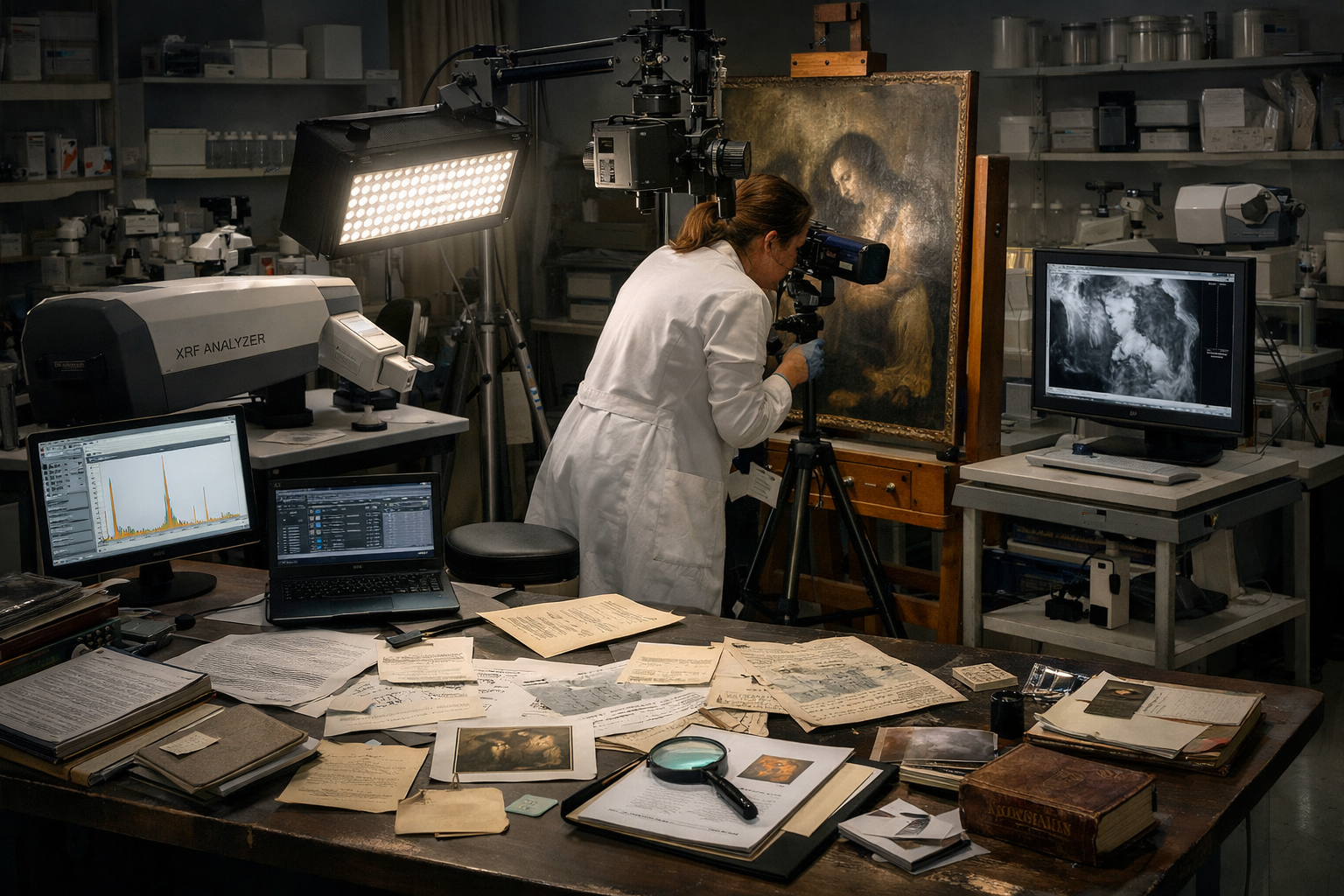
The art market operates on trust in ways that few other asset classes require. Unlike publicly traded securities with regulated disclosure requirements, real estate with title insurance and recorded deeds, or precious metals with standardized assay processes, artworks depend on documentation systems that evolved long before the digital age and authentication practices that blend subjective connoisseurship with objective scientific analysis. For collectors building serious holdings, understanding how authentication and provenance work—their strengths, their limitations, and their practical applications—transforms from academic interest into essential knowledge that directly protects capital and shapes acquisition strategy.
The scale of the authentication challenge has become increasingly apparent as the global art market has grown. The Swiss Fine Art Expert Institute made headlines in 2014 when it reported that seventy to ninety percent of artworks submitted to their laboratory for authentication proved to be either fakes, forgeries, or misattributions. While that statistic requires context—collectors who submit works for scientific analysis typically already harbor suspicions about authenticity—it nonetheless reveals the magnitude of problematic material circulating through markets. Other estimates from industry professionals range more widely, with former Metropolitan Museum of Art director Thomas Hoving famously suggesting that forty percent of artworks he evaluated during his tenure raised authenticity concerns, while practicing dealers often cite figures closer to two to five percent for contemporary works acquired through established channels.
Whatever the precise percentage, the financial implications demand attention. When a collector purchases a work that later proves inauthentic, the financial loss typically approaches total—authentication failures rarely allow for partial recovery, and the reputational damage to the work prevents resale at any significant value. Insurance rarely covers authentication failures as distinct from theft or damage, and legal recourse against sellers often proves complicated, expensive, and uncertain. The asymmetry is striking: proper authentication and provenance research before purchase might add five to fifteen percent to acquisition costs while protecting against losses of one hundred percent.
Explore works with verified provenance and transparent documentation at Artestial, where collectors find artists and galleries committed to authentication standards that protect both cultural integrity and investment value.
Understanding Authentication: The Foundation of Informed Collecting
What Authentication Actually Establishes
Authentication addresses a deceptively simple question: is this artwork genuinely by the artist to whom it is attributed? The simplicity of the question masks enormous complexity in answering it, because authentication must establish not just that an artwork looks like the work of a particular artist but that it demonstrably originated from that artist's hand or authorized production process. The distinction matters because skilled forgers can create works that appear stylistically consistent with an artist's output while scientific analysis reveals material anachronisms that prove the attribution impossible.
The authentication process typically involves three interrelated components that ideally reinforce each other. Stylistic analysis examines whether an artwork demonstrates the characteristic techniques, compositions, color choices, and aesthetic sensibilities associated with a particular artist's verified works. Provenance research traces the documented history of an artwork's ownership, exhibition, and publication back toward the artist's lifetime or, ideally, to the artist's studio itself. Scientific analysis applies technical examination methods ranging from visual inspection under specialized lighting to chemical analysis of pigments and binding media, establishing whether materials and construction methods are consistent with the attributed artist, period, and location of creation.
Each component has particular strengths and limitations. Stylistic analysis can identify works that simply do not fit an artist's established practice—the wrong subjects, inconsistent techniques, quality levels that do not match the artist's demonstrated capabilities—but sophisticated forgers specifically study artists' methods to replicate stylistic characteristics convincingly. Provenance research can establish documented ownership chains but depends on the accuracy of historical records that may themselves be forged or incomplete. Scientific analysis can definitively exclude certain attributions when materials prove anachronistic but cannot affirmatively prove that an artist created a particular work—only that the materials and techniques are consistent with such attribution.
The Hierarchy of Authentication Authority
Not all authentication carries equal weight in the marketplace. The authority of an authentication depends fundamentally on who provides it and under what circumstances. Artist authentication—verification directly from a living artist or their estate—typically commands the highest credibility because the artist possesses unique knowledge of their own production. Living artists can often examine works and confirm whether they remember creating them, while estates maintain archives of studio records, sales documentation, and photographs that document the artist's output.
For deceased artists whose estates no longer provide authentication services—an increasingly common situation as authentication boards have disbanded due to litigation risks—the marketplace relies on catalogue raisonné scholars who have devoted careers to documenting particular artists' complete works. These scholars compile comprehensive records of every known authentic work, including provenance histories, exhibition records, and comparative analysis. Inclusion in a respected catalogue raisonné generally establishes market acceptance of authenticity, while absence raises questions that must be addressed through other means.
Authentication boards—formal committees established to evaluate attributions for particular artists—once represented a primary authentication pathway, particularly for twentieth-century artists whose markets supported the institutional infrastructure required to maintain such organizations. The Andy Warhol Authentication Board, the Jean-Michel Basquiat Authentication Board, and similar bodies evaluated submitted works against extensive archives and collective expertise. However, lawsuits from collectors whose works were rejected—claiming that refused authentication constituted tortious interference with property rights—have prompted many boards to disband rather than continue bearing litigation costs and risks. The dissolution of the Basquiat board in 2012 and the Keith Haring Foundation's cessation of authentication services that same year marked a significant shift that has not been reversed.
Independent authentication experts—scholars, conservators, and art historians who specialize in particular artists or periods—fill some of the gap left by disbanded boards, though their opinions carry varying market weight depending on their established reputations and demonstrated expertise. Auction house specialists provide authentication opinions for works they sell, typically backed by limited guarantees that vary by house and sale category. Museums and academic institutions occasionally provide authentication opinions, though most have become reluctant to issue formal statements given litigation concerns.
When Authentication Fails: Understanding the Risks
Authentication failures occur along a spectrum of severity. At one extreme, outright forgeries—works created specifically to deceive—represent deliberate fraud that may involve elaborate supporting documentation including forged provenance, fabricated exhibition histories, and counterfeit certificates. The Beltracchi scandal, in which German forger Wolfgang Beltracchi created elaborate forgeries of twentieth-century Expressionist works complete with invented provenance and artificially aged canvases, illustrates how sophisticated modern forgery has become and how even major institutions and experienced collectors can be deceived.
Misattributions occupy a different category—works that were not created with intent to deceive but that have acquired incorrect attributions over time. Workshop productions created by an artist's assistants under their supervision, period copies made by other artists for legitimate purposes, and later works incorrectly attributed to more famous predecessors all represent misattributions rather than forgeries. The distinction matters legally and practically: misattributions may reflect honest errors rather than fraud, and establishing intent becomes relevant for legal remedies.
Partial authenticity presents particular complexity. An authentic work by a desirable artist that has been significantly restored, overpainted, or altered may retain some value but not the value of an unaltered original. Determining what percentage of a work represents original material versus later additions requires conservatorial expertise and often technical analysis. Similarly, collaborative works—where multiple artists contributed to a single piece—raise attribution questions that simple authentic/inauthentic binaries cannot address.

Scientific Analysis: The Technical Dimension of Authentication
Non-Invasive Examination Techniques
Modern authentication increasingly relies on scientific analysis that can reveal information invisible to the naked eye while avoiding damage to the artwork being examined. These non-invasive techniques have become standard components of serious authentication investigations, providing objective data that complements subjective stylistic assessments.
Infrared reflectography penetrates surface paint layers to reveal underdrawings and preparatory sketches that artists created before applying final paint layers. Most painters develop characteristic underdrawing styles—particular approaches to preliminary composition, distinctive mark-making patterns, consistent use of certain drawing media—that experts can compare against known authentic works. When underdrawings do not match an artist's established practices, authentication concerns arise. Forgers who study surface characteristics may neglect to consider what lies beneath, creating works that look correct on the surface but reveal inconsistent underdrawing approaches under infrared examination.
Ultraviolet fluorescence examination illuminates artworks with ultraviolet light, causing certain materials to fluoresce in characteristic ways. Original varnish layers fluoresce differently than later restorations or overpainting, revealing the extent and location of conservation interventions. Modern materials often fluoresce differently than historical ones, potentially identifying recent additions to works purporting to be older. UV examination can also reveal previous damage, repairs, and alterations that may affect both authenticity assessment and condition evaluation.
X-radiography examines the internal structure of artworks, revealing canvas weave patterns, stretcher bar construction, earlier compositions beneath current surfaces (pentimenti), and structural anomalies. Artists working in particular periods and regions used characteristic canvas types and stretcher construction methods, so X-ray examination can establish whether structural elements are consistent with attributed origins. Pentimenti—visible evidence of changes the artist made during creation—can authenticate working process when they align with known artist practices.
Multispectral imaging captures images across the electromagnetic spectrum beyond visible light, providing data about pigments, binding media, and construction that single-wavelength examination cannot reveal. Different pigments reflect and absorb light differently across the spectrum, allowing identification of materials without physical sampling. This technique has become increasingly sophisticated as imaging technology has advanced, with hyperspectral systems capturing data across dozens or hundreds of discrete wavelength bands for detailed material characterization.
Invasive Analysis Methods
When non-invasive examination raises questions that require definitive answers, more invasive analytical techniques can provide conclusive information about materials and construction—though always with the trade-off of requiring physical samples that involve some alteration of the artwork.
Fourier-Transform Infrared Microspectroscopy, commonly abbreviated FTIR, identifies organic compounds by analyzing how samples interact with infrared radiation. Different chemical bonds absorb infrared light at characteristic frequencies, producing spectra that function as chemical fingerprints for particular materials. FTIR can identify binding media (oil, tempera, acrylic), organic pigments, and varnish compositions with high specificity, determining whether materials are consistent with attributed periods and geographic origins.
The famous case of purported Jackson Pollock paintings owned by filmmaker Alex Matter illustrates FTIR's power: analysis by forensic chemist James Martin revealed the presence of Red 254, also known as Ferrari Red, in paint samples—a pigment not commercially available until the early 1980s, well after Pollock's death in 1956. That single finding, establishing the presence of an anachronistic material, definitively excluded Pollock as the artist regardless of how visually convincing the works appeared.
Raman spectroscopy identifies inorganic pigments through their characteristic light-scattering patterns when illuminated with laser light. Each mineral pigment produces a unique Raman spectrum based on its crystalline structure, allowing precise identification of materials. This technique proves particularly valuable for Old Master authentication, where specific pigments were available only during certain periods or in certain regions. The presence of a blue pigment available only after 1850 in a painting attributed to a seventeenth-century Dutch master immediately establishes the work as either incorrectly attributed or significantly overpainted.
X-ray fluorescence spectroscopy identifies elemental composition of pigments by detecting characteristic X-ray emissions when samples are excited by incident X-rays. While XRF cannot distinguish between different compounds containing the same elements, it establishes elemental presence with high sensitivity, often detecting trace elements that indicate particular pigment sources or manufacturing processes. Modern portable XRF instruments allow in-situ analysis without transporting artworks to laboratories.
Radiocarbon dating establishes the age of organic materials—canvas fibers, wooden supports, organic binding media—by measuring the ratio of carbon-14 to stable carbon isotopes. This technique can definitively date organic materials within ranges of decades, establishing whether they are consistent with attributed periods. A canvas dating to the twentieth century cannot support an attributed eighteenth-century painting, regardless of surface appearance. However, radiocarbon dating cannot definitively prove authenticity—only that materials are old enough to be consistent with attribution—since forgers can obtain period-appropriate materials for their deceptions.
The Limits of Scientific Analysis
For all its power, scientific analysis cannot definitively prove that any particular artist created any particular work. It can establish that materials and techniques are consistent with attributed origins, and it can definitively exclude attributions when materials prove anachronistic or inconsistent. But consistency does not equal confirmation: that a painting uses materials available in seventeenth-century Holland does not prove Rembrandt painted it—only that Rembrandt could have painted it.
Sophisticated forgers increasingly understand scientific authentication methods and take measures to avoid detection. They seek out period-appropriate canvases, sometimes scraping existing paintings to provide authentically aged supports. They source or manufacture pigments consistent with target periods, avoiding modern synthetic colors. They employ artificial aging techniques to simulate the craquelure patterns and surface characteristics that conservators expect in older works. The forger's toolkit has evolved alongside the authenticator's, creating an ongoing technical contest.
This reality means that scientific analysis functions most effectively as one component of comprehensive authentication rather than a standalone determination. Material consistency enables attribution without confirming it; material inconsistency excludes attribution definitively. The asymmetry—science can disprove but not prove—defines the proper role of technical analysis within broader authentication frameworks.

Provenance Research: Tracing the Paper Trail
What Provenance Establishes and Why It Matters
Provenance—the documented history of an artwork's ownership from creation to the present—provides independent evidence of authenticity while also establishing legal title, cultural significance, and market value. Comprehensive provenance creates multiple anchoring points where an artwork's existence and attribution were documented at particular moments by identifiable parties, making fabrication exponentially more difficult as the chain extends backward through time.
The ideal provenance traces unbroken ownership from the artist's studio through each subsequent owner to the present day, with each transfer documented through sales receipts, gallery records, auction catalogs, exhibition histories, or other contemporaneous evidence. Such complete chains remain rare—documentation loss over decades and centuries is normal rather than exceptional—but the goal of provenance research is to establish as much of this history as surviving evidence permits.
Provenance matters for several interconnected reasons. For authentication, documented ownership during or shortly after an artist's lifetime provides evidence that the work existed and was attributed to that artist at a time when knowledgeable parties could assess accuracy. For legal title, provenance establishes the chain of legitimate ownership transfers, identifying potential breaks where theft, looting, or forced sales may have occurred. For market value, prestigious previous ownership—collections of recognized taste, museum exhibitions, important sales—creates "collector provenance" that enhances desirability beyond the work's intrinsic qualities.
Red Flags and Warning Signs in Provenance
Experienced provenance researchers recognize patterns that suggest fabrication, incompleteness, or concealment of problematic history. Gaps in ownership during the Nazi era (1933-1945) raise immediate concerns about potential looting of Jewish collections, requiring investigation to establish that works were not unlawfully taken during this period. The Washington Principles and subsequent guidelines have made Nazi-era provenance gaps a serious market concern, with major auction houses and museums requiring documentation or due diligence before handling works with suspicious wartime histories.
Provenance that emerges suddenly and recently—a major work by a significant artist appearing without prior exhibition or publication history—warrants skepticism regardless of accompanying documentation. Important works typically leave traces through their histories: exhibition loans, reproduction in catalogs or books, conservation records, insurance documentation, estate inventories. Complete absence of such traces suggests either deliberate concealment or recent fabrication.
Documentation that appears too perfect may indicate forgery. Genuine historical records accumulate organically and often include inconsistencies, errors, and gaps that reflect the messy reality of record-keeping across decades or centuries. Provenance packages that present clean, complete, suspiciously consistent documentation may have been fabricated to create precisely the appearance of legitimacy that forgers know the market requires.
Geographic implausibility raises questions about provenance narratives. Works attributed to artists who rarely sold outside their immediate regions but appearing with provenance placing them in distant locations from early dates warrant additional scrutiny. Similarly, provenance that requires unlikely historical circumstances—works supposedly acquired during periods when markets were closed, sales supposedly occurring at dates when relevant galleries did not yet exist—indicates either error or fabrication.
Conducting Provenance Research
Professional provenance researchers follow systematic methodologies that maximize the likelihood of uncovering available evidence while maintaining critical assessment of documentation quality.
Initial examination of the physical artwork often yields valuable provenance information. Labels attached to stretcher bars, frames, or backing boards may identify previous owners, exhibitions, or dealers. Stamps, stencils, or inscriptions on canvas reverses or panel backs may indicate collection marks, inventory numbers, or historical attributions. Customs stamps or export permits suggest international movement. Photographic documentation of all such physical evidence becomes essential before any conservation treatment that might remove or obscure these historical traces.
Catalogue raisonné consultation represents a primary research step for artists whose works have been comprehensively documented. Inclusion in a scholarly catalogue raisonné typically indicates previous authentication while providing exhibition and provenance information that the compiler assembled. Absence from catalogue raisonnés does not necessarily indicate inauthenticity—catalogues are compiled at particular moments and cannot include works that emerge subsequently—but it shifts the burden toward establishing authenticity through other means.
Archival research into gallery records, auction house archives, exhibition catalogs, collection inventories, and estate records can establish documented ownership at specific historical moments. Major auction houses maintain extensive archives of past sales, though access varies. Gallery records, where they survive, document sales and consignments. Museum archives document exhibition loans and provenance information gathered during institutional research. Estate records—wills, inventories, division agreements—can establish ownership at moments of generational transfer.
The Art Loss Register, founded in 1991, maintains the world's largest database of stolen and missing art, aggregating reports from law enforcement, insurers, and private parties. Checking this database has become standard practice before significant acquisitions, identifying works that may be subject to recovery claims. Similar resources including the FBI's National Stolen Art File and INTERPOL's Works of Art database provide additional checking options.
Digital resources have expanded provenance research capabilities enormously. Digitized newspaper archives may reveal contemporary exhibition reviews or sales notices. Museum collection databases increasingly publish provenance information online. The Getty Provenance Index aggregates art sales documentation across centuries. Academic databases may reveal scholarly publications discussing particular works. Social media and image search capabilities can locate works in historical photographs that establish their existence and context at particular moments.

Blockchain and Digital Authentication: The Emerging Landscape
How Blockchain Technology Applies to Art Authentication
Blockchain technology—the distributed ledger architecture underlying cryptocurrencies—has attracted significant attention as a potential solution to long-standing art authentication challenges. The technology's core characteristics align well with provenance requirements: blockchain records are immutable (cannot be altered once created), transparent (verifiable by any party with access), decentralized (not dependent on any single institution's continued existence), and timestamped (establishing when particular records were created).
Several platforms have emerged to apply blockchain technology to art authentication and provenance. Verisart, founded in 2015, uses the Bitcoin blockchain to create timestamped digital certificates of authenticity that document artwork creation, ownership transfers, and provenance records. Each certificate receives cryptographic verification and blockchain registration that makes subsequent alteration detectable. Artists including Shepard Fairey have adopted the platform for issuing authenticated works.
Artory has developed a blockchain-based registry that documents artwork information, sales, and ownership transfers with major auction house partnerships. The platform's documentation of the $318 million Barney A. Ebsworth Collection sale in 2018 marked the first time a major auction registered an entire collection on blockchain, creating permanent, verifiable records of each transaction.
These platforms create digital certificates that can accompany physical artworks, establishing documented chains of custody from the moment of registration forward. QR codes, NFC chips, and RFID tags can link physical objects to their digital records, enabling instant verification through smartphone applications. The technology addresses the vulnerability of paper certificates to loss, damage, and forgery by creating permanent digital records that exist independently of any physical documentation.
Limitations of Blockchain Authentication
Blockchain technology solves certain authentication problems elegantly while creating new complications and leaving other challenges unaddressed. Understanding these limitations proves essential for collectors evaluating blockchain-based authentication systems.
The fundamental limitation: blockchain can only document what parties choose to record. If a forger creates a fraudulent work and registers it on blockchain with false information—claiming to be an artist they are not, documenting fabricated provenance, asserting authenticity for an inauthentic work—the blockchain faithfully records that fraudulent information with the same immutability it would apply to accurate information. The technology cannot distinguish truth from falsehood at the moment of registration; it can only ensure that whatever was recorded cannot be subsequently altered.
This means blockchain authentication depends entirely on the verification protocols that platforms apply before allowing registration. Verisart requires identity verification for creators and issuers, attempting to ensure that parties registering works are who they claim to be. But such verification addresses only identity, not the underlying truthfulness of what verified parties assert. An artist legitimately verified by their government identification could still register works they did not actually create, or could register works with inaccurate descriptions.
The temporal problem presents another fundamental challenge. Blockchain registration can create unalterable records from the moment of registration forward, but it cannot authenticate works that existed before registration. For contemporary art created after blockchain platforms became available, registration at the moment of creation establishes documented provenance from the outset. For historical works—the vast majority of art in circulation—blockchain registration simply documents current claims about past events without independently verifying those claims. The Rembrandt that a collector registers on blockchain in 2026 receives documentation that the collector made certain claims about the work in 2026, not verification that Rembrandt actually painted it in 1660.
Platform longevity raises practical concerns. While blockchain records theoretically persist indefinitely on distributed networks, the platforms that provide user-friendly interfaces for creating and accessing those records are commercial enterprises that may cease operations. A platform's closure might leave blockchain records intact but practically inaccessible to typical users who lack technical capabilities to query blockchains directly. The decentralization that provides security also creates access challenges when intermediary services fail.
Integrating Blockchain with Traditional Authentication
The most sophisticated approaches to blockchain authentication recognize the technology as complementary to rather than replacing traditional authentication methods. Blockchain excels at documenting verified information immutably; traditional authentication excels at generating the verified information worth documenting.
For contemporary art, the integration pathway is relatively clear. Artists can register works at creation, establishing blockchain-documented provenance from the outset. Galleries can verify their participation in sales, adding their institutional authentication to permanent records. Each subsequent transfer can be documented, creating chains of custody that extend forward from creation. Insurance policies, condition reports, exhibition loans, and conservation treatments can all be registered, building comprehensive records that would have required extensive archives to maintain through traditional paper documentation.
For historical art, blockchain serves primarily as a secure repository for authentication documentation generated through traditional methods. Scientific analysis results, provenance research findings, expert opinions, and conservation records can all be registered, creating permanent records of authentication work performed. While this does not independently verify historical provenance, it does create documented chains showing what authentication evidence existed at particular moments, making subsequent fabrication of documentation more detectable.
The hybrid approach that leading platforms are developing—combining blockchain immutability with physical security features like embedded chips, DNA markers, or microscopic imaging that creates unique "fingerprints" for individual works—addresses some limitations of purely digital systems. These approaches create verifiable links between physical objects and their digital records, reducing the ability to substitute forged works for authenticated originals while maintaining blockchain's documentation advantages.
Due Diligence in Practice: Protecting Your Acquisitions
Pre-Purchase Investigation Protocols
Sophisticated collectors approach significant acquisitions with systematic due diligence that evaluates authentication and provenance before committing capital. The intensity of investigation appropriately scales with acquisition value, artist rarity, and market risk factors—a modest work by a living artist with clear gallery provenance warrants different due diligence than a major historical work with incomplete documentation.
Request and review all available documentation before proceeding with negotiations. Sales records, certificates of authenticity, exhibition catalogs, conservation reports, previous appraisals, and any other materials documenting the work's history should be examined critically. Note what documentation exists, what gaps remain, and whether available materials demonstrate the consistency expected for legitimate provenance.
Verify documentation authenticity where possible. Gallery labels can be compared against known authentic examples; letterheads and signatures can be evaluated for period appropriateness; dates and details can be checked against independently verifiable records. Sophisticated forgers create elaborate supporting documentation, so critical evaluation of provenance materials becomes as important as evaluation of the artwork itself.
Check relevant databases for theft, loss, or legal claims. The Art Loss Register, FBI National Stolen Art File, INTERPOL Works of Art database, and similar resources should be consulted to identify any registered claims. While absence from these databases does not guarantee clear title—not all losses are reported—presence on them establishes serious legal complications.
Research the seller thoroughly. Established dealers with longstanding reputations have more to lose from selling problematic works than do anonymous sellers or short-lived operations. Gallery membership in professional associations typically requires adherence to codes of conduct that provide some recourse for authentication failures. Auction houses provide guarantees that vary by sale category but generally offer better protection than private sales from unknown parties.
Working with Authentication Professionals
Complex authentication questions warrant engagement of appropriate professionals—conservators, scholars, forensic analysts, provenance researchers—whose expertise exceeds what collectors typically possess. Understanding how to engage these professionals effectively maximizes the value of their involvement.
Conservation laboratories with authentication experience can conduct technical examination and scientific analysis. Leading institutions like the Fine Art Expert Institute in Geneva, Orion Analytical in the United States, and similar laboratories provide comprehensive analytical services. Select laboratories based on demonstrated experience with relevant artist periods and media, asking about their specific expertise before engaging services. Authentication costs for serious investigation often range from several thousand to tens of thousands of dollars depending on techniques required—substantial but appropriate relative to significant acquisition values.
Independent scholars specializing in particular artists can provide expert opinions on stylistic and art historical matters. Identify scholars whose expertise is recognized through publication records, catalogue raisonné authorship, or institutional positions. Be aware that many scholars have become reluctant to provide authentication opinions due to litigation risks, so finding available expertise may require research.
Provenance researchers with demonstrated track records can conduct archival investigations more efficiently than collectors attempting research independently. Professional associations including the Art Loss Register and the International Foundation for Art Research maintain directories of qualified researchers. Verify credentials and check references before engaging services.
Art lawyers specializing in authentication matters can advise on legal aspects of transactions, including warranty provisions, title insurance availability, and recourse options if authentication fails. Engaging legal counsel before major acquisitions proves more valuable than attempting to address problems after they emerge.
Warranty and Guarantee Provisions
Understanding the warranty and guarantee landscape enables collectors to negotiate appropriate protections and select acquisition channels that provide suitable recourse for authentication failures.
Major auction houses typically provide guarantees of authenticity for cataloged lots, though the specific terms vary by house and sale category. Sotheby's and Christie's offer rescission rights for five years from sale date when works prove to be forgeries or counterfeits, subject to various conditions and exclusions detailed in conditions of sale. These guarantees generally cover fundamental authenticity but may exclude attribution disputes—the difference between whether a work is "genuine" and which artist specifically created it can become legally significant.
Gallery warranties depend on individual dealer practices and the terms of specific transactions. Reputable galleries typically stand behind their representations and may offer to repurchase works that prove problematic, though such commitments should be documented in writing rather than assumed. The financial capacity of galleries to honor warranties over time represents a relevant consideration—a gallery that closes cannot fulfill outstanding warranty obligations.
Private sales may offer minimal warranties unless specifically negotiated. Sellers without gallery infrastructure or ongoing reputations have reduced incentives to honor representations after transactions close. Written warranties specifying rescission rights, refund conditions, and dispute resolution procedures become essential for significant private purchases.
Title insurance for art purchases, while less common than real estate title insurance, has become increasingly available through specialized insurers. These policies protect against title defects—including previous theft or looting—rather than authentication failures, but provide important protection against claims that could require surrendering purchased works.

Building Authentication into Your Collecting Practice
Creating Documentation from Acquisition Forward
Collectors who acquire works through proper channels with appropriate due diligence begin ownership with documented provenance—but maintaining comprehensive documentation throughout ownership creates additional value while providing evidence for future authentication if questions arise.
Photograph works comprehensively at acquisition, capturing front, back, edges, and details including any labels, stamps, inscriptions, or condition issues. Date and archive these photographs as baseline documentation of condition at the moment you took possession. Subsequent changes, whether through damage, conservation, or natural aging, can be compared against this baseline.
Maintain organized files for each work including all acquisition documentation, subsequent appraisals, insurance records, condition reports, conservation treatments, exhibition loans, and any publication or reproduction. Digital copies preserved in multiple locations provide protection against physical document loss. The cumulative effect of comprehensive documentation creates provenance evidence that establishes your ownership period was thoroughly documented—valuable information for future authentication and sale.
Register significant works with blockchain platforms to create timestamped ownership records. While such registration cannot independently authenticate historical works, it establishes documented chains of custody from registration forward that contribute to provenance records. If platforms mature and gain broader market acceptance, early registration may provide advantages similar to historical collection stamps or gallery labels.
Engage conservation professionals for condition examinations that create additional documentation. Conservation reports identify materials, construction methods, condition issues, and treatment history with professional authority. These reports become part of provenance documentation while also informing decisions about display, storage, and insurance coverage.
When Authentication Concerns Arise
Collectors occasionally discover concerns about works already in their collections—information suggesting possible inauthenticity, claims from other parties, or simply unresolved questions that warrant investigation. Handling such situations appropriately protects both financial interests and ethical responsibilities.
Engage professional investigation before drawing conclusions. Suspicions do not establish facts; concerns warrant thorough examination rather than premature certainty. Scientific analysis, provenance research, and expert consultation can establish actual status—which may confirm authenticity, reveal problems, or produce inconclusive results that require additional consideration.
If investigation reveals authentication problems, consult with legal counsel about implications and options. Works acquired with warranties may be subject to rescission claims against sellers. Works with problematic provenance may involve competing ownership claims requiring legal resolution. Insurance implications may require disclosure to insurers. Tax implications from value changes may require amended returns. The legal landscape around authentication failures can be complex, warranting professional guidance.
Ethical obligations arise when problems are discovered. Selling works known to be inauthentic constitutes fraud; concealing known provenance problems transfers risk to subsequent purchasers unfairly. Collectors who discover authentication failures face difficult choices about how to proceed, but passing problems to unsuspecting subsequent buyers does not represent an ethical option.
Discover contemporary artists whose work comes with comprehensive authentication documentation at Artestial, where galleries and collectors benefit from transparent practices that protect cultural integrity alongside investment value, or connect with specialists for guidance navigating the authentication landscape.
Conclusion: Authentication as Collecting Discipline
The authentication landscape has evolved dramatically over recent decades, with scientific analysis capabilities advancing, blockchain documentation emerging, and the legal environment surrounding authentication becoming increasingly complex. Yet the fundamental challenge remains constant: establishing with appropriate confidence that artworks are what they purport to be, that ownership transfers are legitimate, and that the cultural and financial value collectors believe they are acquiring actually exists.
For collectors, authentication and provenance research represent essential disciplines rather than optional additions to acquisition processes. The financial asymmetry—modest investigation costs protecting against potentially total losses—makes due diligence economically rational regardless of passion for particular works. The cultural dimension adds further weight: collectors who acquire and preserve authentic works contribute to cultural heritage, while those who acquire and circulate forgeries undermine the integrity of art historical knowledge.
The integration of scientific analysis, traditional scholarship, provenance research, and emerging blockchain documentation creates layered verification that no single approach could provide. Each methodology addresses different aspects of authentication—material consistency, stylistic analysis, documented history, chain of custody—and the convergence of multiple independent verification pathways establishes confidence that any single approach cannot achieve. Collectors who understand these methodologies, engage appropriate professionals, and maintain systematic documentation throughout ownership participate in authentication processes that protect their own interests while contributing to broader market integrity.
The market rewards authentication rigor. Works with comprehensive provenance, documented scientific analysis, recognized expert opinions, and proper documentation command premiums over comparable works lacking such evidence. Insurance, lending, and resale all proceed more smoothly when authentication is established rather than questionable. The investment in proper authentication processes typically returns value that exceeds its costs, quite apart from the fundamental protection against acquiring works that prove worthless.
As the art market continues globalizing and values in certain categories continue rising, authentication pressures will intensify. The pool of authentic works by deceased artists remains fixed while demand grows, creating incentives for forgery that attract increasingly sophisticated operators. Blockchain platforms may provide new documentation capabilities, but they cannot solve the fundamental challenge of establishing authenticity for historical works. Scientific methods will continue advancing, but so will forgers' understanding of how to avoid technical detection. Human expertise—the connoisseurship, scholarship, and professional judgment that have always anchored authentication—remains essential even as technological capabilities expand.
Ready to build a collection with authentication confidence? Visit Artestial where transparent documentation practices protect collectors while supporting artists committed to proper authentication, or connect with specialists for guidance developing due diligence protocols appropriate to your collecting interests.
Frequently Asked Questions
How much should collectors expect to spend on authentication and provenance research before purchasing significant artworks?
Authentication costs vary enormously based on the depth of investigation required, the value of works under consideration, and the specific expertise needed for particular artists or periods. For contemporary works with clear gallery provenance from living artists, minimal additional authentication expense may be necessary—the gallery relationship and artist availability provide authentication through normal commercial channels. For historical works, emerging artists with limited market history, or any acquisition that raises questions, investigation costs should be budgeted as a meaningful percentage of acquisition value.
Scientific analysis through established laboratories typically ranges from two thousand to fifteen thousand dollars or more depending on techniques employed. Basic non-invasive examination including UV fluorescence, infrared reflectography, and careful visual analysis under specialized lighting occupies the lower end. Comprehensive analysis including multiple invasive techniques—pigment sampling and analysis, radiocarbon dating, binding media characterization—commands higher fees. The Fine Art Expert Institute in Geneva has reported charging up to fifteen thousand euros for thorough authentication investigations.
Provenance research costs depend on the complexity of histories being traced and the accessibility of relevant archives. Simple verification of recent ownership through gallery records might require minimal expense, while tracing century-old ownership chains across multiple countries can require weeks of professional research time at rates comparable to legal or consulting services. Professional provenance researchers typically charge from several hundred to several thousand dollars daily depending on expertise and location.
Expert opinions from scholars and catalogue raisonné authorities range from nominal fees to several thousand dollars depending on the scholar's prominence and the complexity of evaluation required. Some scholars provide opinions as professional courtesy for straightforward works while others maintain fee schedules reflecting the liability exposure and time commitment involved.
The appropriate total due diligence budget depends on acquisition value and risk assessment. For major acquisitions of historical works from private sources—precisely the situations with highest authentication risk—budgeting five to fifteen percent of acquisition value for comprehensive authentication seems reasonable. For contemporary works through established galleries with clear provenance, such extensive investigation would be unnecessary. The goal is matching investigation intensity to risk profile, investing appropriately to protect against losses that would substantially exceed authentication costs.
What are the most common red flags that suggest an artwork may have authentication problems?
Experienced authentication professionals recognize patterns that should prompt heightened scrutiny, though the presence of any single red flag does not necessarily indicate problems—only that additional investigation is warranted.
Pricing significantly below market expectations represents perhaps the most reliable warning sign. Major works by significant artists rarely sell at dramatic discounts from established market levels; when they appear to do so, something beyond fortunate timing usually explains the price. Sellers claiming urgency, distress, estate settlement, or other circumstances requiring below-market pricing should be treated with skepticism. As the adage suggests, if a deal seems too good to be true, it probably is.
Incomplete or inconsistent provenance documentation warrants investigation. Gaps during historically significant periods—particularly the Nazi era but also other moments of conflict, displacement, or market disruption—may indicate concealed problematic history. Provenance that cannot be verified through independent research or that relies entirely on seller assertions without supporting documentation raises questions. Documentation that appears too complete and consistent may itself be fabricated.
Seller reluctance to provide documentation, allow independent examination, or permit scientific analysis suggests concealment of information that would undermine sale. Legitimate sellers benefit from authentication that validates their representations; only those with reason to fear unfavorable findings resist proper investigation. Pressure to complete transactions quickly, before buyers can conduct proper due diligence, frequently accompanies problematic works.
Physical characteristics inconsistent with attributed origins warrant technical investigation. Canvas or panel construction inconsistent with period practices, modern materials visible in construction, hardware or stretchers that appear too recent, artificial aging that appears mechanical rather than natural—all suggest potential problems requiring professional evaluation.
Absence from expected records raises questions. Important works by significant artists typically leave traces through their histories: exhibition loans, reproduction in publications, mention in correspondence, appearance in collection inventories. Complete absence of such traces for works that would have been notable during their supposed histories suggests either that the works did not exist during claimed periods or that they were not considered significant enough to document—either possibility problematic for works now being represented as important.
Expert reluctance to provide opinions may itself indicate problems. Scholars who have examined works and declined to authenticate them rarely explain their reasoning publicly, but word of rejected authentications sometimes circulates within professional communities. Works that have been refused by multiple experts or that sellers claim were "never submitted for authentication" despite purported importance warrant skepticism.
How do authentication practices differ for prints, photographs, and sculpture compared to unique paintings?
Authentication approaches vary significantly across media, reflecting different production processes, documentation traditions, and forgery risks.
Prints present particular authentication challenges because they exist in multiple legitimate examples—editions—that are meant to be visually identical or nearly so. Authenticating prints requires establishing that a particular impression is a legitimate example from the documented edition rather than a later unauthorized reproduction or counterfeit. This typically involves examining paper characteristics (weight, color, aging, watermarks), ink properties, printing technique details, and edition documentation (numbering, signatures, publisher stamps or blindstamps). Many print publishers and artist estates maintain records of legitimate editions that can be consulted for verification.
The challenge with prints is that reproduction technologies have advanced to the point where visual comparison between authentic impressions and high-quality counterfeits can be extremely difficult. A sophisticated reproduction of a Warhol screenprint may look nearly identical to an authentic impression under normal viewing conditions. Authentication increasingly requires technical analysis—paper fiber examination, ink composition analysis, printing pressure assessment—that goes beyond visual evaluation.
Photographs present similar challenges since they too exist legitimately in multiple prints. Vintage photographs (printed at or near the time of negative creation) command different values than later prints from the same negatives, so authentication must address not just photographer attribution but printing period. Paper types, processing chemistry, print sizes, and mounting methods changed over decades, providing technical markers that help date prints. Photographer estates, foundations, and catalogue raisonné scholars maintain documentation of known vintage prints, exhibition histories, and publication records.
Contemporary photographs often exist in limited editions with numbered prints, certificates of authenticity, and controlled production through publisher relationships—providing authentication documentation similar to fine art prints. Authentication concerns focus on whether prints are legitimate editions from authorized production rather than unauthorized reproductions.
Sculpture introduces three-dimensional considerations including casting methods, patination, foundry marks, and edition documentation. Bronze sculptures are typically cast in editions from artist-authorized molds, with legitimate casts bearing foundry stamps, edition numbers, and other identifying marks. Authentication examines casting quality, patination consistency with attributed period, foundry mark authenticity, and edition documentation. Posthumous casts—produced after an artist's death from existing molds—may be legitimate but typically command lower values than lifetime casts, making accurate dating commercially significant.
Stone and carved sculptures present different challenges since they are typically unique rather than editioned. Authentication focuses on carving technique, tool marks, stone type, weathering patterns, and provenance documentation. Scientific analysis can identify stone sources and surface aging characteristics that help establish attributed origins.
What legal recourse do collectors have when they discover they have purchased a forged or misattributed artwork?
Legal recourse for authentication failures depends on the circumstances of acquisition, the representations made by sellers, applicable contract terms, the jurisdiction governing disputes, and the practical enforceability of claims. Consulting with art law specialists before attempting to pursue remedies ensures that collectors understand their options and limitations.
Contract law provides the primary framework for remedies when purchased works prove inauthentic. If sellers made explicit representations about authenticity that prove false, breach of warranty claims may enable rescission (cancellation of the sale with return of purchase price) or damages. The specificity of representations matters: vague "as-is" sales provide less basis for claims than explicit authenticity guarantees.
Fraud claims may apply when sellers knowingly made false representations to induce purchases. Establishing knowledge is challenging—proving that sellers knew works were inauthentic rather than merely being mistaken requires evidence of actual awareness. However, reckless disregard for authenticity concerns, failure to disclose known problems, or fabrication of supporting documentation may support fraud allegations.
Major auction houses typically provide five-year rescission guarantees for authenticity in their conditions of sale, though these guarantees contain significant limitations and exclusions that should be reviewed before relying on them. Works sold with qualified cataloging (attributed to, circle of, manner of) may fall outside guarantee coverage. Works where authenticity was questioned at time of sale, where buyers received scientific reports, or where attribution was based on then-current scholarly opinion that has subsequently changed may also be excluded.
Statutes of limitations constrain when claims can be brought, and these limitations vary by jurisdiction and claim type. Discovery rules may extend limitations periods until authentication problems are discovered, but some jurisdictions impose absolute limitations regardless of when problems emerge. Prompt action upon discovering authentication concerns protects legal options.
Practical enforceability considerations often determine whether pursuing legal remedies makes sense. Sellers who have ceased business, moved to other jurisdictions, or lack assets to satisfy judgments may be judgment-proof even if legal claims succeed. Litigation costs may exceed recoverable amounts for lower-value works. Cross-border transactions may involve complex jurisdictional questions about where suits can be filed and whether judgments can be enforced.
Alternative dispute resolution—mediation or arbitration—may provide more practical paths to resolution than litigation in some circumstances. Some acquisition contracts specify arbitration requirements. Industry organizations may facilitate mediation between members. Direct negotiation with sellers, particularly established dealers or auction houses concerned about reputation, sometimes produces resolutions without formal legal proceedings.
How is artificial intelligence changing art authentication, and what are the limitations of AI-based authentication systems?
Artificial intelligence and machine learning technologies have attracted significant attention for their potential to analyze artworks at scales and with consistency that human experts cannot match. Several approaches have demonstrated promising capabilities while also revealing significant limitations that prevent AI from functioning as a standalone authentication solution.
Pattern recognition systems trained on large datasets of authenticated works can identify stylistic characteristics—brushstroke patterns, color relationships, compositional structures, surface textures—and flag deviations from expected patterns. These systems excel at processing large numbers of images quickly, potentially screening collections for works that warrant human expert attention. Research projects have demonstrated AI capabilities to distinguish authentic from inauthentic works at rates exceeding untrained human observers, though typically not approaching trained expert accuracy.
Image analysis AI can detect anomalies invisible to human observation—subtle inconsistencies in paint application, minute variations in surface texture, patterns in degradation or aging that differ from expected norms. These capabilities complement traditional connoisseurship by adding data-driven pattern recognition to expert judgment.
Natural language processing systems can analyze provenance documentation, exhibition catalogs, correspondence, and other textual records to identify inconsistencies, anachronisms, or patterns suggesting fabrication. Documents that use terminology not in use during purported periods, reference institutions that did not exist at claimed dates, or exhibit writing style patterns inconsistent with attributed authors can be flagged for further investigation.
The fundamental limitations of AI authentication parallel limitations of other technical approaches: AI can identify patterns consistent or inconsistent with attributed origins but cannot definitively prove authenticity. Training datasets may contain errors—authenticated works that were actually forgeries, misattributed works included as authentic examples—that propagate biases through trained systems. Sophisticated forgers studying AI authentication methods may specifically craft works to pass algorithmic screening while failing other authentication tests.
AI lacks the contextual understanding that human experts bring to authentication. A trained art historian knows not just what an artist's work looks like but why they made particular choices, how their practice evolved over time, what historical circumstances shaped their production, and how their work relates to broader artistic developments. This contextualized understanding informs authentication judgments in ways that pattern recognition alone cannot replicate.
The emerging consensus treats AI as augmenting rather than replacing human authentication expertise. AI tools can screen large volumes of works, identify patterns warranting investigation, process documentation at scale, and add additional data points to authentication evaluations. But the judgment calls that authentication ultimately requires—weighing evidence, assessing probabilities, making attributions despite incomplete information—remain human responsibilities that technology supports but does not replace.
Ready to explore contemporary works with verified provenance and transparent documentation? Visit Artestial where artists and galleries committed to authentication excellence connect with collectors who value cultural integrity alongside investment protection, or connect with specialists for guidance building collections where authentication confidence supports both aesthetic enjoyment and financial security.
Curating excellence, one insight at a time.
— AURUM Team
Disclaimer: This article provides educational information about art authentication and provenance research for informational purposes only. It does not constitute professional advice regarding investment decisions, legal matters, scientific analysis, or authentication determinations. Authentication and provenance research are complex disciplines requiring professional expertise; collectors should engage qualified professionals including conservators, scholars, provenance researchers, and legal counsel when making significant acquisition decisions or addressing authentication concerns. Estimates regarding forgery prevalence in art markets vary significantly among sources and should be understood as illustrative rather than definitive. Scientific analysis capabilities, blockchain platform features, legal frameworks, and market practices continue to evolve; information presented reflects understanding as of February 2026 and may not apply to future developments or specific circumstances. No financial relationships exist between the author or publication and mentioned platforms, laboratories, or service providers. Authentication determinations involve professional judgment applied to available evidence; even thorough investigation cannot eliminate all authentication uncertainty.