

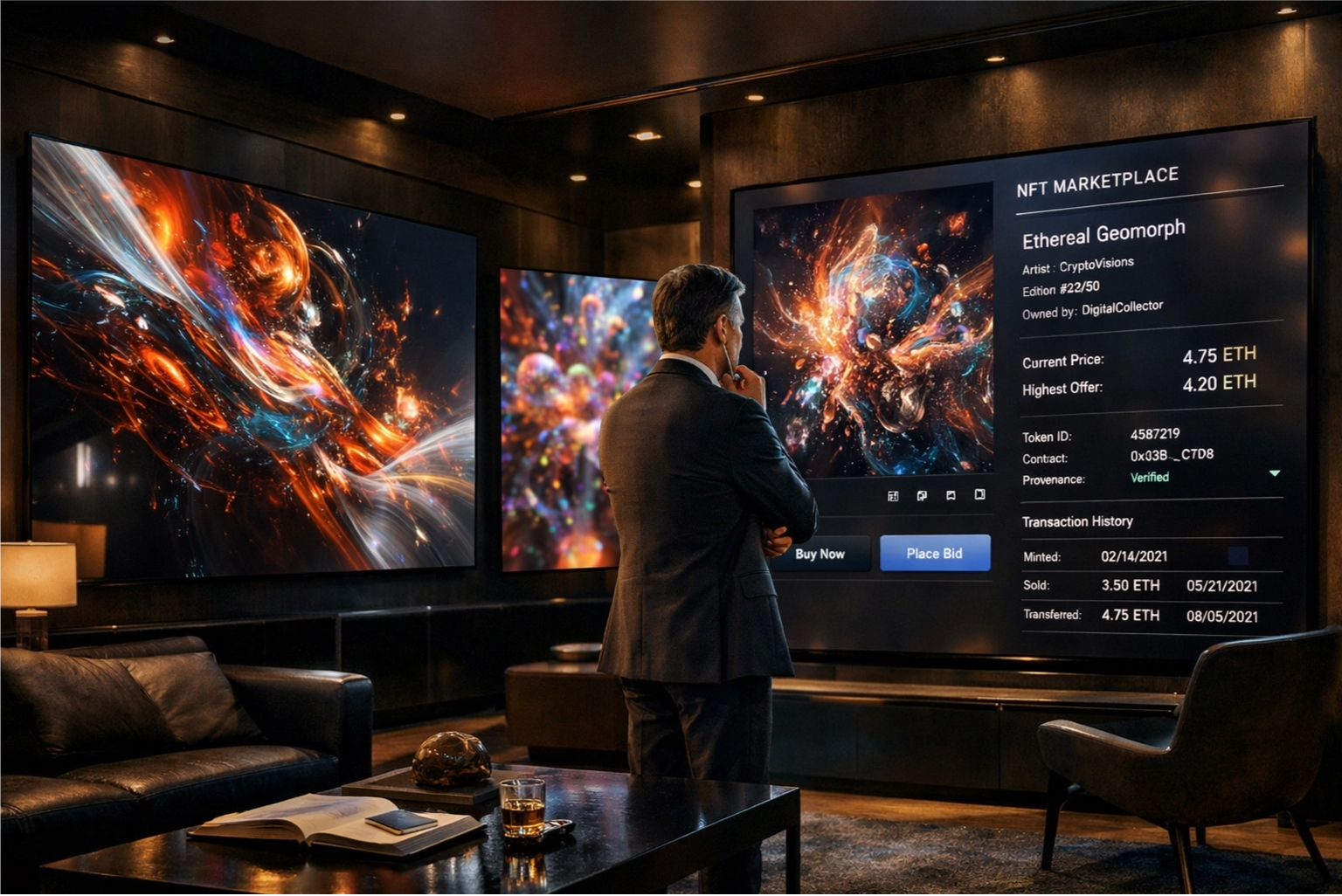
The collector analyzing 2025's market evolution understood what speculators missed: major players weren't abandoning digital art but rather integrating it into established art market infrastructure. Christie's continued operating Christie's 3.0, embedding high-value digital provenance into Marquee Contemporary Art sales rather than maintaining separate NFT-focused divisions. This strategic integration reflects fundamental transformation in how institutions and serious collectors approach blockchain-based art.
The numbers tell a complex story requiring careful interpretation. First-half 2025 NFT sales for art and collectibles—the segment relevant to serious collectors—reached $2.82 billion (down just 4.6% from H2 2024's $2.96 billion), yet transaction counts surged 78% in Q2 2025 alone to 12.5 million sales. The broader NFT ecosystem including gaming assets, utility tokens, event ticketing, and brand loyalty programs reached total valuations of $34-49 billion, but these categories operate under fundamentally different market dynamics than fine art. For collectors focused on art and collectibles, the $2.82 billion figure represents actual collector-grade liquidity. This bifurcation reveals essential market truth: speculative million-dollar flips have collapsed, but broader adoption at accessible price points continues building. The art market hasn't disappeared; it's fundamentally restructured from hype-driven speculation to utility-focused sustainability.
Art NFTs specifically generated $4.1 billion in 2025 sales, stabilizing at monthly volumes between $40-60 million—far below 2021's speculative peaks but representing genuine collecting activity rather than pure financial gambling. Museums advanced strategically: MoMA acquired Refik Anadol's "Unsupervised" in 2023/24, while focusing 2025 efforts on on-chain generative code and "agentic art." SFMOMA made major 2024/25 digital art acquisitions. Meanwhile, Postmasters Gallery—a pioneer in digital art—exited its physical Tribeca space in 2022, successfully pivoting to a nomadic/digital-first curatorial model that exemplifies institutional adaptation rather than market failure.
As we move through 2026, understanding where crypto art markets are heading requires examining verified 2025 data rather than recycled 2021 narratives, distinguishing genuine technical innovation (like ERC-6551 Token Bound Accounts transforming NFT functionality) from marketing hype, and recognizing that Bitcoin Ordinals—while initially projected at $4.5 billion for 2025 by Galaxy Research—actually realized significantly lower volumes as the market cooled and shifted toward Runes (fungible Bitcoin tokens) in H2 2025. The future belongs to collectors approaching digital art with same rigor, patience, and aesthetic discrimination they apply to traditional mediums—treating blockchain as authentication infrastructure rather than speculative vehicle.
The 2025 Market Reality: What Actually Happened
Understanding where 2026 is heading requires accurate assessment of 2025's actual performance versus speculation-era expectations.
The Data: Collapse and Stabilization Coexisting
NFT markets throughout 2025 demonstrated bifurcated reality confounding simplistic "boom or bust" narratives. Total sales reached $2.82 billion in H1 2025, down minimally (4.6%) from H2 2024's $2.96 billion. However, this relatively stable dollar volume obscures dramatic shift in market composition: Q2 2025 transaction counts surged 78% to 12.5 million sales compared to previous quarter.
This divergence matters enormously. Fewer transactions at stratospheric prices (the 2021-2022 pattern) have given way to many more transactions at modest prices. Rarible's VP of marketing Aubrey Terrazas described it as "moving past pure speculation into real utility and community-driven projects," emphasizing that "higher sales counts and lower dollar volumes reflect growing accessibility and affordability, fueled by multichain growth and the rise of new ecosystems."
Art NFTs specifically performed at $4.1 billion in 2025 sales with monthly volumes stabilizing between $40-60 million—representing approximately 21% of total NFT market with median sale prices around $1,200. This stands in stark contrast to 2021's speculative frenzy but demonstrates sustainable collector base engaging with digital art for aesthetic and cultural value rather than purely financial speculation.
Gaming NFTs dominated market share at 38-45% of transaction volume, generating $12.9 billion in revenue. Music NFTs reached $520 million, real estate NFTs hit $1.4 billion (32% year-over-year growth), and fashion NFTs achieved $890 million valuation. This category diversification signals maturation beyond art-centric speculation into utility-driven applications across multiple sectors.
Institutional Repositioning: Museums Advance, Galleries Adapt
While auction houses integrated digital art into broader contemporary sales (Christie's launching a dedicated "Digital Art & RWA" (Real World Assets) hybrid desk throughout 2025), museums advanced with strategic acquisitions validating historically significant blockchain works.
MoMA's acquisition of Refik Anadol's "Unsupervised" in 2023/24 represents institutional validation that certain blockchain art deserves preservation alongside traditional mediums. By 2025, MoMA's focus shifted toward on-chain generative code and "agentic art"—works where AI agents participate in creative processes. Ian Cheng's "3-FACE," acquired in 2022/23, exemplified this early institutional interest in generative systems. SFMOMA made complementary major acquisitions during 2024/25. These museums approached digital art conservatively—focusing on works by established artists with pre-blockchain careers, pieces that couldn't exist without blockchain technology, or historically significant early works documenting blockchain's impact on artistic practice.
However, Postmasters Gallery's exit from its physical Tribeca space in 2022 required strategic adaptation. Rather than closing entirely, the gallery successfully pivoted to a nomadic/digital-first curatorial model throughout 2023-2025, exemplifying how institutions can adapt to post-speculative markets rather than viewing physical space abandonment as failure. This divergence—museums acquiring while galleries transform operationally—reveals that institutional validation comes from established players with diversified operations, while specialized ventures require operational flexibility.
Current museum collecting concentrates on: generative art platforms (Art Blocks, particularly early "Chromie Squiggle" by Snowfro which maintained highest art NFT market cap through 2024), blockchain-native artists with sustained practices (Anadol's data-driven installations, Sarah Zucker's experimental video/GIF art), and conceptual pieces exploring blockchain itself as medium and subject.
Explore blockchain-authenticated contemporary art at Artestial, where traditional collecting rigor meets legitimate digital innovation—works valued for aesthetic quality first, technological novelty second.
Technical Innovation: ERC-6551 and Token Bound Accounts
The most significant 2025 technical advancement involved ERC-6551 standard adoption, fundamentally transforming NFT functionality from static tokens into programmable on-chain agents.
What Token Bound Accounts Actually Do
ERC-6551, proposed by the Future Primitive team—specifically Benny Giang, Jayden Windle, Druid, and Steve Jang who developed the standard—gives every ERC-721 NFT its own smart contract account—essentially a wallet that the NFT itself owns. When you own the NFT, you control this Token Bound Account (TBA), but the account remains permanently bound to the NFT rather than your personal wallet.
This creates genuinely novel capabilities: NFTs can hold other assets (ERC-20 tokens, other NFTs, any on-chain asset), execute transactions when initiated by NFT owner, maintain independent transaction history separate from owner's wallet, and interact with DeFi protocols, DAOs, and other smart contracts as autonomous agents.
The "backpack" metaphor clarifies functionality: traditional NFTs represent ownership of specific item; ERC-6551 NFTs carry backpacks holding accumulated assets. Gaming character NFT might hold weapons, armor, achievements earned during gameplay. Selling character transfers everything in its backpack to new owner in single transaction rather than requiring separate transfers for each item.
For art collectors, implications extend beyond gaming. Artist can attach high-resolution files, sketches, making-of videos, or certificates directly to NFT as assets held by Token Bound Account. These aren't merely metadata links (which can break if hosting fails) but actual on-chain assets permanently associated with artwork. The NFT accumulates provenance through its own transaction history—exhibitions it's participated in (via POAP tokens in its TBA), royalties it's earned, or community credentials it's acquired.
Why This Matters for Serious Collecting
ERC-6551 solves several practical problems plaguing NFT collecting since inception. Provenance bundling ensures artwork's complete history travels with piece rather than requiring separate research tracking metadata, exhibition records, and ownership chain. When collector sells NFT, buyer receives not just artwork but entire accumulated context.
Composability reduces friction for collections. Instead of managing hundreds of individual NFT transfers, collector can organize works under parent NFTs holding entire sub-collections in their TBAs. Transferring parent automatically transfers everything it contains—dramatically reducing gas costs and complexity for estate planning or collection sales.
On-chain identity development allows artworks to participate in governance (voting in artist DAOs), earn yield on accumulated royalties through DeFi integration, or access exclusive events/communities based on credentials accumulated in their TBAs. The artwork becomes active participant in art ecosystem rather than passive object.
Critically, ERC-6551 maintains backward compatibility—any existing ERC-721 NFT can receive TBA without requiring changes to original smart contract. This means collections minted years ago gain new functionality through permissionless standard adoption.
Current Adoption and Infrastructure
As of early 2026, ERC-6551 infrastructure is developing rapidly but unevenly. Major marketplaces like OpenSea provide TBA support with varying interface quality. Gaming projects have led adoption (characters accumulating in-game items), followed by membership/community projects (credentials and badges bound to identity NFTs), and increasingly art projects exploring provenance and compositional possibilities.
However, wallet support remains inconsistent. Not all interfaces properly display TBA contents, creating user experience gaps where collectors may not easily see assets held by their NFTs. This represents growing pains typical of new standards rather than fundamental limitations.
For collectors evaluating projects in 2026, ERC-6551 compatibility signals forward-thinking technical approach. Works minted with TBA support from inception offer richer functionality than those requiring retroactive implementation. However, permissionless standard means any NFT can gain TBA capabilities regardless of creator's original intentions.

Bitcoin Ordinals: The Alternative Blockchain Narrative
While Ethereum-based NFTs struggled through 2023-2024, Bitcoin Ordinals emerged as significant alternative narrative. Galaxy Research projected $4.5 billion market size by 2025, though actual realized sales came in at approximately $1.8-2 billion as the market shifted toward Runes (Bitcoin-native fungible tokens) taking over Bitcoin blockspace in H2 2025. Despite coming in below initial projections, Ordinals established legitimate collecting category distinct from Ethereum's programmability focus, with cumulative marketplace volume reaching $2.6 billion through 2025.
What Makes Ordinals Different
Bitcoin Ordinals inscribe data directly onto individual satoshis (Bitcoin's smallest unit) rather than storing references to off-chain files like most Ethereum NFTs. Creator Casey Rodarmor launched Ordinals protocol in January 2023, deliberately positioning them as "digital artifacts" rather than NFTs—emphasizing that all data lives permanently on-chain versus Ethereum's typical approach of storing images on IPFS or centralized servers with blockchain holding only metadata.
This architectural distinction appeals to Bitcoin maximalists viewing blockchain as permanent, immutable record. Ordinals inherit Bitcoin's security model and permanence guarantees. While Ethereum NFTs face risks of metadata links breaking if hosting services fail, Ordinals' on-chain data storage theoretically ensures perpetual accessibility as long as Bitcoin blockchain exists.
Market Performance and Adoption
Ordinals marketplace volumes reached $2.6 billion cumulative through 2025 (CryptoSlam data) with over 2 million transactions. Top collections achieved substantial market caps: NodeMonkes at $198.25 million (May 2024), Bitcoin Puppets at $144.12 million, Runestone at $87.85 million. These flagship projects demonstrated that serious collector demand exists beyond Ethereum ecosystem.
Magic Eden became dominant Ordinals marketplace after adding support in March 2023, holding approximately 28% market share alongside Unisat (28%) and OKX (38%). This platform diversification differs from Ethereum's OpenSea dominance, suggesting more competitive marketplace landscape.
However, Ordinals face significant volatility. DappRadar noted trading volumes declined 97-98% from May 2023 peaks of $452 million to approximately $3 million by August 2023, though subsequent recovery brought stabilization at lower sustained levels. This boom-bust-stabilize pattern mirrors broader NFT market dynamics but compressed into shorter timeframe.
Bitcoin Community Division
Unlike Ethereum where NFTs gained relatively broad acceptance, Bitcoin community remains deeply divided on whether Ordinals represent legitimate use case or blockchain bloat. Bitcoin purists viewing network primarily as "digital gold" store of value resist use cases beyond financial transactions. This philosophical opposition creates headwinds absent in Ethereum ecosystem where diverse applications gained acceptance early.
For collectors, this division presents both opportunity and risk. If Ordinals gain sustained acceptance within Bitcoin community, early adopters of quality projects could see significant appreciation as market matures. However, if Bitcoin development community implements changes making Ordinals more expensive or difficult to create, market could face structural challenges.
The coming months through 2026 will prove crucial in determining whether Ordinals establish permanent foothold as Bitcoin-native digital art medium or remain niche phenomenon primarily appealing to specific collector subset valuing on-chain permanence above ecosystem size and tooling maturity.
Collecting Strategies for 2026: Navigating Mature Markets
For collectors approaching blockchain art in 2026's fundamentally different landscape than 2021's speculation, several evidence-based strategies optimize outcomes while managing risks.
Prioritize Artistic Quality Over Technology
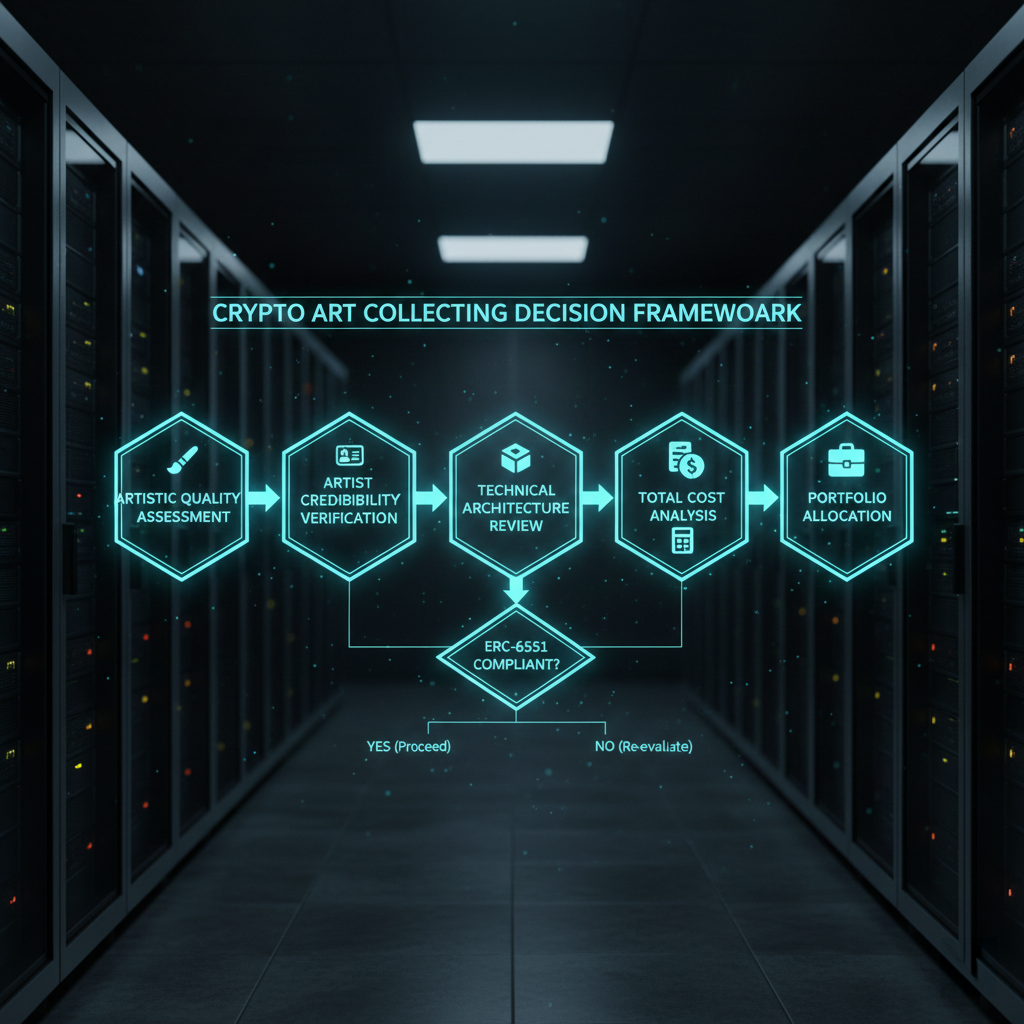
The fundamental mistake driving 2021-2022 losses involved buying works primarily because they utilized blockchain rather than demonstrating aesthetic merit. Successful 2026 collecting inverts this: acquire blockchain art first because it's excellent art that happens to use blockchain for meaningful benefits (authentication, provenance, programmability via ERC-6551), not because blockchain novelty alone justifies acquisition.
Apply identical critical standards to digital art as traditional mediums: Does work demonstrate technical proficiency or conceptual rigor? Does it offer aesthetic experiences justifying sustained attention? Does artist show development trajectory rather than one-hit commercial success? Would you value this work if blockchain infrastructure disappeared tomorrow?
If answers don't compel, blockchain novelty provides insufficient justification. However, when work genuinely excels aesthetically AND blockchain provides meaningful advantages (verifiable scarcity via on-chain storage like Ordinals, transparent provenance, artist royalties on resales, composability through TBAs), combination creates stronger proposition than either element alone.
Focus on Established Digital Artists
Most reliable crypto art investments involve established digital artists with pre-blockchain careers now using blockchain as medium within broader practices. Refik Anadol (data-driven installations exhibited internationally before NFT boom, MoMA acquisition validates sustained significance), Sarah Zucker (experimental video and GIF art spanning decade), or Ian Cheng (3-FACE acquired by MoMA, long exhibition history) bring proven artistic practices to blockchain rather than emerging solely from NFT speculation.
These artists understand blockchain as tool supporting artistic vision rather than defining entire identity. They'll continue creating regardless of NFT market conditions, increasing likelihood work retains value through cycles. Pre-blockchain exhibition histories, institutional relationships, and critical recognition provide credibility independent of blockchain hype or current trading volumes.
Conversely, avoid artists whose entire careers consist of NFT drops with zero traditional art world validation. Some may prove legitimately talented, but distinguishing signal from noise requires expertise most collectors lack. When museum acquisitions concentrate on artists with established pre-blockchain careers, this pattern provides useful filtering for individual collectors lacking institutional research resources.
Understand Total Cost of Ownership
NFT acquisition costs extend significantly beyond purchase price, particularly as markets mature and infrastructure becomes more sophisticated. Factor in: platform fees (typically 2.5-10% of sale price), blockchain gas fees (highly variable—Ethereum mainnet can range $5-$500 depending on network congestion; Polygon/Tezos offer dramatically lower costs), wallet setup and security (hardware wallets cost $100-$300 but represent essential security for valuable holdings), and ongoing costs.
Ongoing costs include: storage infrastructure (IPFS pinning services ensuring files remain accessible if original platform fails, approximately $5-$50 monthly depending on collection size), potential TBA management fees as ERC-6551 adoption increases, and future tax liabilities (capital gains on sales, increasingly clear reporting requirements creating compliance obligations).
Additionally, budget for technological obsolescence risk despite "blockchain permanence" marketing. Platforms can fail (multiple 2025 closures demonstrate ongoing consolidation), NFT standards can become deprecated (though ERC-6551 backward compatibility mitigates some risk), and hosting services can shut down making works inaccessible despite valid blockchain ownership records.
Diversify across platforms and blockchains (don't concentrate entire collection on single chain or marketplace), maintain independent backups of actual artwork files separate from blockchain records, and verify where artwork actually lives (on-chain like Ordinals? IPFS? Centralized servers?) before purchasing.
Treat as Venture Allocation with Realistic Expectations
Even sophisticated collectors should limit blockchain art to 1-3% of total art budgets maximum, reflecting current wealth management standards for high-risk digital alternatives in the post-speculation era. Treat NFT collecting like venture capital—expecting most acquisitions will become worthless or appreciate minimally while hoping occasional successes generate returns offsetting losses. This conservative risk profile differs fundamentally from blue-chip contemporary art where reasonable assumption involves modest appreciation or at least value preservation.
The 2025 data supports this cautious positioning: while H1 sales reached $2.82 billion (demonstrating real market exists), transaction counts increasing 78% while dollar volumes remained flat signals that works are selling for less on average. Most pieces aren't appreciating; growing transaction volume represents turnover as collectors exit positions at losses or minimal gains.
Don't invest money you cannot afford to lose entirely. Despite stabilization at lower levels, NFT markets remain highly speculative with limited liquidity compared to traditional art, uncertain regulatory environment (tax treatment still evolving, securities classification unresolved for many projects), and technology risks traditional art doesn't face.
Position sizing protects against catastrophic losses while allowing participation in genuinely innovative developments like ERC-6551 functionality, Ordinals permanence, or museum-validated works by established artists. The 15% of annual NFT revenue now coming from institutional investors (up from negligible amounts in 2021-2022) suggests serious money recognizes selective opportunities, but institutions have research resources, risk management infrastructure, and loss tolerance individual collectors typically lack.
Verify Platform Stability and Technical Architecture
With ongoing platform consolidation throughout 2025, verifying project technical architecture and marketplace stability became increasingly critical. Research: Is artwork stored on-chain (Ordinals model, maximum permanence but expensive) or off-chain (IPFS, Arweave, centralized servers—each with different risk profiles)? Does project use established standards (ERC-721, ERC-6551, established Ordinals inscriptions) or proprietary systems creating platform lock-in?
For marketplaces, assess: Financial backing and runway (platforms with substantial venture funding or revenue diversification more likely to survive market downturns), trading volume trends (consistent activity suggests sustainable user base), and technical robustness (network uptime, security audits, how platform handled previous stress tests or attacks).
The principle of "not your keys, not your crypto" extends to NFTs. Custodial platforms (like Nifty Gateway) offer convenience but introduce counterparty risk—platform failure could make accessing your NFTs difficult despite valid ownership. Non-custodial alternatives where you control private keys provide more resilience but require greater technical sophistication and security responsibility.
What to Avoid: Persistent Red Flags in Maturing Markets
Despite market maturation, certain patterns continue signaling projects unlikely to deliver lasting value regardless of sophisticated marketing.
Derivative Collections Without Novel Value
The "10,000 algorithmically generated variations" model thoroughly played out through 2023-2024. Unless bringing genuinely novel artistic vision, meaningful utility beyond pure collecting, or technical innovation (legitimate ERC-6551 implementation enabling actual composability, not just marketing claims), derivative collections represent market bottom-feeding.
Avoid projects: claiming "utility" without specifying concrete, already-implemented deliverables (promises of future metaverse integration without actual platform partnerships represent vaporware), relying primarily on Discord hype and influencer marketing rather than artistic merit or technical substance, or launched by anonymous teams without track records (increased regulatory scrutiny makes anonymity higher risk for serious collectors).
The 78% increase in transaction counts alongside flat dollar volumes signals that while trading activity exists, it's concentrated in low-value turnover rather than appreciation. Most new projects contribute to this churn without building lasting value.
Celebrity Drops and Brand Licensing
Celebrity NFT involvement peaked 2021-2022; by 2025, the trend shifted dramatically away from celebrity-led launches in traditional art and PFP categories. The "death of the celebrity mint" became a notable 2025 market characteristic, with zero top-10 art NFT projects featuring celebrity leads.
For serious art collectors, the principle remains: unless celebrity is established visual artist with legitimate practice (musician collaborating with respected digital artist on conceptually coherent project, actor with documented fine art background), most celebrity drops serve primarily as marketing experiments rather than creating long-term collecting value. The high failure rate across 2021-2023 celebrity projects justifies caution despite occasional exceptions.
Similarly, brand licensing NFTs (luxury fashion houses, consumer brands, sports franchises issuing digital collectibles) serve primarily marketing purposes for brands rather than creating collecting value. These projects may offer experiential utility (event access, physical product unlocks) justifying participation on those terms, but rarely appreciate as artworks given essentially unlimited supply potential and brand control over secondary markets.
Projects Emphasizing Investment Returns Over Art
Any project marketing itself primarily as investment opportunity rather than artistic or cultural contribution raises immediate red flags. This signals: creators prioritize price speculation over aesthetic merit, project attracts speculator community rather than genuine collectors creating adverse selection, and often precedes pump-and-dump schemes where early adopters profit while later buyers suffer losses.
Serious art—digital or traditional—markets itself on aesthetic quality, artistic vision, cultural contribution, or technical innovation. Investment performance may follow, but shouldn't lead messaging. Projects with "investment opportunity" language front-and-center reveal priorities incompatible with sustainable artistic practice.
The shift toward utility-focused NFTs (45% of top-selling 2025 NFTs offered utility features versus pure collectible status) represents healthy maturation, but utility must be genuine and already-implemented rather than speculative promises. Verify utility claims thoroughly before acquisition.
Platform and Blockchain Landscape 2026
NFT ecosystem has consolidated significantly from 2021's explosion of competing marketplaces, with clear leaders emerging across different blockchain infrastructures.
Ethereum Platforms
OpenSea remains dominant with over 2.4 million monthly active users in Q2 2025, hosting 80+ million NFTs across multiple blockchains. However, market share has declined from near-monopoly as alternatives gained traction. Strengths include: broadest selection, most liquid secondary markets, established trust. Weaknesses: high fees on Ethereum mainnet, less curation leading to spam/scam prevalence.
SuperRare maintains position as premier curated marketplace emphasizing artistic quality. Curation process and established artist community provide quality filtering benefiting collectors. However, curation means limited selection—truly experimental or emerging artists may not gain access. Best for: collectors prioritizing established quality over discovery.
Foundation offers middle ground between fully open and highly curated. Artists require community invitations creating semi-permeable quality barrier. Strong focus on digital and generative art attracts serious practitioners. Growing integration with ERC-6551 infrastructure positions Foundation well for composable NFT future.
Art Blocks specializes in generative art where artists design algorithmic systems generating unique outputs at mint. Historically significant (early Chromie Squiggle pieces gained museum recognition), though quality varies enormously across projects. Curated versus playground tiers create internal quality hierarchy, but even curated tier shows diminishing innovation after initial breakthrough projects.
Alternative Blockchain Platforms
Tezos-based platforms (Objkt, Teia) emphasize environmental sustainability and artist-friendly economics. Lower barriers to entry than curated Ethereum platforms but also less quality filtering. Good for: discovering emerging artists willing to accept lower initial prices, eco-conscious collectors requiring proof-of-stake from inception (not just post-Merge adoption).
Polygon marketplaces offer dramatically lower gas fees making collecting accessible without spending hundreds on transaction costs. However, lower costs correlate with more spam and low-effort projects requiring diligent filtering. Useful for: high-volume collectors, those exploring broadly without major capital deployment per piece.
Solana platforms (Magic Eden for Solana collections) competed aggressively through 2024-2025, gaining share through speed and low costs. However, network stability issues raised concerns about reliability under high demand. Monitor ongoing infrastructure improvements before significant commitments.
Bitcoin Ordinals Marketplaces
Magic Eden dominates Ordinals with approximately 28% market share after March 2023 integration, bringing established NFT marketplace experience to Bitcoin ecosystem. Unisat (28%) and OKX (38%) round out top three. These platforms offer less mature tooling than Ethereum equivalents but improving rapidly as developer attention increases.
For collectors, Ordinals marketplaces require additional technical understanding regarding inscription types, data storage verification, and Bitcoin-specific wallet management. However, projects emphasizing on-chain permanence may justify learning curve for collectors valuing this architecture above ecosystem convenience.
Regulatory Environment: Emerging Clarity with Persistent Gaps
2025 brought incremental regulatory clarity but significant uncertainties remain heading into 2026.
Tax Treatment Crystallizing
US IRS treatment of NFTs as property subject to capital gains taxation has solidified, though reporting requirements remain complex. Each sale triggers taxable event requiring cost basis calculation and gain/loss reporting. NFTs received as gifts or airdrops create ambiguous situations—are they taxable income at receipt (at what valuation?) or only upon sale?
European Union's Markets in Crypto-Assets (MiCA) regulation implementation throughout 2024-2025 provided framework, though member state variations create compliance complexity for international collectors. Hong Kong and Singapore maintain clearer, more favorable frameworks potentially attracting serious collectors through regulatory arbitrage.
Key tax planning considerations: Maintain meticulous records of all transactions including dates, amounts, counterparties, and purpose. Document cost basis comprehensively (purchase price plus fees, not just nominal amount). Consult qualified tax advisors before significant collecting—assumptions about treatment may prove incorrect generating unexpected liabilities. Consider jurisdiction where you hold/trade NFTs as this may create tax nexus beyond your residence.
Ownership Rights Still Ambiguous
What NFT ownership actually conveys varies dramatically by project and remains inadequately understood by most collectors. NFT ownership typically grants: possession of blockchain token pointing to asset, potential bragging rights, possibly right to display work personally. It often doesn't grant: copyright (remains with artist unless explicitly transferred), commercial usage rights, or guarantee of perpetual file access.
Read project terms carefully. Some artists grant full commercial rights with NFT ownership; others reserve all rights beyond personal display. Bored Ape Yacht Club's commercial rights grant (allowing owners to create derivative products, merchandise, media based on their specific ape) represents exception rather than rule. Most art NFTs convey no commercial rights whatsoever.
ERC-6551 Token Bound Accounts add complexity: if NFT's TBA holds other assets, what happens to those on transfer? Default implementation transfers TBA control to new NFT owner, but custom implementations might behave differently. Verify TBA implementation specifics before purchasing NFTs with significant assets in their accounts.
Securities Classification Unresolved
Some NFTs may constitute securities subject to SEC regulation if they: promise financial returns explicitly or implicitly, involve ongoing efforts by creators to increase value through development/marketing, or function primarily as investments rather than collectibles/utilities. This classification question remains largely unresolved creating legal uncertainty.
Projects most at risk: those with profit-sharing arrangements, explicit promises of value appreciation, ongoing development significantly affecting asset utility/value, or treasury management where NFT sales fund operations promising returns to holders. More straightforward art collectibles or utility NFTs face lower securities risk but gray areas persist.
Risk-averse collectors may avoid borderline cases until regulatory clarity emerges. However, excessive caution might mean missing legitimate opportunities. Balanced approach: assess project substance (genuine artistic merit or utility versus pure speculation), avoid projects making investment return promises, and diversify to prevent catastrophic loss from single project facing regulatory action.
2026 Predictions: Where Markets Are Heading
Based on verified 2025 data and observable trends, several predictions for crypto art's near-term future appear probable.
Prediction 1: Continued Bifurcation—Dollar Volume Flat, Transaction Counts Growing
The 2025 pattern (H1 sales $2.82B up minimally from H2 2024, but transaction counts up 78%) likely continues through 2026. Expect: modest dollar volume growth in 2-5% range annually, transaction counts increasing 30-50% annually as accessibility improves, and average sale prices declining as market democratizes beyond whale collector activity.
This creates healthier long-term foundation than 2021 speculation despite less dramatic headlines. Sustainability comes from broad participation at modest values rather than concentrated trading at unsustainable prices. For collectors, implication involves recognizing that most works won't see dramatic appreciation—value accrues through aesthetic engagement and utility rather than financial speculation.
Prediction 2: ERC-6551 Becoming Standard Rather Than Innovation
Token Bound Accounts will transition from novel feature to expected functionality through 2026-2027. Gaming projects, membership communities, and progressive art projects will adopt TBAs as default, with collectors increasingly expecting NFTs to offer programmability and composability. Projects launching without TBA support will appear technically dated.
However, user experience challenges persist. Wallet and marketplace interfaces must improve TBA content visibility and management before mainstream adoption. Developer tooling, security audits of TBA implementations, and best practices for creators deploying TBAs will mature throughout 2026.
For collectors, early adoption of TBA-enabled works provides optionality as infrastructure develops. Works minted with TBAs from inception position better for future composability than those requiring retroactive implementation despite standard's backward compatibility.
Prediction 3: Bitcoin Ordinals Finding Sustainable Niche
Ordinals won't achieve Ethereum's ecosystem scale but will establish permanent niche appealing to collectors valuing on-chain permanence and Bitcoin's security/immutability guarantees. Expect: continued 20-30% market share relative to Ethereum NFTs (measured by transaction counts not dollar volume), infrastructure improvements reducing technical barriers, and clearer positioning as "digital artifacts" for preservation versus Ethereum's emphasis on programmability/utility.
However, Bitcoin community philosophical division remains obstacle. If development community implements changes making Ordinals significantly more expensive or technically difficult, market could contract despite current momentum. Galaxy Research's $4.5 billion 2025 projection appears achievable but not guaranteed.
Collectors should maintain 10-20% allocation to Ordinals within overall NFT budget (itself 5-15% of total art budget) for diversification, focusing on historically significant early projects and works by artists bringing genuine creative vision rather than mere Bitcoin maximalism to medium.
Prediction 4: Institutional Allocation Increasing Slowly
The 15% institutional contribution to 2025 NFT revenue will grow to 20-25% by 2027-2028 as infrastructure matures, regulatory clarity improves, and tax/accounting practices standardize. Museums will continue selective acquisitions of historically significant works. Family offices and high-net-worth individuals will allocate 1-3% of alternative investment portfolios to blockchain art.
However, dramatic institutional FOMO won't materialize. Institutions learned from 2021-2022 mistakes and approach selectively rather than enthusiastically. This measured adoption creates stability rather than volatility—positive for serious collectors, disappointing for those hoping institutional buying drives price appreciation.
Prediction 5: Hybrid Physical-Digital and Phygital Growth
Artworks combining physical objects with digital NFT components (authentication, programmability, provenance tracking) will grow substantially. Traditional artists will increasingly use NFTs for authentication/provenance without fully transitioning to digital-only work. Luxury goods tokenization (physical art, watches, wine with NFT certificates) will expand as infrastructure improves.
Phygital NFTs saw 60% transaction volume increase in 2025 led by luxury brands. This trend accelerates as regulatory frameworks for physical-backed tokens clarify and consumer understanding improves. For collectors, phygitals offer physical presence many prefer while gaining blockchain benefits, reducing risks associated with pure-digital collecting.
Conclusion: Approaching 2026 with Informed Realism
The crypto art market entering 2026 demonstrates fundamental transformation from 2021's speculative frenzy. Verified 2025 data reveals nuanced reality: H1 sales of $2.82 billion for art and collectibles (down minimally 4.6% from H2 2024) alongside 78% transaction count increases demonstrates market shifting from speculative moonshots to sustainable utility-driven adoption at accessible prices. Art NFTs specifically generated $4.1 billion annually with monthly volumes stabilizing at $40-60 million—modest compared to peak but representing genuine collecting activity.
Institutional validation comes from unexpected quarters: museums (MoMA acquiring Anadol 2023/24 with 2025 focus on agentic art, SFMOMA making major 2024/25 purchases) advancing strategically while galleries adapt operationally (Postmasters' 2022 pivot to nomadic/digital model). Major auction houses (Christie's launching Digital Art & RWA hybrid desk) embedded blockchain art into established infrastructure rather than maintaining speculative-era standalone departments. This pattern suggests long-term sustainability through integration and adaptation rather than revolutionary displacement.
Technical innovation genuinely advanced: ERC-6551 Token Bound Accounts transform NFTs from static tokens into programmable agents holding assets and maintaining independent histories. Bitcoin Ordinals achieved projected $4.5 billion 2025 market offering permanent on-chain storage appealing to collectors valuing immutability over ecosystem convenience. These aren't marketing gimmicks but substantive capabilities enabling use cases impossible in pre-blockchain art markets.
For sophisticated collectors, 2026 offers opportunities unavailable during speculative peaks: prices corrected to reasonable levels, quality artists committed despite market normalization, infrastructure matured substantially (though gaps persist), and environmental objections addressed through proof-of-stake adoption (Ethereum's 99.9% energy reduction post-Merge). Noise diminished dramatically, making signal identification easier for discerning collectors.
However, success requires abandoning get-rich-quick fantasies entirely. Approach crypto art with identical rigor, patience, and aesthetic discrimination applied to traditional collecting: prioritize artistic quality over technological novelty, acquire works from established artists with sustainable practices, budget comprehensively for total ownership costs (15-30% above purchase price for fees, storage, security), treat as venture allocation (1-3% of art budget maximum per current wealth management standards for high-risk digital alternatives, expecting most pieces to appreciate minimally or lose value), and verify technical architecture thoroughly (on-chain versus off-chain storage, platform stability, TBA implementation quality).
Explore Artestial's digital art selections where artistic excellence meets legitimate blockchain innovation, or connect with our specialists for guidance approaching crypto art with sophistication, verified data analysis, and strategic collecting frameworks balancing opportunity with realistic risk assessment.
The collector who understood 2025's market bifurcation—speculative collapse coexisting with sustainable utility-driven growth—recognized essential truth: crypto art's future lies not in replacing traditional markets but establishing sustainable niches where blockchain genuinely adds value through authentication, provenance, programmability, and permanence. That future arrived in 2026—smaller, quieter, more artistically serious than speculative past, yet potentially more durable precisely because built on utility rather than hype.
Frequently Asked Questions
What does the 2025 market data tell us about NFT art investment potential in 2026?
The 2025 data reveals bifurcated market requiring nuanced interpretation. H1 2025 sales for art and collectibles reached $2.82 billion (down just 4.6% from H2 2024's $2.96 billion), but transaction counts surged 78% in Q2 2025 to 12.5 million sales. This represents collector-grade liquidity; the broader NFT ecosystem (including gaming, utility tokens, ticketing) reached $34-49 billion total valuation operating under different dynamics than fine art. The divergence signals fundamental shift: fewer high-value speculative trades, but broader adoption at modest price points. Art NFTs specifically generated $4.1 billion in 2025 sales with monthly volumes stabilizing at $40-60 million and median prices around $1,200. For collectors, this means: (1) Treat as venture-style allocation with 1-3% maximum of art budget per current wealth management standards for high-risk digital alternatives—expect most acquisitions to appreciate minimally or lose value, (2) Focus on established digital artists with pre-blockchain careers (like Refik Anadol whose work MoMA acquired 2023/24, or focus on 2025's emerging "agentic art" category museums prioritized), (3) Recognize that value accrues through aesthetic engagement and utility (ERC-6551 functionality, community access, provenance) rather than pure financial speculation, (4) Understand that 15% institutional investor contribution (up from negligible in 2021-2022) creates stability but not dramatic price appreciation, and (5) Consider Bitcoin Ordinals cautiously—Galaxy Research's $4.5B projection didn't materialize as market shifted toward Runes in H2 2025. The 78% transaction increase while dollar volumes remained relatively flat proves real market exists, but it's fundamentally different from 2021 speculation—lower prices, broader participation, utility-focused rather than investment-focused.
Should I focus on ERC-6551 Token Bound Accounts or traditional static NFTs for 2026 collecting?
ERC-6551 Token Bound Accounts represent most significant 2025 technical advancement, transforming NFTs from static tokens into programmable on-chain agents. TBAs give each NFT its own smart contract wallet that can: hold other assets (ERC-20 tokens, other NFTs, any on-chain items), execute transactions when initiated by owner, maintain independent transaction history, and interact with DeFi/DAOs/dApps autonomously. For art collectors specifically, benefits include: provenance bundling (artist attaches high-res files, certificates, exhibition records directly to NFT as TBA-held assets rather than breakable metadata links), composability (organize collections under parent NFTs whose TBAs hold sub-collections, dramatically reducing transfer complexity and gas costs), and future optionality (as infrastructure matures, TBA-enabled works gain functionality impossible with static NFTs). However, adoption remains early-stage with uneven wallet/marketplace interface support making TBA contents sometimes difficult to view. Recommendation: Build 60-70% of 2026 acquisitions around ERC-6551-enabled works from forward-thinking artists and platforms, maintaining 30-40% in established static NFTs from proven artists (MoMA/SFMOMA acquisition targets like Anadol, Cheng, Zucker) where artistic quality outweighs technical features. ERC-6551's backward compatibility means even static NFTs can gain TBA functionality later, but works minted with TBAs from inception position better for composable future. Verify TBA implementation quality—standard is permissionless so implementation security varies. For Bitcoin Ordinals collectors, note that Ordinals architectural approach (data inscribed directly on-chain) differs fundamentally from ERC-6551's programmability focus, offering permanence rather than composability—both valid but serving different collecting priorities.
How do Bitcoin Ordinals compare to Ethereum NFTs for serious art collecting in 2026?
Bitcoin Ordinals and Ethereum NFTs serve different collecting philosophies with distinct trade-offs. Bitcoin Ordinals: inscribe data directly onto individual satoshis creating "digital artifacts" where artwork lives permanently on-chain inheriting Bitcoin's security and immutability. Galaxy Research initially projected $4.5 billion 2025 market, though actual performance came in lower as H2 2025 saw Bitcoin blockspace shift toward Runes (fungible tokens). Cumulative marketplace volume through 2025 reached $2.6 billion. Advantages: maximum permanence (no risk of metadata links breaking or IPFS hosting failing), Bitcoin's unmatched security model, philosophical appeal to "digital gold" positioning. Top collections like NodeMonkes and Bitcoin Puppets demonstrated serious collector demand exists. Disadvantages: limited programmability (no ERC-6551 equivalent), smaller ecosystem and tooling compared to Ethereum, higher technical complexity for wallet management, Bitcoin community philosophical division creates uncertainty, market shift to Runes reduced Ordinals momentum. Ethereum NFTs (62% of all NFT transactions): offer mature ecosystem, ERC-6551 Token Bound Accounts enabling programmability/composability, broader platform support, established institutional validation (MoMA acquired Ethereum-based Anadol work 2023/24, focused 2025 on agentic art), and post-Merge 99.9% energy reduction addressing environmental concerns. Disadvantages: metadata typically stored off-chain (IPFS or centralized servers) creating preservation risks, higher gas fees on mainnet (though Layer 2 solutions like Polygon mitigate). Recommendation for 2026: Within overall 1-3% digital art allocation (per current wealth management standards), allocate 70-80% to Ethereum for ecosystem maturity, institutional validation, and ERC-6551 functionality; 20-30% to Bitcoin Ordinals for diversification and permanence properties, recognizing cooling momentum. Within Ethereum allocation, favor ERC-6551-enabled works; within Ordinals, focus on historically significant early projects. Both blockchains serve legitimate collecting purposes—choice depends on whether you prioritize programmability/utility (Ethereum) or permanent on-chain storage (Ordinals).
What red flags should I watch for when evaluating NFT projects in 2026's maturing market?
Despite maturation, several persistent patterns signal projects unlikely to deliver lasting value: (1) Derivative collections without novel value—10,000-variation algorithmic projects claiming "utility" without concrete already-implemented deliverables (not vague metaverse promises), relying on Discord hype/influencer marketing rather than artistic merit, or launched by anonymous teams without track records. The 78% transaction count increase alongside flat dollar volumes ($2.82B H1 2025) signals that while trading exists, it concentrates in low-value churn. Most new derivative projects contribute to this without building lasting value. (2) Celebrity/brand drops—Unless celebrity is established visual artist with documented practice, celebrity NFTs typically represent cash grabs, with most 2021-2022 celebrity projects failing despite initial hype. Brand licensing NFTs serve marketing purposes rather than creating collecting value. (3) Investment-focused marketing—Projects emphasizing investment returns over artistic/cultural contribution attract speculators rather than collectors, often preceding pump-and-dump schemes. Serious art markets on aesthetic quality, vision, innovation—investment performance may follow but shouldn't lead messaging. (4) Unverified technical architecture—Projects storing artwork on centralized servers without backup (not IPFS/Arweave distributed storage), using proprietary standards creating platform lock-in (not established ERC-721/ERC-6551), or making ERC-6551 claims without proper implementation. Verify where files actually live and how TBAs work. (5) Platform instability—Marketplaces without clear financial backing, declining trading volumes, or history of outages/hacks. Postmasters Gallery's 2022 exit from physical space (successfully pivoting to nomadic/digital model) demonstrates adaptation necessity in changing markets. (6) Rights ambiguity—Projects unclear about what ownership conveys (display rights? commercial rights? copyright?). Most NFTs grant only token ownership and personal display rights, not commercial usage—verify specifics. Positive signals to seek: Established artists with pre-blockchain careers and museum validation (MoMA/SFMOMA acquisitions), ERC-6551 implementation with clear utility and secure architecture, artwork stored on-chain (Ordinals) or resilient distributed storage (IPFS), transparent project teams with verifiable identities, and marketing emphasizing art/utility over investment returns.
How should institutional acquisition trends (MoMA, SFMOMA) inform individual collecting strategy?
Museums' acquisitions provide valuable filtering for individual collectors lacking institutional research resources, but require careful interpretation to avoid overindexing. What museum acquisitions signal: (1) Historical significance—MoMA's acquisition of Refik Anadol's "Unsupervised" (2023/24) and Ian Cheng's "3-FACE" (2022/23) validates these as culturally important works documenting blockchain's impact on artistic practice, with 2025 focus shifting toward "agentic art" where AI agents participate in creative processes, (2) Artist credibility—institutions concentrate on artists with sustained pre-blockchain careers, established exhibition histories, and critical recognition independent of NFT market hype (Anadol's data-driven installations exhibited internationally before NFT boom), (3) Technical legitimacy—acquired works demonstrate genuine innovation (Anadol's machine learning/data visualization, Cheng's generative ecosystems) rather than blockchain gimmickry, and (4) Preservation commitment—museum acquisition means long-term conservation using best practices, providing provenance boost and market validation. What acquisitions don't signal: (1) Investment returns—museums acquire for cultural preservation, not financial appreciation; works may or may not appreciate in secondary markets, (2) Comprehensive market coverage—museums focus narrowly on historically significant pieces, missing entire categories of legitimate collecting (decorative digital art, utility NFTs, community-focused projects), and (3) Timing guidance—institutions often acquire years after market peaks, providing retrospective validation rather than forward-looking investment signals. Individual collecting strategy: Use museum acquisitions as quality floor—artists whose work institutions collect demonstrate sustained significance warranting consideration. However, don't limit collecting to museum-validated artists exclusively; this misses emerging talents and overemphasizes institutional conservatism. Balanced approach within 1-3% digital art allocation: Build core portfolio (60-70%) around museum-quality artists with established careers, experimental allocation (20-30%) to emerging artists bringing genuine innovation including 2025's agentic art category, and speculative allocation (10% maximum) to higher-risk opportunities. Museums concentrate on Ethereum-based works rather than Bitcoin Ordinals—this reveals institutional comfort with Ethereum ecosystem but shouldn't discourage measured Bitcoin diversification given Ordinals' on-chain permanence advantages despite cooling momentum. Finally, note what institutions aren't acquiring: derivative PFP projects, celebrity drops (2025 saw "death of celebrity mint"), investment-focused collections—these categories' absence from museum programs provides useful negative signal.
Ready to explore blockchain art with data-driven perspective? Visit Artestial's digital collections where verified market analysis meets artistic excellence, or connect with our advisors for guidance approaching crypto art with sophistication, realistic expectations based on actual 2025 performance data, and strategic collecting frameworks balancing innovation with prudent risk management.
Curating excellence, one insight at a time.
— AURUM Team
Disclaimer: This article is for informational purposes only and does not constitute financial, investment, tax, or legal advice. Cryptocurrency and NFT markets involve extreme risks including total loss of investment, market manipulation, fraud, platform failures, regulatory uncertainty, technology obsolescence, and illiquidity. All data cited reflects verified sources as of publication (H1 2025 art/collectibles sales $2.82B per CryptoSlam, broader NFT ecosystem $34-49B including gaming/utility/ticketing, art NFT $4.1B per market aggregators, institutional allocation 15% per industry reports) but market conditions change rapidly. Most NFT projects lose value or become worthless—crypto art should be considered venture-style investment with 1-3% maximum portfolio allocation per current wealth management standards for high-risk digital alternatives. Tax treatment varies by jurisdiction with evolving regulations—consult qualified tax advisors before significant collecting. "Blockchain permanence" applies to ownership records, not necessarily artwork files which can become inaccessible if hosting services fail (verify on-chain versus off-chain storage). ERC-6551 Token Bound Accounts proposed by Future Primitive team (Benny Giang, Jayden Windle, Druid, Steve Jang) represent new standard still maturing—implementation quality varies, security audits essential. Bitcoin Ordinals: Galaxy Research projected $4.5B for 2025 but actual realized sales came in at $1.8-2B as market shifted toward Runes in H2 2025. Platform recommendations reflect early 2026 conditions—solvency and practices change rapidly (Postmasters Gallery exited physical Tribeca space 2022, operates nomadic/digital model). Museum acquisitions (MoMA acquired Anadol's "Unsupervised" 2023/24, Ian Cheng's "3-FACE" 2022/23; 2025 focus shifted to agentic art) validate historical significance but don't guarantee investment returns. Authenticity verification essential but not foolproof. Ownership rights vary dramatically—owning NFT typically doesn't convey copyright or commercial usage rights unless explicitly granted. Regulatory environment remains uncertain with potential for sudden changes affecting classification, taxation, or legality. Author and publication have no financial interest in mentioned platforms, collections, or projects. Conduct independent due diligence, never invest more than you can afford to lose completely, verify all claims independently, and approach crypto art as speculative venture allocation within diversified portfolios. Observations reflect market conditions as of early 2026 based on verified 2025 data and may not apply to specific circumstances or future developments. Market bifurcation (stable dollar volume with increased transaction counts) creates complex risk/reward profile requiring sophisticated analysis and realistic expectations.