


London Fashion Week occupies a distinctive position within the global fashion calendar that collectors should understand before dismissing it as industry entertainment. Positioned between New York and Milan in the February circuit, London has carved an identity defined less by commercial dominance than by creative influence—a city where emerging designers launch careers that eventually reshape how the entire industry thinks about clothing, textiles, and the relationship between fashion and art. The designers who show in London often lack the corporate backing of their Parisian counterparts, yet they frequently generate the ideas, techniques, and aesthetic languages that larger houses later adopt and commercialize.
For the February 2026 edition, the British Fashion Council has doubled its investment in the International Guest Programme, bringing an expanded contingent of international press, cultural commentators, and buyers to evaluate collections that span from blue-chip heritage houses to graduates barely a year out of Central Saint Martins. This deliberate mixing of established excellence and raw experimentation creates an environment where collectors can observe the full spectrum of British design thinking—from the refined romanticism of Erdem Moralioglu's narrative-driven gowns to the subversive maximalism of Chopova Lowena's Balkan-influenced constructions.
The waiving of show fees for designers presenting physically on the main schedule, continued from September 2025's successful implementation, reflects the BFC's recognition that London's value proposition differs fundamentally from cities where established luxury conglomerates dominate proceedings. London nurtures talent that other fashion capitals subsequently absorb; understanding this dynamic helps collectors identify creative voices before market recognition inflates values and diminishes access.
Explore contemporary artists whose work engages fashion, textile, and material culture at Artestial, where collectors find creative practices that bridge traditional fine art boundaries with the craftsmanship and conceptual ambition that characterizes London's most compelling designers.
The Anchor Houses: Heritage Reimagined
Burberry and the Weight of British Identity
Burberry's position as London Fashion Week's anchor show reflects responsibilities beyond commercial prominence. As the most globally recognized British fashion house, Burberry carries expectations about what British design means—its heritage, its evolution, and its contemporary relevance. Under creative leadership that has shifted multiple times in recent years, the house navigates between honoring the trench coat and gabardine heritage that built its reputation and demonstrating that British luxury can compete with French and Italian equivalents on creative ambition.
For collectors, Burberry represents a case study in how heritage brands manage the tension between archival authenticity and contemporary relevance. The house's extensive archives—documenting over 160 years of outerwear development, royal warrants, and cultural moments from World War I trench warfare to 1960s London youth culture—constitute a significant cultural repository that informs not just current collections but broader understanding of how British design identity evolved. Collectors interested in fashion history, military uniform development, or the material culture of British imperialism find Burberry's documented heritage genuinely substantive rather than marketing invention.
The Friday morning show slot, traditionally generating maximum press coverage and celebrity attendance, positions Burberry as the week's centerpiece while creating pressure to deliver something worthy of that prominence. Sophisticated observers watch not just the clothes but the casting choices, venue selection, and styling decisions that communicate how the house understands its contemporary audience and cultural position.
Simone Rocha: Femininity as Intellectual Practice
Simone Rocha has established herself as one of London's most distinctive creative voices through collections that combine Irish heritage references with contemporary subversion of feminine archetypes. Her work operates in registers that fashion journalism often struggles to articulate—somewhere between wearable garments and conceptual art, using materials like tulle, pearl, and embroidery in ways that acknowledge their traditional feminine associations while questioning what those associations mean.
For collectors attentive to the intersection of fashion and contemporary art, Rocha's practice offers particular interest. Her collaborations with artists, her gallery-influenced presentation formats, and her intellectual engagement with themes of motherhood, sexuality, and bodily experience position her work within contemporary art discourse even as it functions commercially as clothing. The texture-heavy romanticism of her designs creates garments that photograph as objects—sculptural forms that exist somewhere between fashion, craft, and art.
Her February 2026 presentation continues developing themes that have made her Sunday afternoon slot a critical highlight for serious fashion observers. The theatrical quality of Rocha shows, with their careful attention to music, casting, and spatial experience, rewards collectors who approach fashion week as curatorial research rather than trend forecasting.
Erdem: Narrative Craftsmanship
Erdem Moralioglu approaches fashion design as historical research and storytelling, creating collections inspired by figures ranging from nineteenth-century French spiritualists to Scottish painters to his own late mother. This narrative methodology distinguishes his practice from designers who work primarily from aesthetic intuition or commercial calculation. Each collection emerges from extensive research into historical sources, artistic references, and personal meaning, creating garments that function as wearable essays on their subjects.
His September 2025 collaboration with Scottish figurative painter Kaye Donachie, presented at the British Museum, illustrated how Erdem collections operate as cultural commentary rather than mere product development. The collection explored the "poetic licence" Donachie took while painting someone she had never met—Moralioglu's mother—using this as a meditation on imagination, memory, and the spaces between representation and reality. Garments overlaid with lustrous sheer organza layers, sculpted-waist gowns, and shimmering paillettes created visual equivalents to Donachie's painterly explorations of absence and presence.
For collectors interested in fashion as cultural production, Erdem's practice demonstrates how clothing design can engage intellectual traditions typically associated with fine art. His use of collaboration with visual artists, his historically grounded research methods, and his willingness to pursue conceptual themes through material means create work that transcends seasonal trend cycles.
The Returns: Established Voices Renewed
Temperley London at Twenty-Five
Alice Temperley's return to the London Fashion Week schedule after a six-year absence marks a significant moment for collectors who followed her brand's journey through the 2010s fashion landscape and subsequent restructuring. Founded in 2000, Temperley London built its reputation on ethereal gowns, bohemian detailing, and occasionwear that offered an alternative to structured continental formality—clothing that felt romantic without sacrificing sophistication.
The brand's trajectory illustrates realities that collectors should understand about the fashion industry's economic pressures. After building significant retail presence and celebrity following, Temperley navigated the challenging conditions that affected many independent designers in the post-2020 period. A 2023 sale of majority stake to Times Square Group LLC and the subsequent opening of a flagship at 134 Sloane Street in the former Façonnable space signal renewed investment and strategic repositioning.
The twenty-fifth anniversary presentation offers opportunity to assess how the brand has evolved while maintaining the feminine escapism that defined its original appeal. For collectors, anniversary moments often produce archivally significant pieces as houses revisit and reinterpret their foundational aesthetic languages. The intersection of heritage reflection and contemporary relevance creates collecting opportunities unavailable during normal commercial seasons.
Julien Macdonald: Glamour Revisited
Julien Macdonald's return after a three-year absence following the 2023 liquidation of his business represents the resilience and reinvention that characterizes fashion entrepreneurship. Known for body-conscious silhouettes and red-carpet glamour that attracted celebrity clientele throughout the 2000s and 2010s, Macdonald built a practice distinct from London's more intellectual design traditions—unabashed celebration of feminine display and technical virtuosity in stretch fabrics and embellishment.
His second collection under new creative direction, presenting Friday afternoon, offers collectors perspective on how established designers navigate business challenges while maintaining creative identity. The fashion industry's consolidation around major conglomerates has made independent designer survival increasingly difficult, yet Macdonald's return demonstrates that compelling creative vision can attract the investment necessary for continued operation.
For collectors interested in the full spectrum of British design rather than only its intellectual wing, Macdonald represents traditions of glamour and craft that have their own historical significance. The technical expertise required to construct figure-flattering garments using demanding stretch materials deserves recognition alongside conceptual ambition, and Macdonald's practice has influenced how the broader industry approaches eveningwear construction.
NEWGEN and Emerging Voices
The BFC's Talent Development Ecosystem
The British Fashion Council's NEWGEN program represents the most systematic talent development initiative among major fashion weeks, providing financial support, business mentoring, and schedule positioning that helps emerging designers transition from graduation to commercial viability. Understanding this ecosystem helps collectors identify creative voices during the early career phases when access and pricing remain favorable.
For February 2026, the NEWGEN showspace returns to 180 The Strand with a cohort including designers at various stages of development. The program's recipients span womenswear, menswear, accessories, and jewelry, creating a concentrated survey of emerging British design thinking that serious collectors can evaluate efficiently. While not every NEWGEN designer achieves commercial success or lasting cultural significance, the program's track record—alumni include Simone Rocha, Craig Green, and numerous other designers who have achieved international recognition—justifies attention to current participants.
The physical concentration of NEWGEN presentations enables collectors to observe multiple emerging practices within single days, comparing approaches to sustainability, craft, cultural reference, and commercial positioning that reveal how younger designers understand their relationship to both tradition and innovation.
Conner Ives: American Nostalgia Through British Lens
As the BFC/Vogue Designer Fashion Fund winner, Conner Ives brings distinctive perspective to British fashion through collections that filter American cultural references—cheerleader uniforms, vintage textiles, consumer product packaging—through London's experimental sensibility. His practice of reconstructing vintage American garments and incorporating found materials creates pieces with inherent narrative complexity: each dress carries histories from previous owners and contexts that inform its current meaning.
For collectors interested in sustainability, upcycling, and the integration of vintage materials into contemporary design, Ives demonstrates sophisticated approaches that avoid the earnest worthiness sometimes associated with eco-conscious fashion. His work maintains visual sophistication and conceptual engagement while genuinely reducing material consumption—a balance that resonates with collectors who care about environmental impact without sacrificing aesthetic quality.
His February 2026 runway presentation, following strong critical response to previous collections, offers opportunity to assess how his practice evolves as expectations and resources increase. The transition from emerging designer to established voice presents particular challenges; collectors can observe how Ives navigates the tension between the scrappy improvisation that defined early collections and the consistency expected of a funded, scheduled designer.
Chopova Lowena: Maximalism as Cultural Statement
Emma Chopova and Laura Lowena's collaborative practice produces collections that combine Bulgarian folk tradition with punk irreverence, creating maximalist garments that resist contemporary minimalism's commercial dominance. Their signature pleated skirts, elaborate embroideries, and bold color combinations create immediately recognizable visual identities that function as tribal markers for communities attracted to their aesthetic.
The label's presentation format and visual language have made it a favorite among photographers and street style documentarians, creating visibility that extends beyond industry insiders to broader cultural awareness. For collectors, this visibility raises questions about the relationship between social media prominence and lasting cultural significance—questions without easy answers but worth considering when evaluating emerging designers.
Chopova Lowena's integration of folk craft traditions with contemporary fashion production offers particular interest for collectors concerned with cultural heritage preservation. The designers' engagement with Bulgarian textile traditions positions their work within broader conversations about how fashion can support and transmit craft knowledge that might otherwise disappear.

The Craft Tradition: Savile Row's Enduring Influence
Bespoke Heritage as Design Foundation
London Fashion Week's ready-to-wear presentations exist within a city whose design identity was fundamentally shaped by Savile Row's bespoke tailoring tradition. Even designers working in entirely different registers—flowing gowns, streetwear influences, avant-garde experimentation—operate in dialogue with the precision, construction quality, and client-centered ethos that the Row represents. Understanding this heritage helps collectors evaluate contemporary British design more sophisticatedly.
The bespoke tradition's emphasis on individual fit, achieved through extensive measurement, pattern cutting, and multiple fittings, establishes standards against which all British fashion is implicitly measured. Houses like Huntsman, Henry Poole, and Gieves & Hawkes, operating from Savile Row for over a century in some cases, preserve techniques that require fifty or more hours of hand labor per two-piece suit. This commitment to craft excellence creates reference points for quality evaluation that inform how collectors assess contemporary production.
The 2025 Met Gala's "Superfine: Tailoring Black Style" theme brought renewed attention to how tailoring traditions have been adapted and transformed by designers like Ozwald Boateng, who became the first Black designer to open a store on Savile Row in 1995. Boateng's color-saturated suits, drawing deliberately from Ghanaian Kente cloth while maintaining British structural foundations, demonstrate how heritage can be reinterpreted rather than merely preserved.
Contemporary Tailoring at Fashion Week
Several designers on the February 2026 schedule integrate tailoring traditions into contemporary ready-to-wear, creating work that bridges bespoke heritage and commercial fashion production. Joseph's return to the schedule brings a brand known for clean-lined tailoring that translates Savile Row principles into accessible price points. Harris Reed's gender-fluid approach to formal dressing reimagines what tailored garments can communicate about identity and self-expression.
The tension between bespoke's client-centered individualism and fashion week's presentation of collection pieces designed for multiple buyers creates productive creative challenges. Designers must translate the fit precision that defines bespoke excellence into standardized sizing while maintaining construction quality that honors tailoring traditions. For collectors, observing how different designers navigate this tension reveals their relationships to craft, commerce, and heritage.
Banshee of Savile Row's participation in recent London Fashion Weeks, presenting womenswear that applies traditional tailoring techniques to feminine silhouettes, illustrates how the Row's historically masculine focus is expanding. Their February 2025 "Interwoven" presentation at Messums Gallery, combining runway show with live painting by artist Eleanor Ekserdjian, demonstrated how contemporary tailoring houses integrate art collaboration into their practice.
Sustainability Requirements: The New Framework
Copenhagen Partnership and Minimum Standards
The British Fashion Council's partnership with Copenhagen Fashion Week to implement new Sustainability Requirements represents significant structural change for London Fashion Week's environmental accountability. Starting with the NEWGEN cohort and coming into full effect in January 2026, the framework establishes minimum standards requiring designers to address eighteen key sustainability considerations to remain on schedule.
For collectors concerned with environmental impact, this framework provides some assurance that scheduled designers have engaged with sustainability questions, even if implementation quality varies. The requirements do not guarantee genuinely sustainable production—fashion industry sustainability claims require careful evaluation—but they establish baseline expectations that distinguish London from fashion weeks lacking similar frameworks.
The partnership with Copenhagen, which pioneered sustainability requirements for fashion week participation, positions London within a network of progressive fashion capitals working to address the industry's environmental impact. Collectors can evaluate whether designers exceed minimum requirements, treating sustainability as genuine creative priority rather than compliance exercise.
Patrick McDowell and Demonstrative Practice
Patrick McDowell, winner of the Queen Elizabeth II Award for British Design, exemplifies how sustainability can function as creative catalyst rather than constraint. His collections demonstrate zero-waste pattern cutting, innovative material development, and supply chain transparency that set standards other designers might follow. For collectors, McDowell's work illustrates that environmental responsibility and aesthetic ambition can reinforce rather than compromise each other.
The visibility that awards and schedule positioning provide to designers like McDowell creates market signals about what values the industry recognizes and rewards. Collectors attentive to these signals can identify how sustainability is transitioning from niche concern to mainstream expectation, with implications for how all fashion will be produced and evaluated in coming years.
Collecting Frameworks for Fashion Week Observation
Fashion as Material Culture
Sophisticated collectors approach fashion week not as entertainment but as research into material culture that may merit preservation, investment, or simply understanding. Garments function as historical documents that record manufacturing techniques, material availability, cultural references, and aesthetic values specific to their moments of production. This documentary function gives fashion significance beyond its commercial or wearable purposes.
London Fashion Week's particular combination of heritage craftsmanship and experimental design creates material culture spanning multiple registers. A Burberry trench coat represents different historical and cultural meanings than a Chopova Lowena pleated skirt, yet both document their moments with equal validity. Collectors who understand these different documentary functions can build holdings that capture the full range of contemporary British design thinking.
The question of what to collect requires criteria that extend beyond personal taste to consider historical significance, craft quality, condition stability, and market recognition. Garments from designers who achieve lasting influence appreciate differently than those from designers who remain obscure; yet predicting which trajectory any emerging designer will follow proves difficult. Diversification across different designer profiles, aesthetic registers, and price points hedges against prediction errors.
Access and Acquisition Channels
Fashion week attendance, while primarily an industry event, offers collectors research opportunities that inform subsequent acquisition strategies. Understanding which designers generate the strongest critical response, observing how collections photograph versus how they appear in person, and noting quality differences between runway samples and eventual retail production all provide information relevant to collecting decisions.
Post-show acquisition operates through multiple channels with different access, pricing, and authentication characteristics. Direct relationships with designers or their studios sometimes enable access to runway samples or archive pieces unavailable through retail channels. Gallery exhibitions focusing on fashion increasingly provide acquisition opportunities within art world frameworks. Auction houses have developed fashion-specific expertise, with vintage and contemporary designer clothing achieving significant prices at Sotheby's, Christie's, and specialized fashion auction venues.
For contemporary pieces, retail remains the primary acquisition channel, though waiting lists, limited editions, and geographic restrictions create access challenges for certain designers and items. Understanding release strategies, maintaining relationships with relevant retailers, and monitoring secondary markets enables collectors to acquire desired pieces despite supply constraints.
Discover artists whose practices engage textiles, fashion, and material culture at Artestial, where collecting transcends medium boundaries to embrace the full spectrum of creative production, or connect with specialists for guidance navigating fashion's intersection with contemporary art.
Conclusion: British Design as Collecting Territory
London Fashion Week February 2026 presents a concentrated opportunity to observe British design excellence across its full range—from heritage houses maintaining centuries of craft tradition to emerging voices developing practices that may reshape how we understand clothing, textiles, and creative production. The city's particular combination of experimental ambition and heritage consciousness creates design thinking that influences global fashion while maintaining distinctively British character.
For collectors, the question is not whether fashion merits serious attention—the material, cultural, and economic significance of clothing production is too substantial to dismiss—but rather how to engage thoughtfully with an industry whose commercial pressures, trend cycles, and celebrity associations can obscure underlying creative and craft achievements. London's fashion week, with its emphasis on emerging talent, sustainability requirements, and heritage integration, offers entry points that favor collectors seeking substance over spectacle.
The designers presenting across the February 19-23 schedule represent the current state of British design thinking, but they also represent the beginning of collections that will circulate through markets for decades. Understanding who creates work of lasting significance, evaluating craft quality and material choices, and building relationships that enable preferred access requires the same due diligence that collectors apply to any cultural asset class.
British design excellence has shaped global aesthetics for centuries, from Savile Row tailoring that defined formal menswear to punk fashion that influenced contemporary streetwear. London Fashion Week provides concentrated access to the current generation of designers continuing and complicating these traditions. Collectors who engage seriously find not entertainment but genuine cultural production worthy of preservation and investment.
Ready to explore contemporary work engaging fashion, textiles, and material culture? Visit Artestial where artists working across traditional boundaries create pieces that reward serious collecting attention, or connect with specialists for guidance building collections that recognize fashion's place within broader creative practice.
Frequently Asked Questions
What distinguishes London Fashion Week from Paris, Milan, and New York for collectors interested in fashion as cultural production?
London Fashion Week's distinctive position derives from several structural factors that create different opportunities and challenges compared to other major fashion capitals. While Paris commands the largest concentration of heritage luxury houses backed by conglomerates like LVMH and Kering, and Milan anchors Italian manufacturing excellence with brands like Prada and Armani, London has historically functioned as the incubator where emerging talent develops before either building independent presence or being absorbed by larger houses elsewhere.
This incubator function creates particular opportunities for collectors interested in identifying creative voices during early career phases when access remains relatively open and pricing has not yet reflected market recognition. Designers who show in London often lack the corporate backing that enables elaborate production and global retail distribution, meaning collections remain smaller, relationships more direct, and archival pieces more accessible than equivalent moments in designer careers that unfold primarily in Paris or Milan.
The British Fashion Council's NEWGEN program systematizes this talent development in ways other fashion weeks lack, creating structured pathway from graduation through emerging designer support to established schedule positioning. Collectors who follow NEWGEN cohorts over multiple seasons observe how designers evolve, which practices prove sustainable, and which voices achieve the consistency that predicts lasting significance.
However, London's incubator position also means that some of its most successful designers eventually relocate primary operations elsewhere. Jonathan Anderson's appointment at Dior, Victoria Beckham's business restructuring, and various designers accepting positions at continental houses all illustrate how London develops talent that other fashion capitals capture. Collectors must evaluate whether to focus on designers likely to remain London-based or to use London as research into talent that will subsequently show elsewhere.
How should collectors evaluate sustainability claims from fashion designers, given widespread concerns about greenwashing?
Evaluating sustainability claims requires understanding the difference between marketing language and verifiable practice, a distinction particularly challenging in fashion where supply chain complexity, material science requirements, and commercial pressures create opportunities for exaggeration. The British Fashion Council's new Sustainability Requirements framework, developed in partnership with Copenhagen Fashion Week, establishes minimum standards that provide baseline accountability but do not guarantee genuinely sustainable production.
Collectors serious about environmental impact should look beyond compliance with minimum requirements to evidence of substantive commitment. This includes examining material sourcing transparency, where designers document specific suppliers and their environmental practices; production location disclosure, which reveals whether manufacturing occurs in facilities with labor and environmental accountability; and circular design consideration, which addresses what happens to garments at end of useful life.
Designers like Patrick McDowell, whose practice centers on zero-waste pattern cutting and innovative material development, demonstrate how sustainability can function as creative methodology rather than compliance exercise. His work provides comparison points for evaluating whether other designers' sustainability claims reflect genuine practice or marketing positioning. Similarly, labels like Chopova Lowena, which integrate heritage craft traditions that inherently involve smaller-scale, more careful production, offer models for sustainability achieved through traditional methods rather than technological innovation.
Certifications including Global Organic Textile Standard, OEKO-TEX, and B Corp status provide third-party verification that supplements designer claims, though collectors should research what each certification actually requires and guarantees. No certification system perfectly captures environmental and social responsibility, but they establish accountability frameworks that pure marketing language lacks.
What is the relationship between fashion collecting and traditional fine art collecting, and how should collectors think about building holdings that span both categories?
The relationship between fashion and fine art collecting has evolved considerably as institutions, auction houses, and collectors increasingly recognize clothing as cultural production worthy of serious attention. Museums from the Metropolitan Museum of Art to the Victoria and Albert Museum maintain significant costume collections and present fashion exhibitions that draw audiences comparable to fine art programming. This institutional recognition provides frameworks for understanding fashion's cultural significance while also influencing market structures and valuation.
For collectors building holdings across both categories, several considerations apply. Material stability differs significantly between fashion and traditional fine art—textiles deteriorate differently than canvas paintings or bronze sculpture, requiring specialized storage, conservation, and insurance approaches. Fashion's intimate relationship with the body creates wear patterns that affect condition evaluation differently than damage to paintings or sculpture. Edition structures and authentication systems in fashion lack the standardization that exists in printmaking or sculpture multiples, requiring collectors to develop fashion-specific expertise.
However, connections between fashion and fine art create collecting opportunities that neither category alone provides. Designer collaborations with visual artists—Erdem Moralioglu with Kaye Donachie, Louis Vuitton with various contemporary artists, Comme des Garçons' sustained engagement with art world presentation formats—produce work that exists between categories and may be undervalued by collectors focused exclusively on either. Textile art practices that blur fashion and fine art boundaries, from Magdalena Abakanowicz's fiber sculptures to contemporary practitioners working in both gallery and fashion contexts, offer investment opportunities that conventional art market tracking may miss.
Collectors can approach cross-category holdings strategically, building positions in designers whose art world connections suggest potential for institutional recognition and market appreciation that follows fine art rather than fashion market dynamics. This strategy requires research into designer backgrounds, exhibition histories, and critical discourse positioning that goes beyond typical fashion media coverage.
How do Savile Row traditions influence contemporary London fashion, and what should collectors understand about British tailoring heritage?
Savile Row's influence on contemporary London fashion operates through multiple channels—direct lineage where designers trained in tailoring apply those skills to different contexts; indirect influence where tailoring's precision and construction standards establish quality expectations against which all British fashion is measured; and cultural reference where Savile Row's associations with British identity inform how designers engage heritage in their work.
The bespoke tradition that Savile Row represents involves construction methods fundamentally different from contemporary fashion production. A bespoke suit requires fifty or more hours of hand labor, multiple fittings to achieve individual fit, and materials selected for the specific client's needs and preferences. This client-centered, craft-intensive approach establishes reference points for quality that influence how collectors evaluate contemporary production, even when that production operates through entirely different methods.
Understanding tailoring heritage helps collectors recognize construction quality that distinguishes exceptional contemporary fashion from competent but unremarkable production. How jackets are canvassed, how seams are finished, how patterns account for body movement—these technical considerations determine whether garments maintain appearance and structure over time or deteriorate with wear. Collectors who can evaluate construction quality make better acquisition decisions and build holdings with greater durability.
The Row's evolution also provides historical context for understanding how British design identity has been constructed and reconstructed. The "New Bespoke Movement" of the 1990s, led by designers including Ozwald Boateng, Richard James, and Timothy Everest, reimagined Savile Row's stuffy associations through color, cut, and client diversification. Contemporary designers from Harris Reed to Grace Wales Bonner engage tailoring traditions from different angles, questioning what formal dressing means for contemporary identity. This ongoing dialogue between heritage and innovation characterizes British fashion generally and provides collectors entry points for understanding how tradition functions in contemporary creative practice.
What practical considerations should collectors address when acquiring contemporary fashion, from authentication to storage to insurance?
Fashion collecting presents practical challenges distinct from traditional fine art that collectors must address to protect their acquisitions. Authentication operates differently in fashion than in art, with fewer established authentication bodies and more reliance on provenance documentation, retailer relationships, and condition evaluation. Designer archives sometimes provide authentication services, but practices vary; some houses maintain extensive records while others have incomplete documentation of their own production histories.
Storage requirements for fashion typically exceed those for paintings or sculpture due to textile sensitivity to light, humidity, temperature fluctuation, and pest damage. Professional textile storage involves climate-controlled spaces, acid-free materials for hanging and boxing, and periodic inspection for condition changes. Collectors with significant fashion holdings may need dedicated storage solutions comparable to those required for temperature-sensitive fine art.
Insurance for fashion collections requires policies that understand the category's specific characteristics. Standard fine art policies may not adequately cover fashion's different damage profiles, depreciation patterns, or authentication challenges. Specialized insurers with fashion expertise can develop coverage appropriate to the actual risks collectors face, though finding such expertise may require research beyond typical fine art insurance providers.
Condition documentation at acquisition proves essential for later authentication, insurance claims, or resale. Detailed photography capturing construction details, label placement, material characteristics, and any existing wear or damage creates records that establish baseline condition. Professional condition reports from textile conservators, while adding acquisition cost, provide authoritative documentation that can prove valuable when pieces change hands.
Ready to explore contemporary work that engages fashion, material culture, and textile traditions? Visit Artestial where artists working across boundaries create pieces that reward serious collecting attention, or connect with specialists for guidance building collections that recognize fashion's place within broader creative practice.
Curating excellence, one insight at a time. — AURUM
Disclaimer: This article provides cultural commentary and educational analysis about London Fashion Week and British fashion for informational purposes only. It does not constitute professional advice regarding investment decisions, fashion acquisition, insurance, conservation, or authentication. Fashion collecting involves risks including condition deterioration, authentication challenges, and market value fluctuation that collectors should evaluate with appropriate professional guidance. Designer career trajectories and market recognition cannot be reliably predicted; collecting decisions should reflect personal values and risk tolerance rather than investment expectations alone. Schedule information reflects provisional announcements as of February 2026 and may change; readers should verify event details through official British Fashion Council sources. Sustainability claims referenced require independent verification; this article does not endorse or validate specific environmental practices. No financial relationships exist between the author or publication and mentioned designers, brands, venues, or organizations. All observations represent analytical perspective as of February 2026 and may not apply to future developments or specific individual circumstances.
London Fashion Week: Where Collectors Spot Tomorrow's Icons Today
Meta Description: Discover London Fashion Week February 2026 through the collector's lens. From Burberry to emerging NEWGEN talent, explore how British design excellence, heritage craftsmanship, and sustainable innovation create collecting opportunities across fashion, textile art, and cultural investment.
When the British Fashion Council announced its provisional schedule for London Fashion Week February 2026—running February 19 through 23 with established houses like Burberry, Erdem, Simone Rocha, and Emilia Wickstead alongside returning designers Temperley London celebrating its twenty-fifth anniversary and Julien Macdonald showing for the first time since 2023—the lineup represented not merely a seasonal fashion calendar but something more significant for collectors attentive to where cultural production intersects with investment value: a concentrated display of British design philosophy that has historically shaped everything from contemporary art patronage to luxury goods authentication, raising questions about what distinguishes London's creative ecosystem from its counterparts in Paris, Milan, and New York, how the city's particular blend of heritage craftsmanship and experimental irreverence creates lasting cultural artifacts worth preserving, and why sophisticated collectors increasingly view fashion week attendance not as celebrity spectacle but as serious research into the artists, techniques, and aesthetic movements that will define the coming decade.
[HERO IMAGE: London Fashion Week runway scene at 180 The Strand showing diverse audience of buyers, editors, and cultural commentators watching designer presentation, with dramatic lighting emphasizing craftsmanship of garments on display. Alt text: "London Fashion Week February 2026 runway show audience designer presentation British fashion"]
London Fashion Week occupies a distinctive position within the global fashion calendar that collectors should understand before dismissing it as industry entertainment. Positioned between New York and Milan in the February circuit, London has carved an identity defined less by commercial dominance than by creative influence—a city where emerging designers launch careers that eventually reshape how the entire industry thinks about clothing, textiles, and the relationship between fashion and art. The designers who show in London often lack the corporate backing of their Parisian counterparts, yet they frequently generate the ideas, techniques, and aesthetic languages that larger houses later adopt and commercialize.
For the February 2026 edition, the British Fashion Council has doubled its investment in the International Guest Programme, bringing an expanded contingent of international press, cultural commentators, and buyers to evaluate collections that span from blue-chip heritage houses to graduates barely a year out of Central Saint Martins. This deliberate mixing of established excellence and raw experimentation creates an environment where collectors can observe the full spectrum of British design thinking—from the refined romanticism of Erdem Moralioglu's narrative-driven gowns to the subversive maximalism of Chopova Lowena's Balkan-influenced constructions.
The waiving of show fees for designers presenting physically on the main schedule, continued from September 2025's successful implementation, reflects the BFC's recognition that London's value proposition differs fundamentally from cities where established luxury conglomerates dominate proceedings. London nurtures talent that other fashion capitals subsequently absorb; understanding this dynamic helps collectors identify creative voices before market recognition inflates values and diminishes access.
Explore contemporary artists whose work engages fashion, textile, and material culture at Artestial, where collectors find creative practices that bridge traditional fine art boundaries with the craftsmanship and conceptual ambition that characterizes London's most compelling designers.
The Anchor Houses: Heritage Reimagined
Burberry and the Weight of British Identity
Burberry's position as London Fashion Week's anchor show reflects responsibilities beyond commercial prominence. As the most globally recognized British fashion house, Burberry carries expectations about what British design means—its heritage, its evolution, and its contemporary relevance. Under creative leadership that has shifted multiple times in recent years, the house navigates between honoring the trench coat and gabardine heritage that built its reputation and demonstrating that British luxury can compete with French and Italian equivalents on creative ambition.
For collectors, Burberry represents a case study in how heritage brands manage the tension between archival authenticity and contemporary relevance. The house's extensive archives—documenting over 160 years of outerwear development, royal warrants, and cultural moments from World War I trench warfare to 1960s London youth culture—constitute a significant cultural repository that informs not just current collections but broader understanding of how British design identity evolved. Collectors interested in fashion history, military uniform development, or the material culture of British imperialism find Burberry's documented heritage genuinely substantive rather than marketing invention.
The Friday morning show slot, traditionally generating maximum press coverage and celebrity attendance, positions Burberry as the week's centerpiece while creating pressure to deliver something worthy of that prominence. Sophisticated observers watch not just the clothes but the casting choices, venue selection, and styling decisions that communicate how the house understands its contemporary audience and cultural position.
Simone Rocha: Femininity as Intellectual Practice
Simone Rocha has established herself as one of London's most distinctive creative voices through collections that combine Irish heritage references with contemporary subversion of feminine archetypes. Her work operates in registers that fashion journalism often struggles to articulate—somewhere between wearable garments and conceptual art, using materials like tulle, pearl, and embroidery in ways that acknowledge their traditional feminine associations while questioning what those associations mean.
For collectors attentive to the intersection of fashion and contemporary art, Rocha's practice offers particular interest. Her collaborations with artists, her gallery-influenced presentation formats, and her intellectual engagement with themes of motherhood, sexuality, and bodily experience position her work within contemporary art discourse even as it functions commercially as clothing. The texture-heavy romanticism of her designs creates garments that photograph as objects—sculptural forms that exist somewhere between fashion, craft, and art.
Her February 2026 presentation continues developing themes that have made her Sunday afternoon slot a critical highlight for serious fashion observers. The theatrical quality of Rocha shows, with their careful attention to music, casting, and spatial experience, rewards collectors who approach fashion week as curatorial research rather than trend forecasting.
Erdem: Narrative Craftsmanship
Erdem Moralioglu approaches fashion design as historical research and storytelling, creating collections inspired by figures ranging from nineteenth-century French spiritualists to Scottish painters to his own late mother. This narrative methodology distinguishes his practice from designers who work primarily from aesthetic intuition or commercial calculation. Each collection emerges from extensive research into historical sources, artistic references, and personal meaning, creating garments that function as wearable essays on their subjects.
His September 2025 collaboration with Scottish figurative painter Kaye Donachie, presented at the British Museum, illustrated how Erdem collections operate as cultural commentary rather than mere product development. The collection explored the "poetic licence" Donachie took while painting someone she had never met—Moralioglu's mother—using this as a meditation on imagination, memory, and the spaces between representation and reality. Garments overlaid with lustrous sheer organza layers, sculpted-waist gowns, and shimmering paillettes created visual equivalents to Donachie's painterly explorations of absence and presence.
For collectors interested in fashion as cultural production, Erdem's practice demonstrates how clothing design can engage intellectual traditions typically associated with fine art. His use of collaboration with visual artists, his historically grounded research methods, and his willingness to pursue conceptual themes through material means create work that transcends seasonal trend cycles.
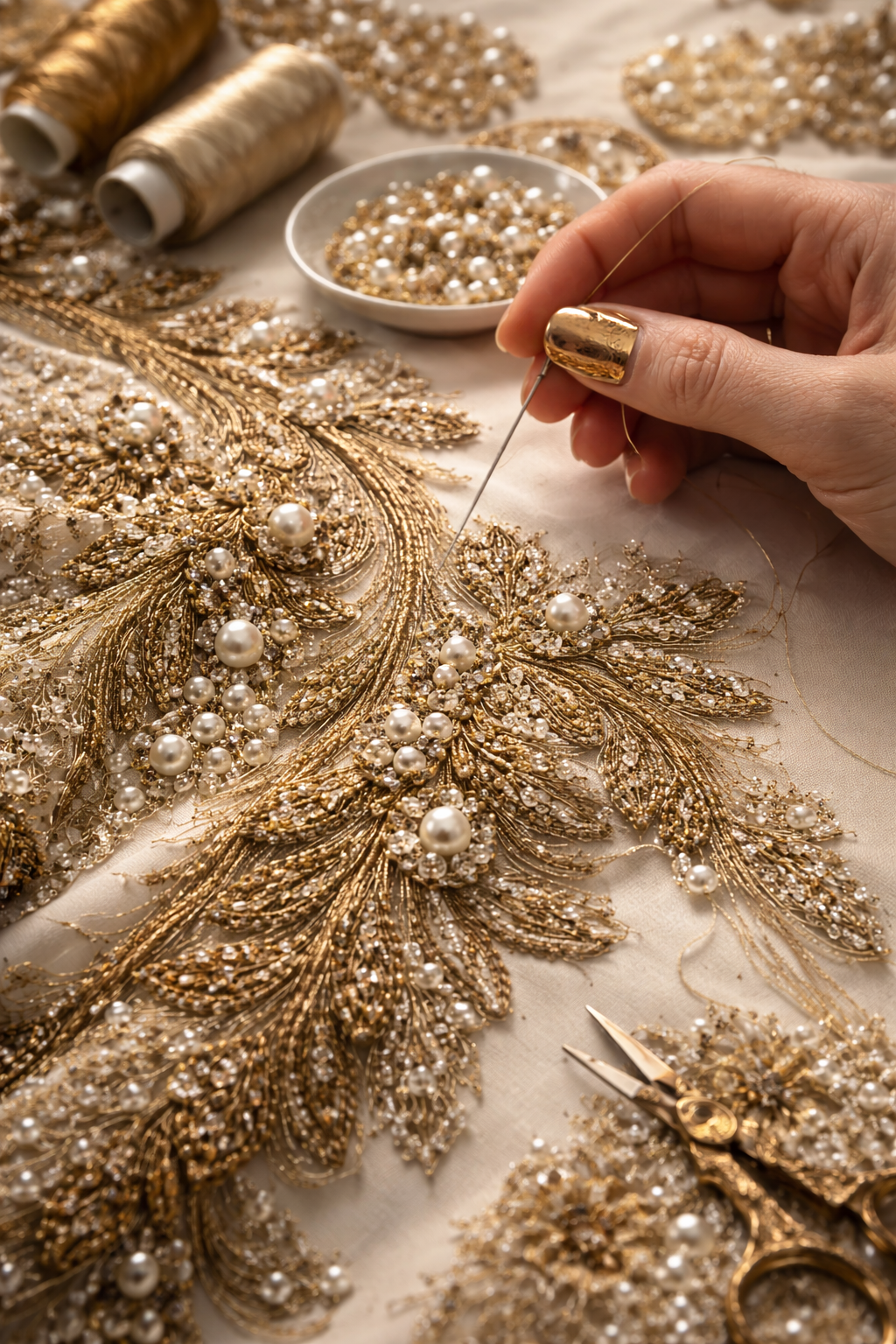
[IMAGE 2: Close-up detail of haute couture embroidery and textile craftsmanship showing hand-stitching, beadwork, and material quality that distinguishes London's heritage-focused designers. Alt text: "British fashion craftsmanship embroidery detail haute couture textile artistry London designer"]
The Returns: Established Voices Renewed
Temperley London at Twenty-Five
Alice Temperley's return to the London Fashion Week schedule after a six-year absence marks a significant moment for collectors who followed her brand's journey through the 2010s fashion landscape and subsequent restructuring. Founded in 2000, Temperley London built its reputation on ethereal gowns, bohemian detailing, and occasionwear that offered an alternative to structured continental formality—clothing that felt romantic without sacrificing sophistication.
The brand's trajectory illustrates realities that collectors should understand about the fashion industry's economic pressures. After building significant retail presence and celebrity following, Temperley navigated the challenging conditions that affected many independent designers in the post-2020 period. A 2023 sale of majority stake to Times Square Group LLC and the subsequent opening of a flagship at 134 Sloane Street in the former Façonnable space signal renewed investment and strategic repositioning.
The twenty-fifth anniversary presentation offers opportunity to assess how the brand has evolved while maintaining the feminine escapism that defined its original appeal. For collectors, anniversary moments often produce archivally significant pieces as houses revisit and reinterpret their foundational aesthetic languages. The intersection of heritage reflection and contemporary relevance creates collecting opportunities unavailable during normal commercial seasons.
Julien Macdonald: Glamour Revisited
Julien Macdonald's return after a three-year absence following the 2023 liquidation of his business represents the resilience and reinvention that characterizes fashion entrepreneurship. Known for body-conscious silhouettes and red-carpet glamour that attracted celebrity clientele throughout the 2000s and 2010s, Macdonald built a practice distinct from London's more intellectual design traditions—unabashed celebration of feminine display and technical virtuosity in stretch fabrics and embellishment.
His second collection under new creative direction, presenting Friday afternoon, offers collectors perspective on how established designers navigate business challenges while maintaining creative identity. The fashion industry's consolidation around major conglomerates has made independent designer survival increasingly difficult, yet Macdonald's return demonstrates that compelling creative vision can attract the investment necessary for continued operation.
For collectors interested in the full spectrum of British design rather than only its intellectual wing, Macdonald represents traditions of glamour and craft that have their own historical significance. The technical expertise required to construct figure-flattering garments using demanding stretch materials deserves recognition alongside conceptual ambition, and Macdonald's practice has influenced how the broader industry approaches eveningwear construction.
NEWGEN and Emerging Voices
The BFC's Talent Development Ecosystem
The British Fashion Council's NEWGEN program represents the most systematic talent development initiative among major fashion weeks, providing financial support, business mentoring, and schedule positioning that helps emerging designers transition from graduation to commercial viability. Understanding this ecosystem helps collectors identify creative voices during the early career phases when access and pricing remain favorable.
For February 2026, the NEWGEN showspace returns to 180 The Strand with a cohort including designers at various stages of development. The program's recipients span womenswear, menswear, accessories, and jewelry, creating a concentrated survey of emerging British design thinking that serious collectors can evaluate efficiently. While not every NEWGEN designer achieves commercial success or lasting cultural significance, the program's track record—alumni include Simone Rocha, Craig Green, and numerous other designers who have achieved international recognition—justifies attention to current participants.
The physical concentration of NEWGEN presentations enables collectors to observe multiple emerging practices within single days, comparing approaches to sustainability, craft, cultural reference, and commercial positioning that reveal how younger designers understand their relationship to both tradition and innovation.
Conner Ives: American Nostalgia Through British Lens
As the BFC/Vogue Designer Fashion Fund winner, Conner Ives brings distinctive perspective to British fashion through collections that filter American cultural references—cheerleader uniforms, vintage textiles, consumer product packaging—through London's experimental sensibility. His practice of reconstructing vintage American garments and incorporating found materials creates pieces with inherent narrative complexity: each dress carries histories from previous owners and contexts that inform its current meaning.
For collectors interested in sustainability, upcycling, and the integration of vintage materials into contemporary design, Ives demonstrates sophisticated approaches that avoid the earnest worthiness sometimes associated with eco-conscious fashion. His work maintains visual sophistication and conceptual engagement while genuinely reducing material consumption—a balance that resonates with collectors who care about environmental impact without sacrificing aesthetic quality.
His February 2026 runway presentation, following strong critical response to previous collections, offers opportunity to assess how his practice evolves as expectations and resources increase. The transition from emerging designer to established voice presents particular challenges; collectors can observe how Ives navigates the tension between the scrappy improvisation that defined early collections and the consistency expected of a funded, scheduled designer.
Chopova Lowena: Maximalism as Cultural Statement
Emma Chopova and Laura Lowena's collaborative practice produces collections that combine Bulgarian folk tradition with punk irreverence, creating maximalist garments that resist contemporary minimalism's commercial dominance. Their signature pleated skirts, elaborate embroideries, and bold color combinations create immediately recognizable visual identities that function as tribal markers for communities attracted to their aesthetic.
The label's presentation format and visual language have made it a favorite among photographers and street style documentarians, creating visibility that extends beyond industry insiders to broader cultural awareness. For collectors, this visibility raises questions about the relationship between social media prominence and lasting cultural significance—questions without easy answers but worth considering when evaluating emerging designers.
Chopova Lowena's integration of folk craft traditions with contemporary fashion production offers particular interest for collectors concerned with cultural heritage preservation. The designers' engagement with Bulgarian textile traditions positions their work within broader conversations about how fashion can support and transmit craft knowledge that might otherwise disappear.
[IMAGE 3: NEWGEN presentation space at 180 The Strand showing emerging designer collection with industry audience of buyers and press evaluating new talent. Alt text: "London Fashion Week NEWGEN emerging designers presentation 180 Strand British fashion talent"]
The Craft Tradition: Savile Row's Enduring Influence
Bespoke Heritage as Design Foundation
London Fashion Week's ready-to-wear presentations exist within a city whose design identity was fundamentally shaped by Savile Row's bespoke tailoring tradition. Even designers working in entirely different registers—flowing gowns, streetwear influences, avant-garde experimentation—operate in dialogue with the precision, construction quality, and client-centered ethos that the Row represents. Understanding this heritage helps collectors evaluate contemporary British design more sophisticatedly.
The bespoke tradition's emphasis on individual fit, achieved through extensive measurement, pattern cutting, and multiple fittings, establishes standards against which all British fashion is implicitly measured. Houses like Huntsman, Henry Poole, and Gieves & Hawkes, operating from Savile Row for over a century in some cases, preserve techniques that require fifty or more hours of hand labor per two-piece suit. This commitment to craft excellence creates reference points for quality evaluation that inform how collectors assess contemporary production.
The 2025 Met Gala's "Superfine: Tailoring Black Style" theme brought renewed attention to how tailoring traditions have been adapted and transformed by designers like Ozwald Boateng, who became the first Black designer to open a store on Savile Row in 1995. Boateng's color-saturated suits, drawing deliberately from Ghanaian Kente cloth while maintaining British structural foundations, demonstrate how heritage can be reinterpreted rather than merely preserved.
Contemporary Tailoring at Fashion Week
Several designers on the February 2026 schedule integrate tailoring traditions into contemporary ready-to-wear, creating work that bridges bespoke heritage and commercial fashion production. Joseph's return to the schedule brings a brand known for clean-lined tailoring that translates Savile Row principles into accessible price points. Harris Reed's gender-fluid approach to formal dressing reimagines what tailored garments can communicate about identity and self-expression.
The tension between bespoke's client-centered individualism and fashion week's presentation of collection pieces designed for multiple buyers creates productive creative challenges. Designers must translate the fit precision that defines bespoke excellence into standardized sizing while maintaining construction quality that honors tailoring traditions. For collectors, observing how different designers navigate this tension reveals their relationships to craft, commerce, and heritage.
Banshee of Savile Row's participation in recent London Fashion Weeks, presenting womenswear that applies traditional tailoring techniques to feminine silhouettes, illustrates how the Row's historically masculine focus is expanding. Their February 2025 "Interwoven" presentation at Messums Gallery, combining runway show with live painting by artist Eleanor Ekserdjian, demonstrated how contemporary tailoring houses integrate art collaboration into their practice.
Sustainability Requirements: The New Framework
Copenhagen Partnership and Minimum Standards
The British Fashion Council's partnership with Copenhagen Fashion Week to implement new Sustainability Requirements represents significant structural change for London Fashion Week's environmental accountability. Starting with the NEWGEN cohort and coming into full effect in January 2026, the framework establishes minimum standards requiring designers to address eighteen key sustainability considerations to remain on schedule.
For collectors concerned with environmental impact, this framework provides some assurance that scheduled designers have engaged with sustainability questions, even if implementation quality varies. The requirements do not guarantee genuinely sustainable production—fashion industry sustainability claims require careful evaluation—but they establish baseline expectations that distinguish London from fashion weeks lacking similar frameworks.
The partnership with Copenhagen, which pioneered sustainability requirements for fashion week participation, positions London within a network of progressive fashion capitals working to address the industry's environmental impact. Collectors can evaluate whether designers exceed minimum requirements, treating sustainability as genuine creative priority rather than compliance exercise.
The Digital Product Passport (DPP) requirements coming into full force across the EU and UK in 2026 provide collectors with unprecedented tools for verifying sustainable provenance. These mandatory digital records—accessible via QR codes or NFC chips embedded in garments—document material origins, manufacturing processes, supply chain participants, and environmental impact data throughout a product's lifecycle. For collectors building holdings with sustainability criteria, DPPs transform vague marketing claims into verifiable documentation, enabling the same due diligence rigor applied to artwork authentication. Forward-thinking designers showing at London Fashion Week are already integrating DPP infrastructure, recognizing that transparency will increasingly differentiate genuine sustainability practice from greenwashing.
Patrick McDowell and Demonstrative Practice
Patrick McDowell, winner of the Queen Elizabeth II Award for British Design, exemplifies how sustainability can function as creative catalyst rather than constraint. His collections demonstrate zero-waste pattern cutting, innovative material development, and supply chain transparency that set standards other designers might follow. For collectors, McDowell's work illustrates that environmental responsibility and aesthetic ambition can reinforce rather than compromise each other.
The visibility that awards and schedule positioning provide to designers like McDowell creates market signals about what values the industry recognizes and rewards. Collectors attentive to these signals can identify how sustainability is transitioning from niche concern to mainstream expectation, with implications for how all fashion will be produced and evaluated in coming years.
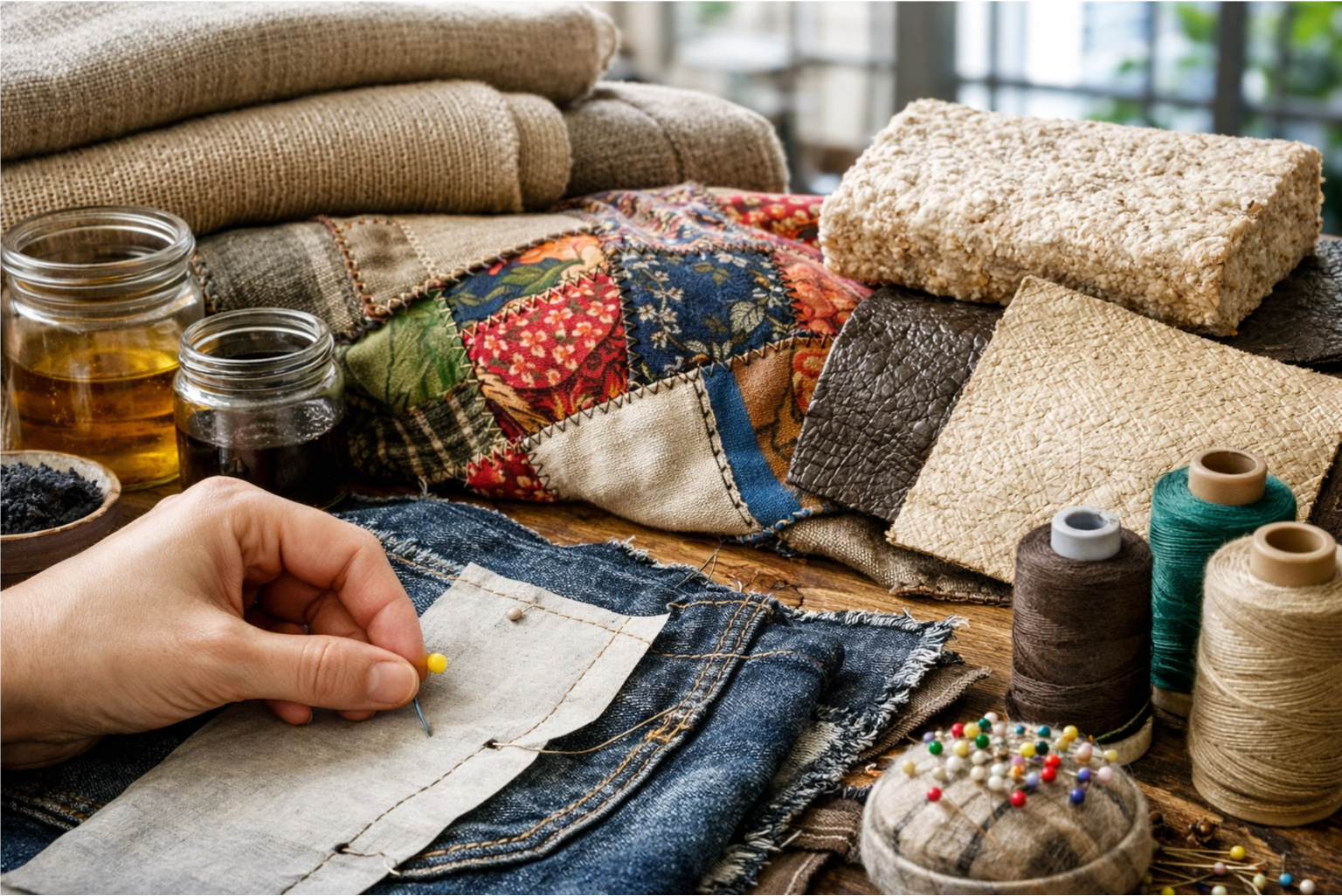
[IMAGE 4: Sustainable fashion materials and techniques showing organic textiles, upcycled elements, and environmentally conscious design approaches from London designers. Alt text: "Sustainable British fashion organic textiles upcycled materials eco-conscious London Fashion Week design"]
Collecting Frameworks for Fashion Week Observation
Fashion as Material Culture
Sophisticated collectors approach fashion week not as entertainment but as research into material culture that may merit preservation, investment, or simply understanding. Garments function as historical documents that record manufacturing techniques, material availability, cultural references, and aesthetic values specific to their moments of production. This documentary function gives fashion significance beyond its commercial or wearable purposes.
London Fashion Week's particular combination of heritage craftsmanship and experimental design creates material culture spanning multiple registers. A Burberry trench coat represents different historical and cultural meanings than a Chopova Lowena pleated skirt, yet both document their moments with equal validity. Collectors who understand these different documentary functions can build holdings that capture the full range of contemporary British design thinking.
The question of what to collect requires criteria that extend beyond personal taste to consider historical significance, craft quality, condition stability, and market recognition. Garments from designers who achieve lasting influence appreciate differently than those from designers who remain obscure; yet predicting which trajectory any emerging designer will follow proves difficult. Diversification across different designer profiles, aesthetic registers, and price points hedges against prediction errors.
Access and Acquisition Channels
Fashion week attendance, while primarily an industry event, offers collectors research opportunities that inform subsequent acquisition strategies. Understanding which designers generate the strongest critical response, observing how collections photograph versus how they appear in person, and noting quality differences between runway samples and eventual retail production all provide information relevant to collecting decisions.
Post-show acquisition operates through multiple channels with different access, pricing, and authentication characteristics. Direct relationships with designers or their studios sometimes enable access to runway samples or archive pieces unavailable through retail channels. Gallery exhibitions focusing on fashion increasingly provide acquisition opportunities within art world frameworks. Auction houses have developed fashion-specific expertise, with vintage and contemporary designer clothing achieving significant prices at Sotheby's, Christie's, and specialized fashion auction venues.
For contemporary pieces, retail remains the primary acquisition channel, though waiting lists, limited editions, and geographic restrictions create access challenges for certain designers and items. Understanding release strategies, maintaining relationships with relevant retailers, and monitoring secondary markets enables collectors to acquire desired pieces despite supply constraints.
Discover artists whose practices engage textiles, fashion, and material culture at Artestial, where collecting transcends medium boundaries to embrace the full spectrum of creative production, or connect with specialists for guidance navigating fashion's intersection with contemporary art.
Conclusion: British Design as Collecting Territory
London Fashion Week February 2026 presents a concentrated opportunity to observe British design excellence across its full range—from heritage houses maintaining centuries of craft tradition to emerging voices developing practices that may reshape how we understand clothing, textiles, and creative production. The city's particular combination of experimental ambition and heritage consciousness creates design thinking that influences global fashion while maintaining distinctively British character.
For collectors, the question is not whether fashion merits serious attention—the material, cultural, and economic significance of clothing production is too substantial to dismiss—but rather how to engage thoughtfully with an industry whose commercial pressures, trend cycles, and celebrity associations can obscure underlying creative and craft achievements. London's fashion week, with its emphasis on emerging talent, sustainability requirements, and heritage integration, offers entry points that favor collectors seeking substance over spectacle.
The designers presenting across the February 19-23 schedule represent the current state of British design thinking, but they also represent the beginning of collections that will circulate through markets for decades. Understanding who creates work of lasting significance, evaluating craft quality and material choices, and building relationships that enable preferred access requires the same due diligence that collectors apply to any cultural asset class.
British design excellence has shaped global aesthetics for centuries, from Savile Row tailoring that defined formal menswear to punk fashion that influenced contemporary streetwear. London Fashion Week provides concentrated access to the current generation of designers continuing and complicating these traditions. Collectors who engage seriously find not entertainment but genuine cultural production worthy of preservation and investment.
Ready to explore contemporary work engaging fashion, textiles, and material culture? Visit Artestial where artists working across traditional boundaries create pieces that reward serious collecting attention, or connect with specialists for guidance building collections that recognize fashion's place within broader creative practice.
Frequently Asked Questions
What distinguishes London Fashion Week from Paris, Milan, and New York for collectors interested in fashion as cultural production?
London Fashion Week's distinctive position derives from several structural factors that create different opportunities and challenges compared to other major fashion capitals. While Paris commands the largest concentration of heritage luxury houses backed by conglomerates like LVMH and Kering, and Milan anchors Italian manufacturing excellence with brands like Prada and Armani, London has historically functioned as the incubator where emerging talent develops before either building independent presence or being absorbed by larger houses elsewhere.
This incubator function creates particular opportunities for collectors interested in identifying creative voices during early career phases when access remains relatively open and pricing has not yet reflected market recognition. Designers who show in London often lack the corporate backing that enables elaborate production and global retail distribution, meaning collections remain smaller, relationships more direct, and archival pieces more accessible than equivalent moments in designer careers that unfold primarily in Paris or Milan.
The British Fashion Council's NEWGEN program systematizes this talent development in ways other fashion weeks lack, creating structured pathway from graduation through emerging designer support to established schedule positioning. Collectors who follow NEWGEN cohorts over multiple seasons observe how designers evolve, which practices prove sustainable, and which voices achieve the consistency that predicts lasting significance.
However, London's incubator position also means that some of its most successful designers eventually relocate primary operations elsewhere. Jonathan Anderson's appointment at Dior, Victoria Beckham's business restructuring, and various designers accepting positions at continental houses all illustrate how London develops talent that other fashion capitals capture. Collectors must evaluate whether to focus on designers likely to remain London-based or to use London as research into talent that will subsequently show elsewhere.
How should collectors evaluate sustainability claims from fashion designers, given widespread concerns about greenwashing?
Evaluating sustainability claims requires understanding the difference between marketing language and verifiable practice, a distinction particularly challenging in fashion where supply chain complexity, material science requirements, and commercial pressures create opportunities for exaggeration. The British Fashion Council's new Sustainability Requirements framework, developed in partnership with Copenhagen Fashion Week, establishes minimum standards that provide baseline accountability but do not guarantee genuinely sustainable production.
Collectors serious about environmental impact should look beyond compliance with minimum requirements to evidence of substantive commitment. This includes examining material sourcing transparency, where designers document specific suppliers and their environmental practices; production location disclosure, which reveals whether manufacturing occurs in facilities with labor and environmental accountability; and circular design consideration, which addresses what happens to garments at end of useful life.
Designers like Patrick McDowell, whose practice centers on zero-waste pattern cutting and innovative material development, demonstrate how sustainability can function as creative methodology rather than compliance exercise. His work provides comparison points for evaluating whether other designers' sustainability claims reflect genuine practice or marketing positioning. Similarly, labels like Chopova Lowena, which integrate heritage craft traditions that inherently involve smaller-scale, more careful production, offer models for sustainability achieved through traditional methods rather than technological innovation.
Certifications including Global Organic Textile Standard, OEKO-TEX, and B Corp status provide third-party verification that supplements designer claims, though collectors should research what each certification actually requires and guarantees. No certification system perfectly captures environmental and social responsibility, but they establish accountability frameworks that pure marketing language lacks.
What is the relationship between fashion collecting and traditional fine art collecting, and how should collectors think about building holdings that span both categories?
The relationship between fashion and fine art collecting has evolved considerably as institutions, auction houses, and collectors increasingly recognize clothing as cultural production worthy of serious attention. Museums from the Metropolitan Museum of Art to the Victoria and Albert Museum maintain significant costume collections and present fashion exhibitions that draw audiences comparable to fine art programming. This institutional recognition provides frameworks for understanding fashion's cultural significance while also influencing market structures and valuation.
For collectors building holdings across both categories, several considerations apply. Material stability differs significantly between fashion and traditional fine art—textiles deteriorate differently than canvas paintings or bronze sculpture, requiring specialized storage, conservation, and insurance approaches. Fashion's intimate relationship with the body creates wear patterns that affect condition evaluation differently than damage to paintings or sculpture. Edition structures and authentication systems in fashion lack the standardization that exists in printmaking or sculpture multiples, requiring collectors to develop fashion-specific expertise.
However, connections between fashion and fine art create collecting opportunities that neither category alone provides. Designer collaborations with visual artists—Erdem Moralioglu with Kaye Donachie, Louis Vuitton with various contemporary artists, Comme des Garçons' sustained engagement with art world presentation formats—produce work that exists between categories and may be undervalued by collectors focused exclusively on either. Textile art practices that blur fashion and fine art boundaries, from Magdalena Abakanowicz's fiber sculptures to contemporary practitioners working in both gallery and fashion contexts, offer investment opportunities that conventional art market tracking may miss.
Collectors can approach cross-category holdings strategically, building positions in designers whose art world connections suggest potential for institutional recognition and market appreciation that follows fine art rather than fashion market dynamics. This strategy requires research into designer backgrounds, exhibition histories, and critical discourse positioning that goes beyond typical fashion media coverage.
How do Savile Row traditions influence contemporary London fashion, and what should collectors understand about British tailoring heritage?
Savile Row's influence on contemporary London fashion operates through multiple channels—direct lineage where designers trained in tailoring apply those skills to different contexts; indirect influence where tailoring's precision and construction standards establish quality expectations against which all British fashion is measured; and cultural reference where Savile Row's associations with British identity inform how designers engage heritage in their work.
The bespoke tradition that Savile Row represents involves construction methods fundamentally different from contemporary fashion production. A bespoke suit requires fifty or more hours of hand labor, multiple fittings to achieve individual fit, and materials selected for the specific client's needs and preferences. This client-centered, craft-intensive approach establishes reference points for quality that influence how collectors evaluate contemporary production, even when that production operates through entirely different methods.
Understanding tailoring heritage helps collectors recognize construction quality that distinguishes exceptional contemporary fashion from competent but unremarkable production. How jackets are canvassed, how seams are finished, how patterns account for body movement—these technical considerations determine whether garments maintain appearance and structure over time or deteriorate with wear. Collectors who can evaluate construction quality make better acquisition decisions and build holdings with greater durability.
The Row's evolution also provides historical context for understanding how British design identity has been constructed and reconstructed. The "New Bespoke Movement" of the 1990s, led by designers including Ozwald Boateng, Richard James, and Timothy Everest, reimagined Savile Row's stuffy associations through color, cut, and client diversification. Contemporary designers from Harris Reed to Grace Wales Bonner engage tailoring traditions from different angles, questioning what formal dressing means for contemporary identity. This ongoing dialogue between heritage and innovation characterizes British fashion generally and provides collectors entry points for understanding how tradition functions in contemporary creative practice.
What practical considerations should collectors address when acquiring contemporary fashion, from authentication to storage to insurance?
Fashion collecting presents practical challenges distinct from traditional fine art that collectors must address to protect their acquisitions. Authentication operates differently in fashion than in art, with fewer established authentication bodies and more reliance on provenance documentation, retailer relationships, and condition evaluation. Designer archives sometimes provide authentication services, but practices vary; some houses maintain extensive records while others have incomplete documentation of their own production histories.
Storage requirements for fashion typically exceed those for paintings or sculpture due to textile sensitivity to light, humidity, temperature fluctuation, and pest damage. Professional textile storage involves climate-controlled spaces, acid-free materials for hanging and boxing, and periodic inspection for condition changes. Collectors with significant fashion holdings may need dedicated storage solutions comparable to those required for temperature-sensitive fine art.
Insurance for fashion collections requires policies that understand the category's specific characteristics. Standard fine art policies may not adequately cover fashion's different damage profiles, depreciation patterns, or authentication challenges. Specialized insurers with fashion expertise can develop coverage appropriate to the actual risks collectors face, though finding such expertise may require research beyond typical fine art insurance providers.
Condition documentation at acquisition proves essential for later authentication, insurance claims, or resale. Detailed photography capturing construction details, label placement, material characteristics, and any existing wear or damage creates records that establish baseline condition. Professional condition reports from textile conservators, while adding acquisition cost, provide authoritative documentation that can prove valuable when pieces change hands.
Ready to explore contemporary work that engages fashion, material culture, and textile traditions? Visit Artestial where artists working across boundaries create pieces that reward serious collecting attention, or connect with specialists for guidance building collections that recognize fashion's place within broader creative practice.
Curating excellence, one insight at a time.
— AURUM Team
Disclaimer: This article provides cultural commentary and educational analysis about London Fashion Week and British fashion for informational purposes only. It does not constitute professional advice regarding investment decisions, fashion acquisition, insurance, conservation, or authentication. Fashion collecting involves risks including condition deterioration, authentication challenges, and market value fluctuation that collectors should evaluate with appropriate professional guidance. Designer career trajectories and market recognition cannot be reliably predicted; collecting decisions should reflect personal values and risk tolerance rather than investment expectations alone. Schedule information reflects provisional announcements as of February 2026 and may change; readers should verify event details through official British Fashion Council sources. Sustainability claims referenced require independent verification; this article does not endorse or validate specific environmental practices. No financial relationships exist between the author or publication and mentioned designers, brands, venues, or organizations. All observations represent analytical perspective as of February 2026 and may not apply to future developments or specific individual circumstances.