

The art advisor stood before a 1937 Talbot-Lago T150-C SS Teardrop Coupe, studying its curves with the same intensity she applied to Brancusi sculptures. "Look at that roofline," she told her client, a Manhattan collector with $50 million in contemporary art. "Figoni & Falaschi treated metal like Giacometti treated bronze—pure sculptural vision."
They were at Pebble Beach Concours d'Elegance, but the conversation could have occurred at Art Basel. The car—valued at $7 million—would find garage space alongside her client's Basquiat and a Kusama. The decision reflected broader shifts among sophisticated collectors who increasingly view exceptional automobiles not as transportation or a mere hobby, but as mobile sculpture deserving serious capital allocation.
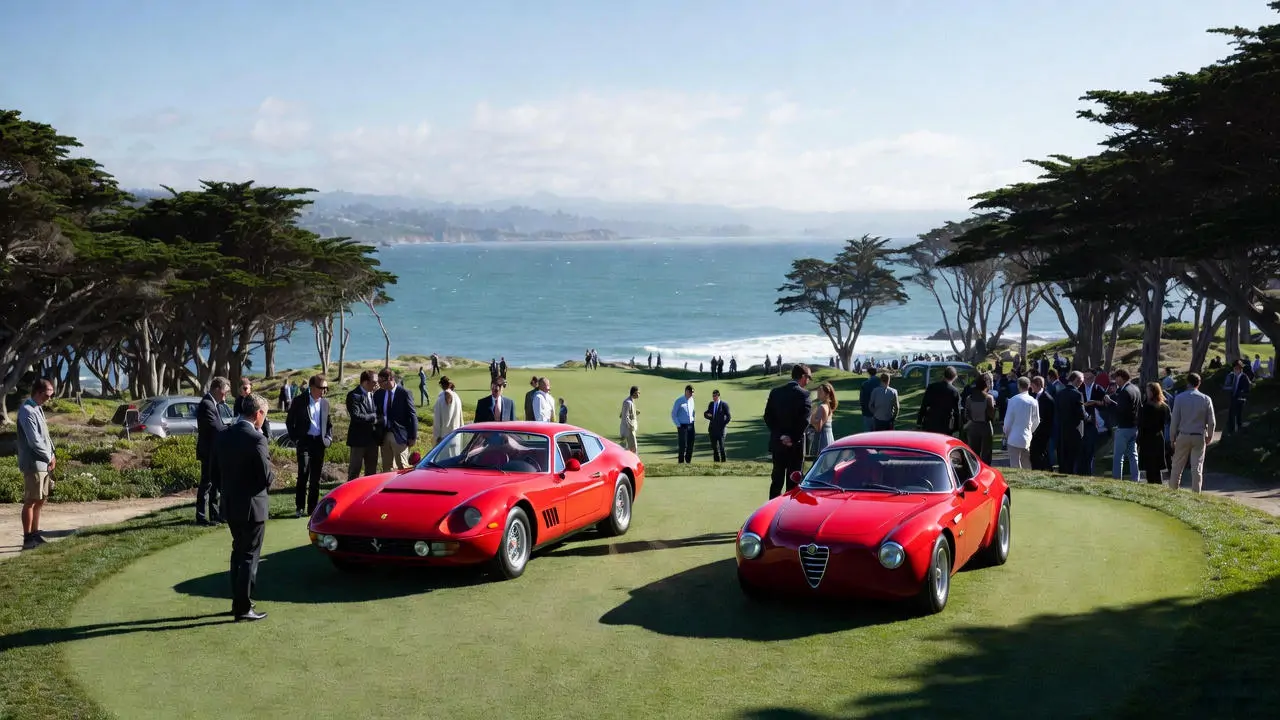
Pebble Beach Concours d'Elegance marks its 75th anniversary on August 16, 2026, celebrating three-quarters of a century as the world's premier automotive elegance competition. Ferrari takes center stage as featured marque, with Ferrari legends, Vignale-bodied masterpieces, and new classes honoring everything from pre-WWI American Speedsters to Japanese endurance racing greats. For collectors who understand art market dynamics, the anniversary presents opportunities to study automotive craftsmanship at its apex while reconsidering classic cars' role in diversified alternative asset portfolios.
The Pebble Beach Phenomenon: Where Automotive Art Achieves Museum Status
The Pebble Beach Golf Links 18th fairway transforms each August into what insiders call the automotive equivalent of a museum retrospective. Approximately 200 vehicles, selected from thousands of applicants, line the legendary hole with the Pacific Ocean as a backdrop. Experts judge elegance, technical merit, and historical significance. Best of Show—the pinnacle achievement—carries weight comparable to major art prizes.
The 2025 event saw a 1924 Hispano-Suiza H6C Nieuport-Astra Torpedo claim top honors, shown by collectors from Naples, Florida. This aero-inspired masterpiece exemplifies what draws sophisticated investors—sculptural coachwork, documented provenance, mechanical excellence, and historical significance converging in single vehicles commanding eight-figure valuations.
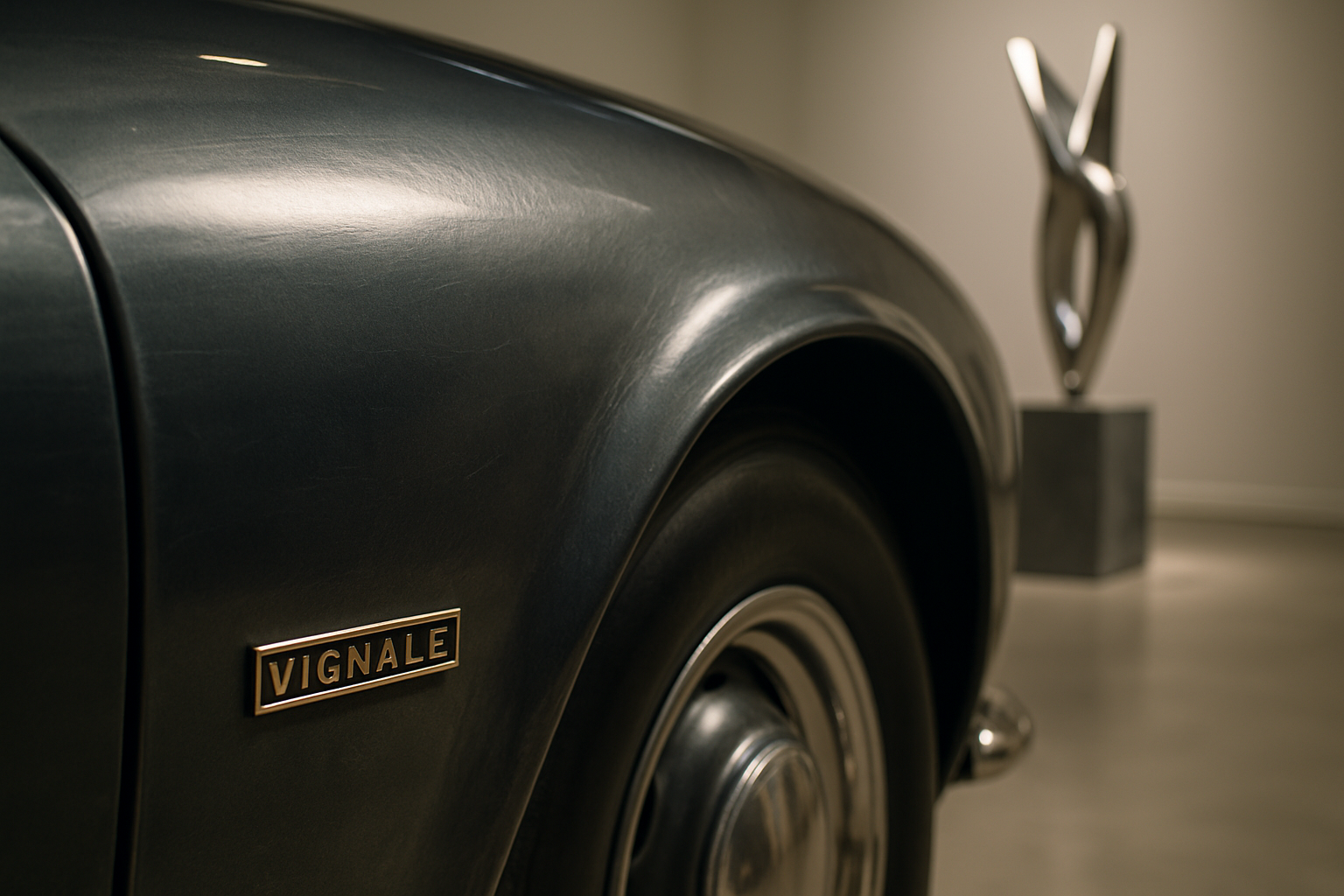
The 2026 diamond jubilee promises exceptional presentations. Ferrari's overall Le Mans winners and NART competition cars showcase a racing pedigree. Carrozzeria Alfredo Vignale receives featured coachbuilder recognition, highlighting the la dolce vita elegance that defined postwar Italian design. New classes debut: Early American Speedsters celebrating Mercer Raceabout and Stutz Bearcat minimalism, Classic Streamliners honoring 1930s aerodynamic marvels, and Japanese Motorsports spotlighting endurance racing heritage.
Beyond competition, Pebble Beach functions as a marketplace. Manufacturers debut concepts and production models. Collectors negotiate private transactions worth tens of millions. Auction houses—RM Sotheby's, Gooding & Company, Bonhams—schedule sales during Monterey Car Week, collectively generating $400+ million annually. The ecosystem mirrors Art Basel's commercial integration with cultural celebration.
The Investment Thesis: Why Classic Cars Outperformed Equities
Classic car values surged 185% over the past decade, according to Knight Frank's 2023 Wealth Report—outpacing wine, watches, and art. The global market reached $31.6 billion in 2022, projecting $51.3 billion by 2028 at an 8.7% CAGR.
From 2012-2022, classic cars appreciated at consistent double-digit annual rates with maximum annual drawdowns averaging only 5%—remarkable stability for alternative assets. The Hagerty Price Guide Index shows models like the Ferrari 250 GTO appreciated 8% annually over ten years.
During the 2008 crisis, classic cars recovered within two years. Their performance shows low correlation with stocks, bonds, and gold. Like luxury art, they exhibit a positive correlation with inflation—functioning as wealth preservation vehicles.
UHNWI population grows 30-50% every five years, creating sustained demand against fixed supply. McKinsey research identifies transparency advantages over art—cars carry unique chassis numbers, public registration, and extensive provenance documentation, providing valuation benchmarks.
Explore investment-grade contemporary art at Artestial, where rigorous authentication and provenance standards mirror best practices in classic car collecting.
The Big Three Marques: Ferrari, Porsche, Mercedes-Benz
Investment-grade classic car collecting centers on manufacturers whose heritage, engineering excellence, and racing provenance drive sustained demand. Understanding their distinct characteristics helps collectors build balanced portfolios.
Ferrari: Racing Heritage Commands Premium Returns
Ferrari dominates Pebble Beach 2026 as the featured marque for sound reasons. The prancing horse holds ten Best of Show victories—tied for most with Mercedes-Benz. Models like 250 GTO, 250 GT California Spider, and 288 GTO command eight-figure valuations while maintaining liquidity rare among collectibles.
The 1962 Ferrari 250 GTO that sold for $48.4 million in 2018 exemplifies Ferrari's investment ceiling. Even "accessible" Ferraris—1970s Daytonas, 1980s Testarossas—show strong appreciation. The brand's Formula One dominance, limited production numbers, and meticulous factory support create ideal conditions for value retention.
Ferrari's Classiche certification program provides factory authentication and restoration guidance, maintaining provenance integrity essential for resale. Collectors benefit from an organized community, extensive documentation, and a global service network. Entry points range from $200,000 for 1980s models to eight figures for competition history examples.
Porsche: Engineering Excellence Meets Accessibility
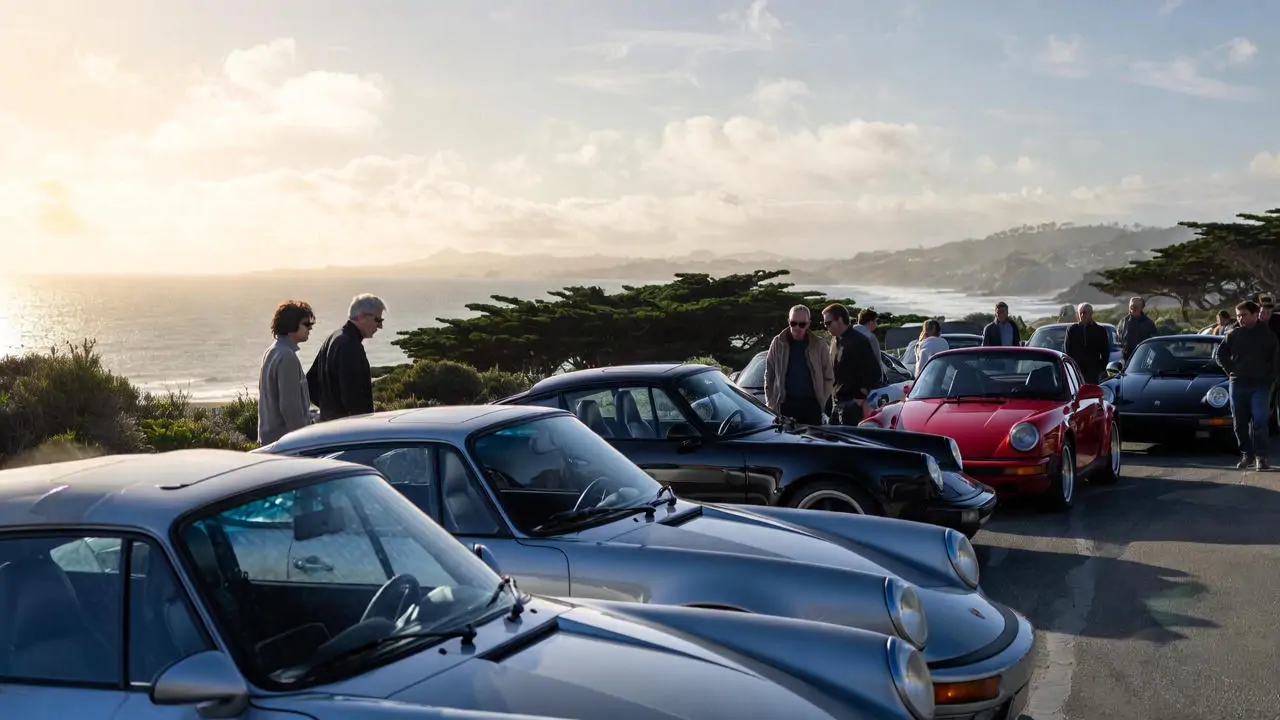
Porsche's air-cooled 911 variants represent blue-chip investments across price points. The 1973 911 Carrera RS 2.7, early 911 Turbos, and limited production variants like 1988's Carrera Club Sport appreciate steadily. Unlike ultra-exclusive Ferraris, Porsche production volumes create depth supporting active trading.
The Stuttgart manufacturer's racing pedigree—Le Mans victories, rally championships, endurance records—adds historical significance. Collector interest spans generations, with younger enthusiasts entering through 1990s-2000s models now qualifying as "modern classics." This demographic expansion supports long-term demand.
Porsche's investment case includes manageable maintenance costs relative to exotic competitors. Independent specialists supplement factory support, reducing service expenses. Parts availability exceeds most manufacturers. These practical advantages suit collectors seeking enjoyment alongside appreciation.
Mercedes-Benz: German Engineering as Art
Mercedes-Benz ties Ferrari with ten Pebble Beach Best of Show victories, reflecting Stuttgart's commitment to engineering as an art form. The 300 SLR Uhlenhaut Coupé that sold for $143 million in 2022 set the all-time automotive record—surpassing any art sale except da Vinci's Salvator Mundi.
Pre-war Mercedes models—540K Special Roadsters, supercharged SSKs—exemplify coachbuilt craftsmanship commanding seven-figure valuations. Post-war 300 SLs, both Gullwing and Roadster variants, represent accessible entry points at $1-3 million while maintaining investment-grade status.
The brand's comprehensive Classic Center network provides authentication, restoration, and documentation superior to most manufacturers. This infrastructure supports provenance integrity, crucial for institutional investors and high-net-worth collectors treating cars as portfolio components rather than toys.
Automotive Collecting Parallels Fine Art Investment
The convergence between art and automotive collecting extends beyond metaphor. Both fields reward deep connoisseurship—the ability to distinguish exceptional examples from merely excellent ones. Both demand patience, as museum-quality pieces rarely surface. Both offer communities of passionate experts whose knowledge sharing elevates collective expertise.
Collectors building significant art holdings often extend curatorial instincts to automobiles. Thematic collecting might emphasize specific coachbuilders, particular racing eras, or technological innovations. Display considerations mirror art presentation—proper lighting, climate control, security systems, and transforming garages into private museums.
Authentication protocols overlap meaningfully. Art due diligence examines provenance chains, restoration histories, and expert opinions. Automotive authentication verifies chassis numbers, matching numbers analysis, and competition histories. Both combat sophisticated forgeries threatening market integrity. Major auction houses employ specialists in each field applying similar investigative rigor.
The psychological rewards align equally. Exceptional automobiles deliver aesthetic pleasure through visible craftsmanship—hand-formed coachwork, jewel-like instrumentation, perfectly executed mechanical systems. Like contemplating important artworks, experiencing significant cars provides daily engagement with masterful human achievement.
Market infrastructure is increasingly merging. Sotheby's, Christie's, and Bonhams maintain automotive departments alongside art divisions. Collectors work with advisors specializing in both categories. Family offices allocate capital across art, cars, wine, and watches using unified alternative asset strategies. Insurance providers offer packages covering diverse collections through single policies.
The 2026 Pebble Beach Classes: What Collectors Watch
Specific featured classes at Pebble Beach 2026 signal market direction and collecting opportunities. Understanding these categories helps investors identify emerging appreciation potential before mainstream recognition drives premiums.
Early American Speedsters (Pre-WWI) celebrate minimalist performance machines like the Mercer Raceabout and the Stutz Bearcat that defined the American sporting spirit. These brass-era vehicles represent automotive's transition from transportation to performance, with racing provenance examples commanding $500,000-2 million. Limited survival numbers create scarcity, supporting values.
Classic Streamliners spotlight 1930s aerodynamic masterpieces merging form with function into futuristic designs. Think Bugatti Type 57SC Atlantic, Delahaye 165, Talbot-Lago Teardrop Coupes—sculptural achievements comparable to Art Deco architecture. Values range $3-15 million for exceptional examples, with Pebble Beach recognition often catalyzing appreciation.
Ferrari Le Mans Winners and NART Competition Cars showcase racing heritage at the premium. Competition provenance multiplies values—$2 million road cars become $10+ million with documented race history. NART (North American Racing Team) Ferraris carry particular cachet among American collectors, combining Italian engineering with American motorsport heritage.
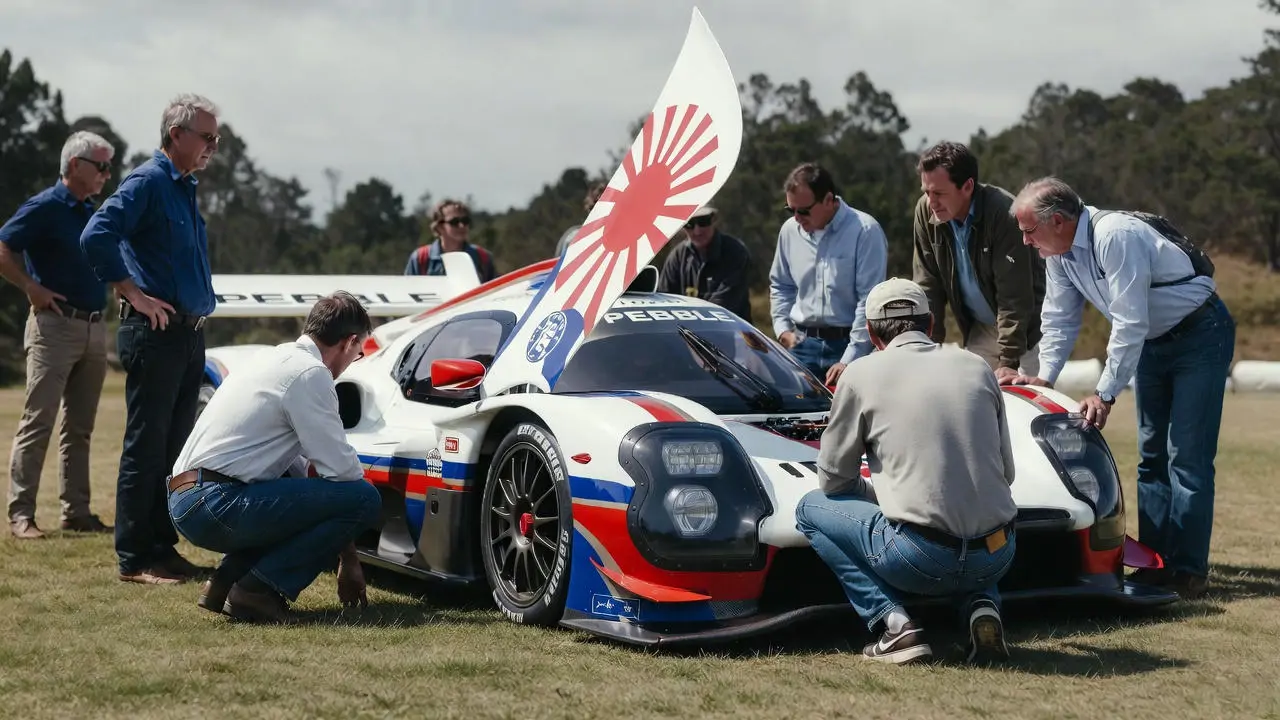
Japanese Motorsports: Rising Sun at Le Mans represents an emerging category with significant upside potential. Mazda 787B Le Mans winner, Nissan R390 GT1, Toyota TS010—these technological marvels attracted limited Western collecting attention historically. Younger collectors with different cultural references and appreciation for Japanese engineering drive growing demand, suggesting an appreciation runway.
The Pebble Beach Road Racing Greats class honors Phil Hill, Carroll Shelby, and the pioneers who established a regional motorsport legacy. Cars with documented racing histories at vintage Pebble Beach races or nearby Laguna Seca carry premiums reflecting historical significance. Provenance research identifying these connections adds value to seemingly ordinary examples.
Market Dynamics: Timing and Acquisition Strategy
Classic car markets experience cycles requiring strategic timing. Pandemic speculation saw certain models double in six months. Correction followed—values declined 20-30% from peaks before stabilizing around sustainable levels in 2026.
Current conditions favor educated collectors. Quality examples trade on fundamentals—rarity, condition, provenance. Several acquisition channels serve collectors:
Pebble Beach week auctions offer premier examples with expert vetting. RM Sotheby's, Gooding & Company, and Bonhams provide authenticated inventories. Premiums add 10-15% but reputation justifies costs for significant purchases.
Private transactions through specialists like Hexagon Classics or Fiskens offer confidential acquisitions without public exposure. Negotiation flexibility and privacy suit certain buyers.
Online platforms like Bring a Trailer improved transparency through detailed photography and community commentary. Lower transaction costs suit $50,000-$500,000 purchases.
Build diversified alternative asset portfolios at Artestial, where art and automotive collecting converge through shared emphasis on provenance and craftsmanship.
Due Diligence and Authentication
Automotive investment demands rigorous verification. Unlike art, where condition remains relatively static, cars represent mechanical systems requiring proper function alongside aesthetic presentation. Matching numbers—original engine, transmission, rear axle, matching chassis—dramatically affect values. Non-matching examples trade 30-50% below identical matching cars.
Professional pre-purchase inspections prove essential. Specialists examine structural integrity, mechanical condition, restoration quality, and authenticity. Costs range $1,000-5,000 depending on thoroughness, but pale against the downside risk of undetected issues. For six-figure purchases, multiple expert opinions provide a valuable perspective.
Documentation research confirms provenance. Factory build sheets, original ownership records, service histories, and prior sale documentation—complete archives support premium valuations. Gaps raise concerns about hidden issues or authenticity questions. Professional historians specialize in marque-specific research, charging $2,000-10,000 to compile comprehensive vehicle histories.
Restoration quality profoundly impacts value. Concours-level restorations costing $300,000-1 million for complex classics command significant premiums. Conversely, substandard work destroys value. Evaluating restoration requires expertise—paint thickness measurements, metallurgical analysis, and parts authenticity verification. Collectors often engage specialists charging $5,000-20,000 for thorough assessments before significant purchases.
Essential Questions Automotive Collectors Ask
How does classic car investment compare to art in terms of returns and risk?
Classic cars appreciated 185% over the past decade, versus art's varying performance by category—old masters, contemporary, and emerging markets show different trajectories. Cars demonstrate lower maximum drawdowns (5% annually) than art market segments during corrections. However, cars incur ongoing costs (storage, insurance, maintenance) typically 5-6% annually, while art storage costs less. Liquidity favors art for sub-$1 million pieces but evens at ultra-premium levels, where both require specialist buyers. Diversification benefits suggest holding both rather than choosing between them.
What's the minimum realistic investment for meaningful classic car collecting?
Entry points begin around $50,000 for investment-grade examples—1980s Porsche 911s, early Datsun Z-cars, or BMW M3s showing appreciation potential. Serious collectors typically start $150,000-300,000, acquiring single exceptional vehicles or multiple mid-tier examples. Institutional-quality portfolios begin $1-2 million, enabling diversification across marques and eras. Unlike art, where entry can be lower, automotive investment demands capital for proper storage, insurance, and maintenance infrastructure.
How liquid is the classic car market compared to art?
Liquidity varies dramatically by value tier. Blue-chip Ferraris, Porsches, and Mercedes models trade actively with typical selling periods of 3-6 months at fair prices. Exotic rarities may require 12-18 months to locate motivated buyers willing to pay full value. This matches mid-tier art liquidity, where $100,000-2 million pieces sell reasonably quickly, while ultra-premium works require patience. Emergency liquidations rarely achieve optimal pricing in either market. Plan minimum 5-year holding periods for serious investment positions.
Should I focus on preservation cars or restored examples?
Market trends favor both depending on rarity and condition. Preservation cars—original, unrestored examples—command premiums for authentic patina and originality. A preserved Ferrari worth $3 million might cost $4+ million versus a comparable restored example. However, preservation only works for exceptional survivors. Poorly preserved equals neglected, which destroys value. High-quality restorations suit most collectors, offering usability and pride of ownership while maintaining investment potential. Diversified portfolios might hold 70% restored, 30% preservation examples.
How do I protect automotive investments through insurance and storage?
Specialized collector car insurance from providers like Hagerty, Grundy, or American Modern offers agreed-value coverage—the insurer pays a predetermined amount regardless of market fluctuations. Annual premiums run 1-2% of insured value. Climate-controlled storage (60-70°F, 50% humidity) prevents deterioration—budget $200-500 monthly per vehicle, depending on location and security level. Battery maintainers, tire care, and periodic engine starts prevent mechanical issues. Documentation photographs, condition reports, and appraisals should be updated annually, protecting against disputes during claims.
The Future Intersection of Automotive and Art Collecting
Pebble Beach's 75th anniversary occurs amid broader shifts in luxury collecting. Younger collectors bring different perspectives—appreciating Japanese performance cars alongside Italian exotics, valuing driving experience equal to static beauty, embracing technology while respecting tradition.
The electrification of new vehicles paradoxically strengthens classic car appreciation. As combustion engines disappear from showrooms, vintage examples become cultural artifacts preserving mechanical artistry and analog driving experiences. This scarcity premium mirrors photography's value increase as digital technology replaced film—the displaced technology gains historical significance and collector demand.
Fractional ownership platforms like Rally and Collectable democratize access, allowing $500 investments in $500,000 cars. These structures suit younger collectors building expertise before committing six figures. Success could expand the collector base significantly, supporting long-term demand as participants graduate to whole-car ownership.
For collectors who understand art market dynamics, classic cars offer compelling diversification. Tangible assets you can drive occasionally. Mechanical marvels representing human ingenuity. Financial instruments appreciating alongside aesthetic pleasure. Museum-quality examples anchoring collections spanning art, watches, wine, and automobiles—unified by craftsmanship, provenance, and cultural significance.
The Manhattan art collector who commissioned that Talbot-Lago study? She purchased it for $7.2 million three months after Pebble Beach 2025. The car sits in a climate-controlled garage alongside her Basquiat, Kusama, and a Patek Philippe Nautilus. She drives it twice yearly to vintage rallies, enjoying experiences her paintings never provide. The investment thesis combines financial appreciation with experiential return—the ultimate luxury alternative asset strategy.
Curating excellence, one insight at a time.
— AURUM Team
Disclaimer: This article is for informational purposes only and does not constitute financial, investment, or tax advice. Classic car markets fluctuate based on multiple factors, including economic conditions, collector preferences, and vehicle condition. Past performance does not guarantee future returns. Storage, maintenance, insurance, and restoration costs significantly impact net returns. Consult qualified financial advisors and automotive specialists before making significant investment decisions. Observations reflect industry knowledge as of early 2026 and may not apply to specific situations.