

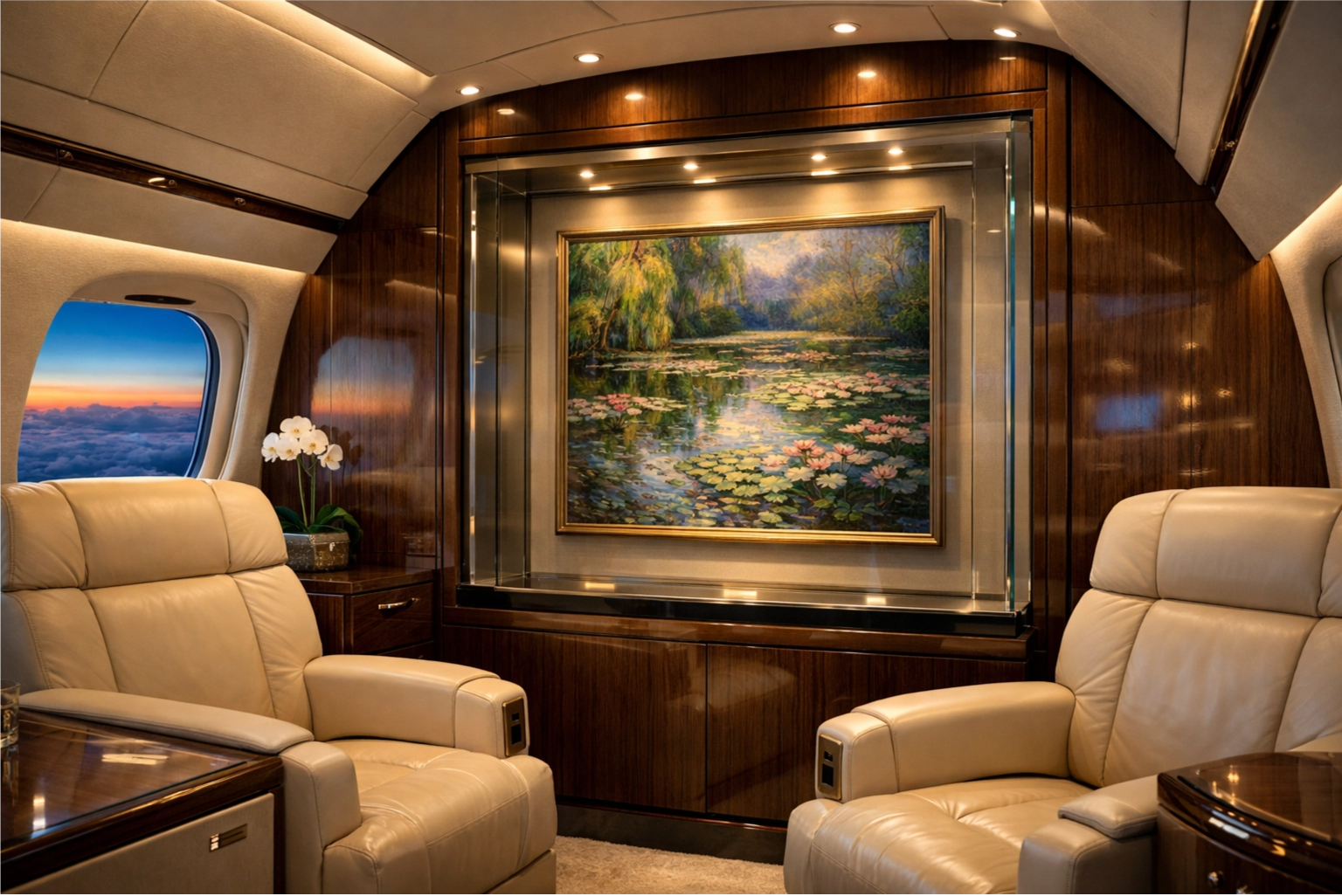
The collector examining aviation completion center portfolios from Winch Design, Jet Aviation Basel, or AMAC Aerospace—featuring museum-quality LED lighting systems, temperature-stabilized zones, and consultation services from specialists understanding both art conservation and aerospace engineering—understands what commercial aviation passengers miss: for individuals traveling 200+ hours annually on private aircraft, cabin environments function as extensions of primary residences—living spaces requiring same aesthetic consideration, comfort standards, and yes, art curation that ground-based homes receive.
This isn't mere vanity or status display (though those motivations certainly exist). The most sophisticated aircraft owners approach cabin design as spatial problem-solving: how to create psychologically restorative environments within metal tubes traveling 600 mph at altitudes where outside temperature reaches -60°F, air pressure requires constant adjustment, and every pound of weight impacts fuel efficiency and range. Art plays crucial functional role here—providing visual interest that combats monotony, creating emotional anchors during extended flights, establishing personal identity in otherwise standardized spaces.
The UAE market exemplifies this evolution particularly well. With Dubai and Abu Dhabi serving as global aviation hubs (Dubai International handling 87 million passengers annually pre-pandemic, recovering to 86.9 million in 2023) and the region hosting highest per-capita concentration of ultra-high-net-worth individuals globally (approximately 250,000 residents worth $30M+), demand for bespoke aircraft interiors has created entire sub-industries. Jetex, Empire Aviation, and ExecuJet maintain dedicated completion centers in the Emirates specifically serving Middle Eastern, South Asian, and African clients requiring culturally appropriate design incorporating Islamic geometric patterns, Arabic calligraphy art, and climate considerations for frequently flying between temperature extremes.
As we move through 2026, understanding private aviation's art dimension requires examining not Instagram-worthy cabin photos but practical realities: structural limitations restricting what can actually be installed, conservation challenges at cruising altitude, regulatory requirements for fire safety and emergency egress, insurance complexities for works in transit, and most importantly—whether mobile art installations enhance collecting practice or merely represent expensive transportation of static works that would be better appreciated in controlled gallery environments.
Explore aviation-inspired contemporary art at Artestial, where sophisticated collectors find works capturing movement, technology, and luxury aesthetics transcending any single location.
The Aircraft as Canvas: Design Possibilities and Practical Constraints
Private jet interiors occupy unique design space operating under dramatically different constraints than residential or gallery environments, creating both limitations and opportunities for art integration.
Structural Realities of Aircraft Design
Commercial aircraft cabins measure approximately 7.5-8 feet wide by 6.5-7 feet tall; even the largest purpose-built business jets like Boeing Business Jet (BBJ) conversions max out around 11-12 feet width with 7-8 feet ceiling heights in main cabin areas. These dimensions immediately eliminate wall-mounted works exceeding roughly 4x3 feet and any floor sculptures taller than 6 feet or requiring substantial footprint.
Weight presents even more severe limitation. FAA and EASA regulations require certification of all cabin modifications, with every added pound reducing either passenger capacity, fuel range, or cargo allowance. A single oil painting with heavy wooden frame might weigh 40-60 pounds; ornate sculpture could exceed 100 pounds. For perspective, Gulfstream G650ER's maximum takeoff weight of 103,600 pounds includes structure, fuel, passengers, baggage, and cabin furnishings—every decorative element competes with practical payload.
This creates interesting design challenge: how to achieve visual impact while minimizing weight? Solutions include:
Lightweight materials prioritization—Contemporary works on aluminum panels rather than traditional stretched canvas with wood frames, LED light installations instead of heavy bronze sculptures, digital displays replacing framed photographic prints. Aviation design studios like Greenpoint Technologies (serving Boeing completions) and PJCC (Embraer specialists) maintain relationships with contemporary artists working specifically in aerospace-grade materials: titanium sculptures, carbon fiber panels, aerospace aluminum installations.
Built-in integration replacing freestanding works—Rather than hanging framed pieces on cabin walls, highest-end completions incorporate art directly into aircraft structure. Winch Design's $80 million BBJ project featured custom marquetry panels (intricate wood inlay depicting client's estates and yachts) laminated directly onto composite bulkhead panels, adding minimal weight while creating permanent installation. Jet Aviation Basel completed ACJ319 featuring backlit LED "sky ceiling" panels programmed to display changing cloudscapes, constellation patterns, and abstract color fields—digital art installation that weighs less than equivalent traditional ceiling panels.
Multi-functional art elements—Sophisticated completions blur boundaries between art and functional cabin components. PJCC's Lineage 1000 designs integrate translucent stone panels (backlit onyx, jade, agate) as both illuminated room dividers and art installations. Alberto Pinto Studio's Gulf
stream G650 concepts feature sculptural credenzas and coffee tables by contemporary designers (Marc Newson, Zaha Hadid Studios) serving as both functional furniture and collectible design objects. Privacy screens become canvases for Arabic calligraphy or geometric patterns executed in precious metals and semi-precious stones.
Conservation Challenges at Altitude
Climate conditions inside pressurized aircraft cabins at cruise altitude (typically 35,000-45,000 feet) present unique conservation challenges absent from ground-based galleries.
Pressure fluctuation effects—While cabin pressurization maintains approximately 8,000-foot altitude equivalent (pressure around 10.9 psi versus 14.7 psi at sea level), rapid ascent/descent cycles subject artworks to regular pressure changes. Oil paintings on stretched canvas experience subtle dimensional shifts as canvas tautness responds to pressure variations. Over hundreds of flights, these micro-movements can accelerate crazing (fine cracking in paint layers) or canvas stress.
Museum-quality installations address this through rigid substrate mounting (painting transferred to aluminum honeycomb panels eliminating canvas flexibility) or climate-controlled display cases maintaining constant pressure differential. The latter approach—essentially miniature pressure chambers—appears in ultra-high-end completions but adds significant weight (pressurized cases require thick acrylic or glass, reinforced frames, active pressure management systems) and cost ($50,000-$150,000 per display case installation).
Temperature and humidity variations—Aircraft cabin temperature typically maintains 65-75°F during flight, but ground operations in extreme climates (Dubai summer: 120°F+ tarmac temperatures, Moscow winter: -20°F) subject cabin interiors to dramatic thermal swings when environmental control systems shut down during short layovers. Similarly, humidity levels fluctuate based on outdoor conditions, number of passengers, and aircraft humidification systems (many business jets maintain 10-20% relative humidity at cruise—far below museum-standard 45-55%).
These conditions prove challenging for organic materials: wood warping, varnish yellowing, adhesive degradation, textile fiber embrittlement. Smart completions specify materials proven in aviation environments: epoxy-resin-stabilized wood veneers, UV-resistant protective coatings on paintings, archival-grade adhesives rated for temperature cycling, synthetic fabrics replacing natural fibers for textile-based works.
Vibration and shock loading—Unlike building structures designed for static loads, aircraft experience constant vibration during flight (engine harmonics, air turbulence) and significant shock loads during takeoff, landing, and rough weather. Mounted artworks require specialized fastening systems meeting FAA Part 25 and EASA CS-25 crash-load requirements (16g forward, 4g lateral, 2g vertical acceleration) while managing vibration effects. Critical consideration: true "vibration isolation" (mounting systems that decouple artwork from structural vibration using compliant materials) directly conflicts with rigid structural attachment required for crash-load certification. Aviation engineers resolve this through compromise solutions—mounts rigid enough to meet safety standards but incorporating controlled flexibility absorbing shock loads without transferring excessive stress to artwork. These bespoke systems undergo extensive testing and Supplemental Type Certificate (STC) approval, with engineering and certification costs typically exceeding $250,000 per custom museum-grade installation for one-off designs, beyond basic mounting hardware costs.
Digital Art Solutions: Weight and Flexibility Advantages
Given physical constraints, digital art installations present compelling advantages for aviation applications—minimal weight, instant content changes, no conservation concerns about climate variations.
Ultra-thin OLED displays—Latest-generation OLED panels measure less than 4mm thick, weigh under 10 pounds for 55-inch diagonal sizes, and consume minimal power (critical for aircraft electrical systems). However, current FAA and EASA certification for cabin-mounted displays requires static, flush-mounted installations with fire-blocking materials and electromagnetic shielding preventing interference with avionics. Large-scale "rotating" or mechanically moving display systems face significant certification barriers due to fire safety (moving parts creating potential ignition sources) and structural requirements (additional weight of rotation mechanisms). As of early 2026, certified installations utilize fixed-position displays with content rotation rather than physical movement.
Some completions feature multiple displays throughout cabin programmed for coordinated themes: morning flight might display serene landscapes, evening return shows abstract works in warm color palettes, overnight redeye flights present calming monochromatic pieces supporting sleep. Content libraries can include thousands of works, effectively creating infinite gallery impossible with physical art.
Projection-based installations—Alternative to panel displays, some ultra-luxury completions integrate ceiling or wall-mounted laser projectors displaying content onto acoustic panels or specially prepared surfaces. Advantage: projectors centrally located, surfaces add zero weight (existing cabin panels), and content absolutely flexible. Disadvantage: requires darkness for optimal viewing, less suitable for daylight flights.
NFT and blockchain-authenticated digital art—Forward-thinking collectors treat aircraft displays as venues for NFT collections, with blockchain authentication ensuring displayed works are genuine token-controlled pieces rather than mere reproductions. This creates interesting synergy: mobile collector can showcase digital art collection while traveling, rotating pieces from larger holdings, potentially even "lending" display access to other collectors via smart contracts.

Aviation Design Studios and the Art of Bespoke Completions
The global market for private jet interior completions represents approximately $1.5-2 billion annually in dedicated interior outfitting work (distinct from base aircraft costs or heavy maintenance), with top-tier bespoke projects commanding $20-80 million beyond base aircraft cost. Understanding key players and their approaches provides insight into what's achievable.
Leading Completion Centers and Design Studios
Winch Design (London/UK) - Perhaps most prestigious name in ultra-luxury aviation interiors, Winch has completed projects for royal families, heads of state, and billionaires globally. Known for museum-quality craftsmanship, collaboration with contemporary artists, and projects where completion costs exceed aircraft purchase price. Notable: BBJ featuring commissioned Damien Hirst artworks, ACJ with Hermès interior design, multiple Middle Eastern royal family aircraft.
Winch's approach emphasizes integrated art curation from project inception rather than afterthought decoration. Design team includes art consultants who work with clients' existing collections, commission new works scaled for aviation constraints, and coordinate with artists' studios on aerospace-appropriate materials and installation methods. Typical Winch completion timeline: 24-30 months from contract to delivery.
Alberto Pinto Studio (Paris/France) - Before Pinto's passing in 2012, his studio defined aviation interior elegance for Gulf region clients. Studio continues under leadership of Linda Pinto, maintaining signature style blending classical European luxury with contemporary elements. Known for jewel-toned color palettes, semi-precious stone installations, custom commissioned furniture, and seamless integration of Islamic geometric patterns with Western luxury aesthetics.
Pinto completions frequently feature art as architectural element: backlit onyx panels serving as room dividers while displaying stone's natural patterns as abstract art, handcrafted mosaic installations referencing Islamic tile work traditions, custom carpet designs by contemporary artists functioning as both flooring and textile art.
Greenpoint Technologies (Moses Lake, Washington/USA) - Largest independent completion center globally, specializing in Boeing-based conversions (primarily BBJ family). Greenpoint's scale enables comprehensive in-house capabilities: engineering, interior design, manufacturing, certification, and maintenance. Less design-forward than European studios but offering technical excellence and faster turnaround (18-24 months typical).
Greenpoint clients often source their own art advisory separately, with completion center handling technical installation under curator guidance. This approach works well for collectors with established relationships to galleries and advisors who understand their taste but need aviation-specific engineering expertise for safe installation.
PJCC (São José dos Campos, Brazil) - Embraer's affiliated completion center, specializing in Lineage and Praetor families. PJCC distinguished by Brazilian modernist design aesthetic—clean lines, tropical hardwoods, contemporary art emphasis, and vibrant color palettes contrasting with more formal European approaches. Strong relationships with Latin American contemporary artists enable unique commissions not available through other centers.
Jet Aviation Basel (Basel, Switzerland) - Part of General Dynamics, Jet Aviation handles primarily Bombardier and Gulfstream completions. Swiss precision engineering combined with access to European contemporary art scene creates completions emphasizing technical perfection and avant-garde aesthetics. Known for innovative lighting designs, contemporary sculpture integration, and pioneering digital art display systems.
UAE-Based Completion and Service Centers
The UAE hosts several specialized completion facilities serving regional market's unique requirements and aesthetic preferences.
Jetex (Dubai) - While primarily FBO (fixed-base operator) and charter services, Jetex maintains interior design consultation partnering with regional craftsmen for mid-tier completions emphasizing Islamic art elements, Arabic calligraphy, and culturally appropriate aesthetics. Typical project budget $2-8 million for Gulfstream or Challenger-class aircraft, serving successful business owners rather than ultra-high-net-worth royal family segment.
Empire Aviation Group (Dubai) - Offers design consultation and project management coordinating with completion centers globally (frequently Greenpoint or Jet Aviation). Empire's value lies in cultural translation—helping Western completion centers understand Gulf client expectations regarding privacy layouts, prayer facilities, separate male/female areas, and Islamic art appropriate for devout collectors.
ExecuJet (Dubai) - Maintenance and completion services focusing on practical, durable interiors suitable for high-utilization corporate aircraft. Less emphasis on art integration compared to ultra-luxury studios, but expertise in hard-wearing materials and finishes suitable for frequently flown aircraft in harsh Middle Eastern climate (temperature extremes, sand/dust exposure, high UV radiation on tarmac).
Commission Processes and Costs
Bespoke completion with significant art integration typically follows this process:
Phase 1: Concept Development (3-6 months) - Client meetings establishing aesthetic direction, functional requirements, art preferences. Design studio proposes multiple interior concepts with rendering, material samples, preliminary art suggestions. Budget refined from initial ballpark ($15-25M? $40-60M? $80M+?) to more detailed estimates. Retainer/deposit paid ($500K-$2M typical).
Phase 2: Detailed Design (6-9 months) - Selected concept developed into engineering drawings, specifications, custom furniture/fixture designs. Art commissions finalized—either existing works from client's collection adapted for installation, or new works commissioned from contemporary artists. Aviation certification engineers review all custom elements for compliance. Fixed-price contract executed.
Phase 3: Manufacturing and Installation (12-18 months) - Aircraft stripped to bare structure, new interior manufactured and installed, all systems (lighting, HVAC, entertainment, communications) integrated. Art installations completed last, after all trade work finished to prevent damage. Multiple inspections ensure quality and regulatory compliance.
Phase 4: Certification and Delivery (2-4 months) - Aviation authorities (FAA, EASA, or regional equivalents) inspect completed aircraft, test all systems, review documentation. Supplemental Type Certificate (STC) issued approving modifications. Client acceptance flights identify any final adjustments. Delivery ceremony and handover.
Total timeline: 24-36 months from contract signing to delivery. Costs breakdown approximately:
- Base aircraft (varies by model): $40M (Gulfstream G650) to $75M (BBJ 737-based)
- Completion interior (no art): $15-25M (standard luxury) to $40-60M (ultra-bespoke)
- Art integration (installation + commissions): $2-10M (modest) to $20M+ (museum-quality)
- Project management/design fees: 10-15% of completion costs

Collecting Considerations: When Mobile Art Makes Sense
For serious collectors, critical question isn't whether aircraft can display art—clearly they can—but whether they should, and under what circumstances mobile installations enhance collecting practice.
Legitimate Use Cases for Aircraft Art
Extended travel with single work—Collectors who spend weeks or months abroad (conducting business, between multiple residences, extended vacations) may legitimately prefer traveling with favorite work rather than being separated from it. Museum-quality installation addressing conservation concerns enables this without excessive risk to artwork.
Example: Gulf-based collector with homes in London, Dubai, and Aspen might install rotating display in Bombardier Global 7500 (16-hour range enabling nonstop Dubai-Los Angeles), bringing different work from permanent collection on each seasonal migration. Three-month London summer, three months Swiss Alps autumn, three months UAE winter, three months Aspen spring—each location paired with contextually appropriate work from collection.
Commissioned works specifically for aircraft—Some contemporary artists create pieces designed for aviation context—playing with ideas of movement, perspective from altitude, compression of distance, luxury mobility. These works achieve fullest expression in intended environment rather than static gallery.
Artist Anselm Reyle created "Cloudscape" series specifically for private aviation—abstract works incorporating aerial photography, meteorological data visualization, and reflective materials responding to changing cabin light during flight. Installed in appropriate aircraft, these pieces engage with actual flying experience; hung in ground-based gallery, much of the contextual meaning disappears.
Digital art collections requiring display infrastructure—For NFT collectors building significant digital art holdings, aircraft with high-quality display systems provide legitimate exhibition venue. Since digital works have no conservation concerns in aircraft environment and weight impact is negligible (display hardware weighs same regardless of content), aviation context presents fewer downsides than physical art installations.
Questionable Motivations and Red Flags
Status display overwhelming aesthetic consideration—When art selection prioritizes recognizable names/high price tags over works actually suited to space or collector's genuine aesthetic preferences, installation becomes expensive bragging rather than collecting. Aircraft featuring Basquiat simply because "everyone knows Basquiat" rather than because work genuinely resonates or suits environment represents missed opportunity.
Inappropriate works for mobile environment—Fragile works, those requiring precise climate control, pieces incorporating materials poorly suited to vibration/pressure cycles, or works so valuable that insurance costs and security concerns outweigh enjoyment. Installing $15M Rothko in aircraft (even with museum-quality climate control) ties up substantial capital in insurance, creates security nightmare during ground operations, and subjects irreplaceable work to unnecessary conservation risks.
Treating aircraft as storage rather than exhibition—Some ultra-wealthy collectors use aircraft as climate-controlled transportation for works moving between auctions, galleries, or properties. While practical, this differs from thoughtful art installation—essentially using very expensive air freight for convenience rather than creating meaningful display environment.
Insurance and Security Implications
Insuring fine art installed in aircraft presents unique challenges and often-underestimated costs:
Transit vs. fixed installation coverage—Critical exclusion—Standard fine art insurance policies typically exclude coverage when works function as "permanent decor" in mobile environments (aircraft, yachts) rather than discrete transit between fixed locations. This exclusion catches many collectors by surprise. Coverage requires specialized Marine/Transit Rider or dedicated aviation art policy, commanding premiums 3-5x higher than standard residential coverage. For context: residential fine art coverage costs 0.1-0.3% of insured value annually; aircraft installations require specialized policies at 1-2% annually—but securing that coverage first requires confirming underwriter willingness to insure aviation applications at all, which many standard fine art insurers decline entirely.
Annual premiums typically run 1-2% of insured value for aircraft installations versus 0.1-0.3% for static residential displays—10x cost reflecting increased risk. For $5M artwork in aircraft, expect $50,000-$100,000 annual insurance premium just for art coverage (separate from aircraft hull insurance).
Security considerations at FBOs—Private aircraft park at FBO facilities (fixed-base operators—private aviation terminals) with varying security levels. Major international FBOs (Signature, Jet Aviation, Jetex) maintain high security with controlled access, 24/7 monitoring, and dedicated ramp security. Smaller regional FBOs might have minimal security—essentially fenced parking lot.
Collectors with valuable installed art should specify FBO requirements in flight planning: only facilities with monitored security, enclosed hangars when available, security personnel present during overnight stops. This limits operational flexibility (can't stop at convenient small airport lacking proper security) and increases costs (hangar rental $500-$2,000/night vs. ramp parking $50-$200).
Customs and export/import documentation—Fine art crossing international borders requires carnet documentation (temporary import bonds) or formal customs declarations. Aircraft with installed art need appropriate documentation proving works are part of aircraft interior (not cargo for sale/trade) to avoid customs complications.
Smart approach: maintain detailed inventory with photographs, appraisals, export licenses where required, and legal opinions from aviation attorneys confirming art constitutes "aircraft equipment" rather than separately imported goods. Initial documentation costs $5,000-$15,000 but prevents expensive customs issues at international destinations.

2026 Trends: What's Emerging in Aviation Art
Several notable trends are shaping how collectors and designers approach aircraft art integration as we move through 2026.
Sustainability and Ethical Materials
Growing consciousness about aviation's environmental impact extends to interior materials selection. Progressive completion centers now offer "sustainable luxury" options: reclaimed wood veneers instead of rare tropical hardwoods, recycled precious metals in decorative elements, lab-grown gemstones replacing mined stones, water-based finishes instead of volatile organic solvents.
For art specifically, this manifests as commissions from artists working in recycled/sustainable materials, preference for digital art eliminating physical resource consumption, and installations incorporating actual sustainable technology (solar panels integrated into fuselage-mounted sculptural elements powering cabin systems, for example).
Cynics note irony of sustainability emphasis inside aircraft burning thousands of gallons of jet fuel per flight, but collectors respond that choosing sustainable interior materials represents meaningful action within sphere they control, even while acknowledging aviation's larger carbon footprint.
Cultural Identity and Regional Aesthetics
UAE and broader Gulf market particularly emphasizes interiors reflecting cultural heritage while maintaining contemporary luxury aesthetic. This moves beyond merely incorporating traditional motifs into genuinely innovative fusion.
Examples include contemporary reinterpretations of Islamic geometric patterns by artists like Nasser Al-Salem or Monir Shahroudy Farmanfarmaian—traditional principles applied to modern materials and scale. Arabic calligraphy transformed from religious text into abstract art form through artists like eL Seed or Wissam Shawkat. Regional landscape photography by artists like Tareq Al-Ghanem documenting disappearing Emirati heritage sites.
These installations convey cultural pride and identity while showcasing region's contemporary art scene to international guests experiencing the aircraft. For Emirati and Gulf collectors especially, aircraft interior becomes ambassador for regional culture when hosting international business partners or dignitaries.
Wellness and Biophilic Design
Recognition of flight's physiological impacts (circadian rhythm disruption, dry air, reduced oxygen saturation, prolonged sitting) drives wellness-focused design incorporating art serving therapeutic functions.
Biophilic design principles—integrating natural elements, organic forms, and references to nature—reduce stress and improve psychological well-being during flight. Installations might include nature photography large-scale murals, abstract works in organic earth tones, or digital displays presenting slow-moving natural scenes (ocean waves, forest canopy, desert dunes) synchronized to flight duration.
Some completions integrate art with wellness technology: circadian-rhythm LED lighting shifting color temperature throughout flight mimicking natural light progression, sound-dampening art panels reducing cabin noise, aromatherapy systems incorporated into decorative elements.
Modular and Rotating Displays
Rather than fixed permanent installations, latest completion designs enable rotating displays—giving collectors flexibility to change exhibited works seasonally, based on flight purpose, or simply when bored with existing selection.
Technical approaches include:
- Magnetic mounting systems allowing quick artwork changes (works printed on magnetic-backed substrates attach to steel panels integrated into cabin walls)
- Digital displays with content libraries managed via tablet app
- Interchangeable panel systems where entire sections of cabin wall/ceiling panels swap out (requiring completion center service but enabling major aesthetic refreshes without full refit)
This addresses legitimate collector concern that aircraft operating 15-20+ years might feel dated if art installation fixed at completion. Modular approaches enable evolution matching collector's growing sophistication or changing aesthetic preferences.
Practical Advice for Collectors Considering Aircraft Art
For collectors contemplating art integration in current or planned aircraft purchase, several practical considerations merit attention.
Start with Aircraft Selection and Mission Profile
Art possibilities vary dramatically by aircraft platform. Ultra-long-range, large-cabin aircraft (Gulfstream G650/700, Bombardier Global 7500, Boeing Business Jets) offer genuine gallery potential with multiple distinct zones, ceiling heights accommodating substantial works, and cabin length enabling impressive installations. Mid-size jets (Citation X, Challenger 350) present far more constraints—minimal wall space, lower ceilings, short cabin length forcing compromises.
Honest mission profile assessment matters: collectors flying primarily short regional trips (1-2 hours) experience very different relationship to cabin environment than those conducting 10-14 hour transoceanic flights. Short trips might not justify extensive art installation—passengers barely settle in before descent begins. Extended flights provide time to genuinely engage with displayed works, making investment more worthwhile.
Work with Specialized Aviation Art Consultants
Few traditional art advisors understand aviation's unique constraints and opportunities. Specialized consultants operating at intersection of art and aviation worlds provide valuable expertise.
These consultants maintain relationships with contemporary artists willing to work in aerospace-grade materials, understand regulatory requirements for aircraft modifications, coordinate with completion centers on engineering aspects, and advise on insurance/documentation requirements.
Expect fees of 10-15% of art acquisition and installation costs—premium over standard art advisory rates but justified by specialized expertise preventing expensive mistakes. Wrong material choice discovered after installation might require complete cabinet removal costing hundreds of thousands in labor; knowledgeable consultant prevents this upfront.
Consider Phased Approach
Rather than attempting comprehensive art integration during initial completion (already overwhelming project managing hundreds of decisions), some collectors prefer conservative first completion focusing on excellent basics—superior materials, perfect execution, minimal art beyond perhaps single digital display.
After operating aircraft 12-18 months, collector understands actual usage patterns, identifies which cabin areas receive most attention, recognizes where art would enhance experience versus merely adding complexity. At first major inspection cycle (typically 3-4 years), targeted art additions address lessons learned from actual operation.
This phased approach costs more overall (reopening completed aircraft for modifications requires re-engineering, re-certification, and premium labor rates) but reduces risk of expensive installations that don't serve intended purpose.
Budget Realistically for Lifecycle Costs
Aircraft ownership involves ongoing costs: crew salaries, hangar rental, insurance, fuel, maintenance, inspections, upgrades—easily $2-4 million annually for mid-size jet, $4-8 million for large-cabin ultra-long-range aircraft. Art installations add specific lifecycle costs often overlooked during initial enthusiasm:
- Insurance premiums (1-2% of art value annually)
- Security requirements (hangar rental instead of ramp parking adds $100,000-$200,000/year)
- Periodic conservation assessments (art conservator inspections every 2-3 years: $5,000-$15,000)
- Potential restoration after incidents (turbulence damage, climate control failures, etc.)
- Documentation updates for customs, insurance, estate planning
- Replacement if tastes evolve or works damaged beyond repair
These ongoing expenses compound over aircraft's 15-20 year operational life, potentially exceeding initial installation costs. Budget $50,000-$150,000 annually for art-related ongoing costs depending on installation scope.

Conclusion: Mobile Galleries or Expensive Indulgence?
Private jet interiors featuring serious art installations exist in fascinating gray zone between legitimate collecting practice and luxury excess. The most defensible implementations share common characteristics: art selected for aesthetic resonance rather than status signaling, installations engineered to conservation standards protecting rather than endangering works, pieces suited to aviation context (either specifically created for it or selected understanding constraints), and overall approach treating aircraft as genuine living environment meriting same curatorial thoughtfulness as primary residences.
Less defensible examples abound: inappropriate masterworks subjected to unnecessary conservation risks for bragging rights, installations prioritizing Instagram-worthy photos over genuine collector engagement, or treating aircraft as flying storage facility rather than exhibition space. The most thoughtful approaches—incorporating climate-controlled compartments for traveling with works between residences (legitimate transportation need with proper conservation engineering), plus digital displays enabling extensive collection exhibition without physical art risks—balance practical needs with conservation realities.
For UAE-based collectors especially, aircraft art presents intriguing opportunity to showcase regional contemporary art to international audiences who might never visit Middle Eastern galleries. A Dubai collector's ACJ featuring commissioned works by Emirati artists functions as cultural ambassador, introducing business partners, investors, and guests to artistic traditions and contemporary practices they'd otherwise miss. This cultural diplomacy dimension adds significance beyond mere decoration.
The practical reality: aircraft art makes most sense when collector genuinely spends substantial time aboard (200+ annual flight hours), installation addresses real aesthetic needs (not just status display), budget accommodates lifecycle costs without strain, and selected works enhance rather than endure the aviation environment. Digital installations present lowest-risk entry point—minimal conservation concerns, infinite flexibility, and negligible weight. Physical art installations demand greater commitment but offer unique satisfactions when executed thoughtfully.
Explore contemporary art suitable for aviation aesthetics at Artestial, where collectors find works celebrating movement, technology, luxury, and cross-cultural dialogue—themes resonating whether displayed at 41,000 feet or in ground-based galleries, or connect with specialists for guidance navigating aviation art installations, completion center selection, and building collections that transcend any single location.
The ultimate measure of success isn't completion center's reputation or installation's cost but whether months later, during routine flight, collector still pauses to appreciate the work—finding it genuinely enhances the journey rather than merely occupying expensive wall space. That's the test distinguishing thoughtful collecting from expensive indulgence, and it applies equally whether artwork hangs in penthouse gallery or flies at 45,000 feet between time zones.
Frequently Asked Questions
What are the biggest challenges installing fine art in private aircraft, and how do completion centers address conservation concerns at cruising altitude?
Private aircraft present unique conservation challenges absent from ground-based galleries: pressure fluctuations (cabin maintains ~8,000-foot equivalent pressure versus sea-level 14.7 psi, with rapid ascent/descent cycles), temperature extremes (ground operations in Dubai's 120°F+ summer or Moscow's -20°F winter when environmental systems shut down between flights), low humidity (10-20% relative humidity at cruise versus museum-standard 45-55%), constant vibration (engine harmonics, air turbulence), and shock loads (takeoff, landing, rough weather requiring 16g-rated mounts). Leading completion centers address these through: rigid substrate mounting (paintings transferred from flexible canvas to aluminum honeycomb panels eliminating pressure-response dimension changes), climate-controlled display cases maintaining constant pressure/temperature/humidity independent of cabin conditions ($50K-$150K per case), UV-resistant protective coatings, aerospace-grade adhesives rated for temperature cycling (-40°F to +160°F), vibration-isolating mounts meeting transport-category crash-load requirements, and redundant attachment systems preventing detachment during turbulence. Digital art installations bypass most conservation concerns entirely—OLED displays weigh under 10 pounds for 55-inch sizes, consume minimal aircraft power, require no climate control beyond normal cabin conditioning, and enable infinite content rotation from NFT collections or museum partnerships without physical conservation risks. However, even with engineering solutions, valuable or fragile works ($10M+ masterpieces, works on paper, pieces incorporating temperature-sensitive materials) face legitimate question whether aviation environment justifies risks versus enjoying them in controlled gallery settings. Insurance premiums reflect this—aircraft art coverage costs 1-2% of insured value annually (10x higher than 0.1-0.3% for static residential displays), with underwriters requiring periodic conservation assessments, security protocols at FBOs, and customs documentation for international travel.
How do UAE-based collectors approach aircraft interior art differently than Western clients, and which completion centers best serve Middle Eastern aesthetic preferences?
UAE and broader Gulf region collectors bring distinct aesthetic priorities and cultural considerations to aircraft completions reflecting Islamic art traditions, regional identity, and hospitality customs. Key differences include: emphasis on geometric patterns and Arabic calligraphy as primary decorative elements (Islamic artistic tradition avoiding figurative representation, though contemporary Gulf collectors increasingly commission both traditional and figurative works), incorporation of precious materials signaling generosity and hospitality (gold leaf detailing, semi-precious stone installations like backlit onyx/jade panels, hand-knotted custom carpets), privacy-focused layouts separating male/female areas or family/business zones for devout clients, integration of prayer facilities with built-in compasses indicating Qibla direction and appropriate spaces for ritual cleanliness, and showcasing of contemporary regional artists (Emirati, Saudi, Kuwaiti artists) functioning as cultural ambassadors to international guests. Leading completion centers for Gulf clients include Alberto Pinto Studio (Paris)—known for jewel-toned palettes and seamless Islamic geometric pattern integration with Western luxury; Winch Design (London)—completed multiple royal family aircraft incorporating commissioned works by contemporary Middle Eastern artists alongside European masters; and PJCC (Brazil)—offers modernist aesthetic with strong color/pattern work appealing to younger Gulf collectors. UAE-based coordination services like Empire Aviation Group and Jetex provide cultural translation—helping Western completion centers understand client expectations regarding modesty, hospitality spaces, and appropriate Islamic art elements while avoiding cultural missteps. Material preferences trend toward: richly figured exotic woods (burl walnut, bird's-eye maple, zebrawood), hand-stitched leather in traditional geometric patterns, custom mosaic installations by regional craftsmen, and contemporary art commissions from artists like eL Seed (Franco-Tunisian calligraphist), Monir Shahroudy Farmanfarmaian (Iranian geometric abstractions), or Nasser Al-Salem (Saudi contemporary artist). Costs for Gulf-client completions typically range $25-60M for top-tier ultra-luxury work (beyond base aircraft), with timelines 24-36 months reflecting extensive customization and international coordination complexity.
What's the realistic budget for aircraft art installations ranging from modest to museum-quality, and what drives costs beyond just artwork purchase price?
Aircraft art installation costs vary dramatically by scope, ranging from minimal ($50K-$200K for digital displays and modest physical works) to museum-quality installations exceeding $20M for ultra-luxury completions. Budget tiers break down as: Entry-level ($50K-$200K): Single high-quality OLED display (Samsung "The Frame" aviation adaptation $15K-$30K installed), museum-partnership content licensing ($5K-$15K annually), plus 2-3 contemporary works in aerospace-appropriate materials ($10K-$50K each), lightweight mounting systems ($5K-$15K total engineering/installation), and basic insurance/documentation ($2K-$5K setup). Suitable for owner-flown light jets or mid-size aircraft where art enhances environment without dominating completion budget. Mid-tier ($500K-$2M): Multiple digital displays throughout cabin zones ($75K-$150K), commissioned works by established contemporary artists specifically created for installation ($100K-$400K for 3-5 pieces), custom furniture by collectible designers (Marc Newson, Zaha Hadid Studios pieces $50K-$200K each functioning as both utility and art), climate-controlled display cases for 1-2 valuable works from existing collection ($100K-$300K for museum-quality pressurized cases), specialized lighting systems (LED programmable displays $30K-$75K), aviation engineering for mounting systems meeting certification requirements ($50K-$150K), enhanced insurance ($10K-$40K annually), and art consultant fees (10-15% of total $50K-$300K). Appropriate for serious collectors treating aircraft as extension of residential art practice. Ultra-luxury ($5M-$20M+): Comprehensive integration where art becomes defining interior characteristic—commissioned works by blue-chip contemporary artists ($500K-$3M per major piece for 5-10 works), architectural art elements (backlit semi-precious stone installations, custom marquetry panels, sculptural bulkheads $1M-$5M), multiple climate-controlled zones throughout aircraft ($500K-$1.5M for distributed systems), cutting-edge digital infrastructure (4K projection mapping, interactive displays, NFT-authenticated content $200K-$800K), bespoke furniture/fixtures by name designers ($500K-$2M), lighting as art installation (programmable LED "sky ceilings," fiber-optic installations $150K-$500K), extensive engineering/certification for complex custom work ($300K-$1M), premium insurance and security infrastructure ($50K-$150K annually), and top-tier art consultant/design studio fees ($500K-$3M). Reserved for UHNW collectors where aircraft completion costs match or exceed base airframe. Cost drivers beyond artwork purchase include: aerospace engineering (every custom element requires structural analysis, weight calculations, crash-load testing), regulatory certification (Supplemental Type Certificates from FAA/EASA for modifications), specialized installation labor (aviation technicians command premium rates $150-$300/hour), climate control systems (active humidity/temperature/pressure management for conservation), insurance premiums (1-2% annually of art value), customs documentation for international operations ($10K-$25K for comprehensive carnet packages), periodic conservation assessments ($5K-$15K every 2-3 years), and consultant fees (aviation art specialists 10-15% vs standard art advisors' 5-10% reflecting specialized expertise). Lifecycle costs over aircraft's 15-20 year operational life often exceed initial installation investment—budget $50K-$150K annually for art-related insurance, security (hangar vs ramp parking), conservation, and documentation updates. Critical insight: completion centers typically quote interior work excluding art beyond basic decorative elements; art integration requires separate budget line items adding 10-40% to overall project costs depending on ambition level.
How does art installed in aircraft affect insurance coverage, and what security measures are necessary when operating internationally with valuable works?
Aircraft art insurance presents unique complexities combining fine art coverage, aviation hull insurance, and international transit considerations. Standard approach involves: Specialized aviation art policies covering works as permanently installed aircraft equipment (distinct from standard fine art policies covering works at specified locations plus transit between them), with annual premiums 1-2% of insured value—significantly higher than 0.1-0.3% for static residential displays reflecting increased risk from vibration, pressure cycles, temperature extremes, and security variations across international FBO facilities. For $5M artwork in aircraft, expect $50K-$100K annual premium just for art (separate from aircraft hull insurance covering airframe/systems). Appraisal and documentation requirements include: professional appraisals updated every 2-3 years, detailed photographic documentation of condition, engineering certifications confirming proper mounting/conservation systems, export licenses where required (CITES for works incorporating restricted materials, cultural property export certificates from origin countries), and legal opinions from aviation attorneys confirming works constitute "aircraft equipment" rather than cargo subject to customs duties. Initial documentation package costs $10K-$25K but prevents expensive customs complications. Security protocols address varying FBO facility standards: major international FBOs (Signature, Jet Aviation, Jetex Dubai, TAG Aviation Geneva) maintain controlled access, 24/7 video monitoring, dedicated ramp security, and enclosed hangar availability; smaller regional facilities may offer minimal security (essentially fenced parking lots). Collectors should: specify security-tier requirements in flight planning (limiting operational flexibility but protecting assets), utilize enclosed hangars for overnight stops when valuable art installed (hangar rental $500-$2,000/night vs ramp parking $50-$200), engage local security during extended ground time at lower-tier facilities ($200-$500/day for dedicated guard), and consider removing highest-value portable works during layovers at questionable locations (requires climate-controlled ground transport and secure storage arrangements). Claims considerations note that aviation art policies typically include: higher deductibles than residential coverage ($25K-$100K vs $5K-$10K reflecting complexity of aviation claims), specific exclusions for damage from "normal operations" (gradual deterioration from pressure cycles, humidity variations may not be covered unless sudden failure of climate systems), requirements for periodic conservation assessments (insurer-approved conservators inspect installations every 2-3 years confirming proper maintenance), and potential coverage reductions if aircraft operated contrary to documented procedures (landing at non-approved facilities, exceeding service intervals, modifying climate systems without re-certification). International operations create additional complexity: customs carnets (temporary import bonds allowing artwork to enter countries without duty payments, requiring detailed inventory and posted bonds equal to estimated duty amounts), country-specific restrictions (some nations prohibit import of certain materials, require special permits for cultural property, or mandate inspection before departure), and tax implications (works permanently installed as aircraft equipment generally exempt from VAT/sales tax but documentation must prove status). Smart practice: maintain comprehensive "aircraft art file" including appraisals, photographs, engineering certifications, customs documentation, insurance policies, conservation reports, and aviation attorney opinions confirming regulatory compliance—stored both aboard aircraft and in secure cloud location accessible during international operations. Work with insurance brokers specializing in aviation and fine art (HUB International, Willis Towers Watson, AIG Private Client Group maintain dedicated practices) rather than standard aviation insurance handling only hull/liability or art insurers unfamiliar with aviation complexities. Budget $15K-$35K annually for broker services, documentation updates, and compliance management beyond base insurance premiums.
What role do digital art and NFT collections play in aviation interiors, and why might blockchain-authenticated works be particularly suitable for aircraft installations?
Digital art presents compelling advantages for aviation applications, addressing many constraints that challenge physical art installations while enabling unique possibilities. Weight and space efficiency: Ultra-thin OLED displays measure <4mm thick, weigh under 10 pounds for 55-inch diagonal sizes (versus 40-60 pounds for equivalent oil painting with frame), consume minimal aircraft electrical power (critical for system loads), and require no dedicated climate control beyond normal cabin conditioning. This enables comprehensive art presence throughout cabin—multiple display zones, rotating content, thousands of works from digital library—without weight penalty reducing range or passenger capacity. Conservation advantages: Digital works experience no deterioration from pressure fluctuations, temperature/humidity variations, vibration, or UV exposure that challenge physical art at altitude. Content remains pristine regardless of flight hours, climate zones traversed, or years in service. No insurance premium surcharges for conservation risks, no periodic conservator inspections, no restoration costs after climate control failures or turbulence incidents. Infinite flexibility: Aircraft digital displays can present different content based on time of day (calming abstracts for overnight flights, energizing works for morning departures), flight destination (regional artists when traveling to specific countries), passenger preferences (business mode showing contemporary abstracts vs family mode with lighter figurative works), or rotation schedules preventing visual fatigue. Museum partnerships enable access to comprehensive collections—Louvre, MoMA, Tate, Guggenheim licensing programs provide thousands of masterworks for monthly fees ($5K-$15K depending on resolution/exclusivity). NFT-specific advantages: Blockchain-authenticated digital art creates unique synergies with mobile collecting: (1) Provenance verification—passengers viewing displayed NFT can scan QR codes accessing blockchain provenance confirming genuine token-controlled work vs reproduction, (2) Collection showcase—collectors building significant NFT holdings (often dozens or hundreds of pieces) can rotate displayed works from broader collection, using aircraft displays as curated exhibition venue for pieces not shown elsewhere, (3) Dynamic programming—smart contracts enable time-based releases (NFT artwork programmed to "reveal" different layers/versions based on flight duration or destinations reached), location-responsive content (work displaying different interpretations when aircraft operates in different countries), or interactive elements (passengers voting via cabin systems on displayed pieces, with choices recorded on blockchain), (4) Lending and sharing—collectors could theoretically "lend" display rights to other NFT holders via smart contracts (fellow collector borrows display time during owner's non-flying periods, with blockchain recording terms), (5) Investment flexibility—NFT holdings easily liquidated or acquired without physical installation/removal complications; collection evolution costs nothing in mounting hardware or completion center modification fees. Implementation approaches range from: Entry-level ($15K-$50K): Single Samsung "The Frame" aviation-adapted display with museum-partnership content licensing or NFT wallet integration, Mid-tier ($75K-$200K): Multiple displays in cabin zones (main cabin, bedroom, conference area) with centralized content management via tablet app, 4K resolution, blockchain authentication display for NFT provenance, Premium ($300K-$800K): Comprehensive installation with ceiling-mounted laser projectors enabling dynamic content across acoustic panel surfaces, 8K OLED panels, interactive touch capabilities, integration with cabin entertainment systems, AI-curated content selection based on passenger preferences/flight parameters, and exclusive licensing agreements with specific artists or estates. Technical considerations: Displays require aircraft electrical certification (interference with navigation/communication systems), secure mounting meeting crash-load requirements, and thermal management (though modern OLEDs generate minimal heat). Content management systems need cybersecurity protocols protecting NFT wallet credentials and preventing unauthorized content access. Internet connectivity via satellite systems (Viasat, Inmarsat) enables real-time content updates and blockchain transaction capabilities during flight. Market perspective: Digital art in aviation represents fastest-growing segment—completion centers report 60-70% of new projects requesting significant digital display integration versus 30-40% five years ago. NFT-specific installations still emerging but accelerating as collectors recognize practical advantages: zero conservation risk, infinite flexibility, genuine provenance verification distinguishing their genuine tokens from reproductions anyone could screenshot. For collectors hesitant about physical art's aviation risks but wanting art presence aboard, digital approach offers best-of-both-worlds solution—sophisticated visual environment without endangered masterpieces or conservation complexities.
Ready to explore aviation-inspired art or discuss mobile collecting strategies? Visit Artestial where contemporary works celebrate themes of movement, technology, and transcendent luxury, or connect with specialists for guidance navigating the intersection of fine art collecting and ultra-luxury aviation.
Curating excellence, one insight at a time.
— AURUM Team
Disclaimer: This article provides informational content about private aviation interior design and art installation practices for educational purposes only. It does not constitute professional advice regarding aircraft modifications, art conservation, insurance coverage, customs compliance, or investment decisions. Private aircraft ownership and modification involve substantial financial commitments ($40M-$100M+ for aircraft and completion), ongoing operating costs ($2M-$8M+ annually), complex regulatory requirements (FAA/EASA certification for modifications), and specialized expertise. All aircraft modifications require professional engineering, regulatory approval through Supplemental Type Certificates, and compliance with aviation safety standards including FAA Part 25/EASA CS-25 crash-load requirements (16g forward, 4g lateral, 2g vertical). Art installation in aircraft presents unique conservation challenges (pressure fluctuations, temperature extremes, vibration, security risks during international operations) requiring specialized consultation with third-party aviation completion centers (not aircraft manufacturers' standard offerings), art conservators familiar with aerospace environments, insurance professionals experienced in both aviation and fine art, and legal advisors for customs/export documentation. Critical insurance consideration: Standard fine art policies typically exclude coverage for works functioning as permanent decor in aircraft; specialized Marine/Transit Riders or dedicated aviation art policies required at premiums 3-5x higher than residential coverage (1-2% annually of insured value versus 0.1-0.3% for static displays), with many fine art underwriters declining aviation applications entirely. Completion budgets ($15M-$80M+ for bespoke interiors) and global completion market estimates ($1.5-1.8B annually for dedicated ultra-luxury interior outfitting work, excluding base aircraft costs) reflect industry analysis as of early 2026. Completion centers and design studios mentioned (Winch Design, Jet Aviation Basel, AMAC Aerospace, Greenpoint Technologies, PJCC) represent established third-party specialists; aircraft manufacturers (Gulfstream, Bombardier, Boeing) do not offer museum-quality art installation zones as catalog options—these require post-delivery modifications through independent completion centers. Technical limitations: As of early 2026, certified cabin displays limited to static, flush-mounted installations; large-scale rotating or mechanically moving display systems face certification barriers due to fire safety and electromagnetic interference concerns. Museum-grade custom art mounting systems requiring Supplemental Type Certificate approval typically exceed $250,000 in engineering and certification costs for one-off installations, reflecting extensive testing and regulatory compliance requirements. UAE-specific references (Jetex, Empire Aviation, ExecuJet, Dubai FBO facilities) reflect regional aviation infrastructure; international operations involve varying regulatory frameworks requiring country-specific research. Conservation best practices (climate-controlled cases, crash-load-certified mounts, UV-resistant coatings) reflect current understanding but require aerospace engineering validation for each installation. All observations reflect market conditions as of early 2026 and may not apply to specific individual circumstances or future developments in aviation design, certification standards, or art conservation technology. Collectors considering aircraft art integration should conduct independent due diligence, obtain multiple professional opinions, verify all regulatory requirements, secure appropriate specialized insurance (not assuming standard fine art policies extend to aviation use), and carefully evaluate whether mobile installations align with collecting goals given substantially higher costs and conservation risks compared to ground-based display.