

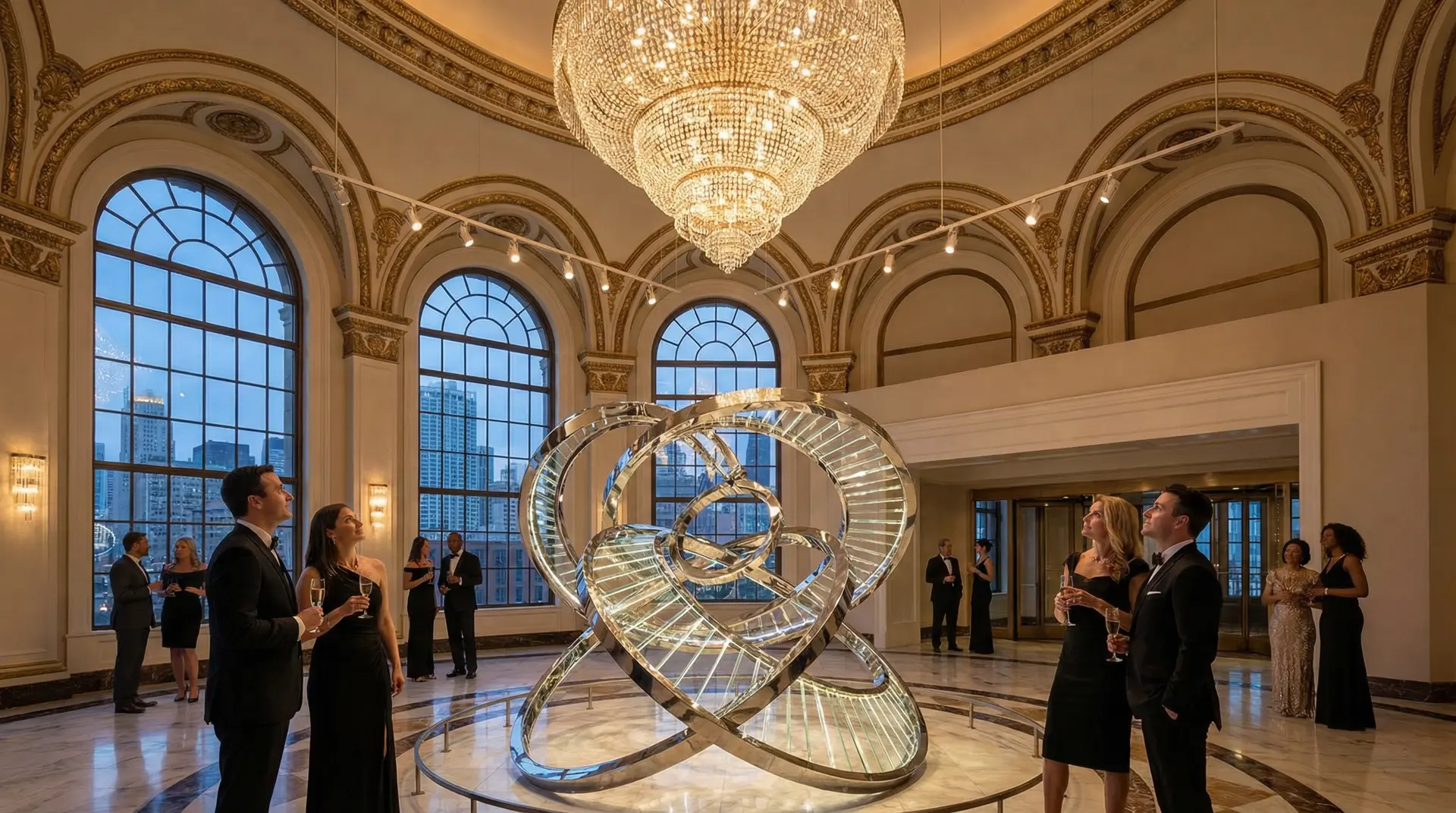
The transformation of hospitality art from afterthought to strategic priority accelerated dramatically between 2023 and 2026. According to industry research, hotels allocating 2-3% of renovation budgets specifically to art programs report room rate premiums of 40-60% compared to properties without curated collections. The 21c Museum Hotels model, pioneered by collectors Laura Lee Brown and Steve Wilson in Louisville in 2006, has matured into a template replicated by major brands including Four Seasons, Rosewood, Aman, and emerging boutique operators who recognize that contemporary art creates the "destination" quality that justifies premium positioning.
Saatchi Art's Hospitality Art Advisors completed over 390 distinct hotel projects in 2025 alone, each requiring custom curation tailored to property history, location, and brand positioning. The scale of this market indicates a structural shift rather than passing trend. When Champalimaud Design collaborated with Bellagio on the Spa Tower Suites renovation, the ivory-white sculptural works complementing rich velvets and muted tones weren't additions to completed interiors—they were conceived alongside architectural planning, integrated from project inception rather than installed as finishing touches.
For collectors observing this evolution, hotel art programs offer a revealing lens on market dynamics, artist discovery, and curatorial best practices. The same consultants advising Four Seasons on commissioned installations work with private clients building residential collections. The artists gaining visibility through high-traffic hotel placements frequently see corresponding gallery and auction market interest. Understanding hospitality's approach to art illuminates opportunities and techniques applicable far beyond hotel walls.
Discover how curated collections transform spaces at Artestial, where collectors access artists whose work bridges hospitality and residential applications with museum-quality provenance.
The Evolution From Decoration to Destination
How Art Became Competitive Advantage
The trajectory from generic prints to curatorial programming follows luxury hospitality's broader evolution from accommodation provider to experience curator. In previous decades, hotel art served functional purposes: filling wall space, providing visual interest without distraction, meeting brand standards requiring inoffensive imagery that wouldn't alienate any guest demographic. The result was forgettable uniformity—the very definition of "hotel art" became pejorative, suggesting safe mediocrity chosen by committee rather than vision.
The 21c Museum Hotels model inverted this logic entirely. By combining boutique hotels with contemporary art museums open free to the public twenty-four hours daily, Brown and Wilson demonstrated that art could drive rather than merely accompany hotel selection. Their Louisville property, occupying five restored 19th-century warehouses, features permanent installations by artists including Bill Viola, Tony Oursler, Kara Walker, and Chuck Close, alongside rotating exhibitions that attract visitors regardless of whether they're staying overnight. The model proved financially viable: 21c expanded to Durham, Cincinnati, Bentonville, Lexington, Kansas City, Chicago, and St. Louis, with a $48 million renovation of Durham's historic Hill Building exemplifying the investment scale required.
The Faena Hotels approach in Miami and Buenos Aires established another template: art as brand architecture rather than simply collection. Site-specific installations grouped under the Faena Art platform include museum-quality works from Salvador Dalí, Pablo Picasso, Damien Hirst, and Jeff Koons, creating environments where art defines rather than decorates space. Visitors to Faena Miami encounter art that would be at home in major museum collections, justifying room rates that significantly exceed neighboring properties.
The Curation Imperative
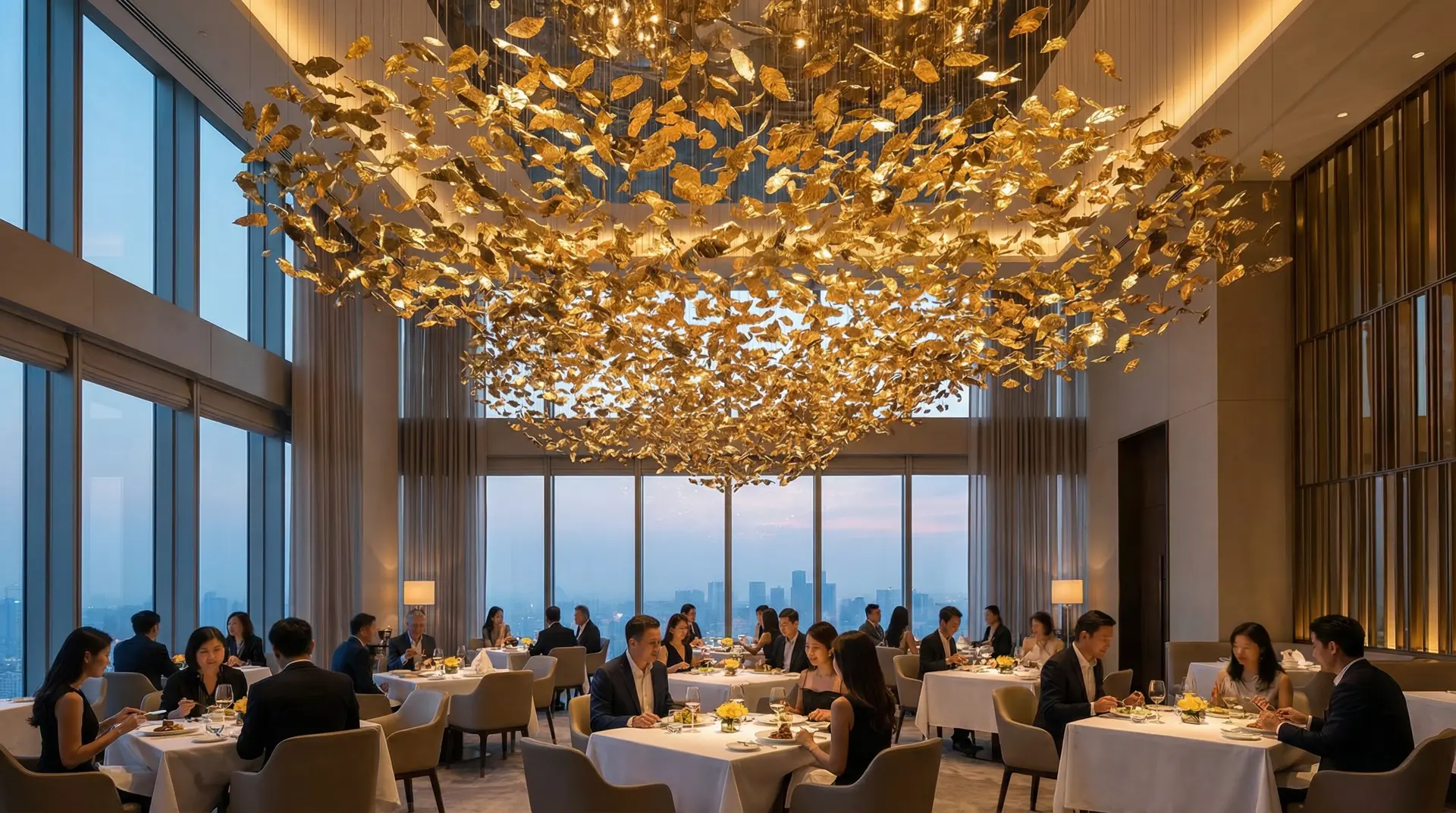
Wild Apple's 2025-2026 hospitality trend analysis identifies the shift from "flat, mass-produced prints" toward "textural and dynamic" works featuring "layered compositions, painterly brushstrokes, and mixed-media influences that feel more bespoke and sophisticated." This language reveals how hospitality design has absorbed fine art vocabulary, evaluating acquisitions through criteria previously reserved for gallery exhibitions rather than interior decoration.
In-room art, traditionally an afterthought, now receives curatorial attention previously reserved for public spaces. Hotels recognize that guests photograph rooms as frequently as lobbies, and social media amplification makes every design choice potentially viral. Properties compete not only for bookings but for Instagram presence, and art that photographs distinctively generates organic marketing value impossible to purchase through traditional advertising channels.
The tension between maximalism and minimalism that designer Gray Davis of Meyer Davis identifies—"layering large-scale patterns on walls with deep jewel tones, highly textured leathers, and deep veined colored marbles"—represents hospitality's response to residential design trends filtering through luxury properties. Hotels increasingly function as showrooms for design approaches that guests subsequently request from residential designers and art advisors.
Hotel Art as Investment Vehicle
Art on the Balance Sheet
Beyond aesthetic and marketing value, sophisticated hotel operators increasingly treat art as capital asset rather than operating expense. The Four Seasons George V in Paris reportedly maintains a collection valued at €12 million that has appreciated approximately 400% since acquisition, transforming what might have been decorative expenditure into investment generating returns alongside room revenue.
This financial approach requires different acquisition strategies than pure decoration would suggest. Properties with investment-grade collections prioritize works by artists with established secondary markets, documented provenance, and institutional recognition. They maintain conservation standards equivalent to museums, recognizing that condition preservation protects asset value. Some properties employ dedicated conservation staff or retain outside specialists for regular assessment, treating art maintenance as essential as building maintenance.
The implications for collectors are significant. Hotels acquiring investment-grade art compete for the same works private collectors seek, potentially affecting availability and pricing in specific market segments. Simultaneously, hotels selling works from collections—as occasionally occurs during ownership transitions or strategic rebalancing—create acquisition opportunities for collectors monitoring hospitality market movements.
Commission Economics
Hotel commissions represent substantial income for artists able to work at hospitality scale. Site-specific installations for lobby spaces, outdoor sculptures, and multi-location series can generate fees ranging from $50,000 for emerging artists to seven figures for established names creating signature works. These commissions often exceed gallery sales income, making hospitality a significant revenue stream for artists whose work translates to architectural contexts.
The Wythe Hotel in Brooklyn exemplifies thoughtful commission programming. Curator Kimia Kline describes her role as "cultivator of deep conversations between local artists and the hotel," prioritizing artists embedded in the borough's cultural fabric rather than importing international names. This localized approach creates opportunities for emerging artists while building collections that authentically represent their geographic context.
For collectors, artist relationships with hospitality clients can signal production capacity, professional infrastructure, and institutional validation. An artist successfully completing a complex hotel commission demonstrates ability to execute at scale, meet client specifications, and navigate the commercial dynamics that accompany public installation—skills that translate to private commission capability.
Explore artists whose work bridges hospitality and residential contexts at Artestial, where collectors connect with talent recognized by leading hotel brands and curatorial consultancies.
Design Trends Shaping 2026 Hospitality
Quiet Luxury and Its Implications
The "quiet luxury" movement reshaping fashion and consumer goods has arrived fully in hospitality design. Andrew Lieberman of AvroKO describes "a shift away from food halls and larger communal social experiences" toward "more personable one-to-one interactions" and "individual cabins where operators can curate a specific experience." This intimacy-focused approach demands art that rewards close viewing rather than commanding attention from across grand lobbies.
Practically, quiet luxury privileges craft visibility, material quality, and subtle complexity over scale and spectacle. Hotels embracing this aesthetic favor hand-finished works revealing process evidence, limited editions with meaningful distinction between impressions, and objects whose quality becomes apparent through tactile engagement rather than visual impact alone. The shift creates opportunities for artists working in media that suffer in photographed reproduction but reward physical presence—ceramics, textiles, works on paper with delicate surfaces, sculptural objects inviting touch.
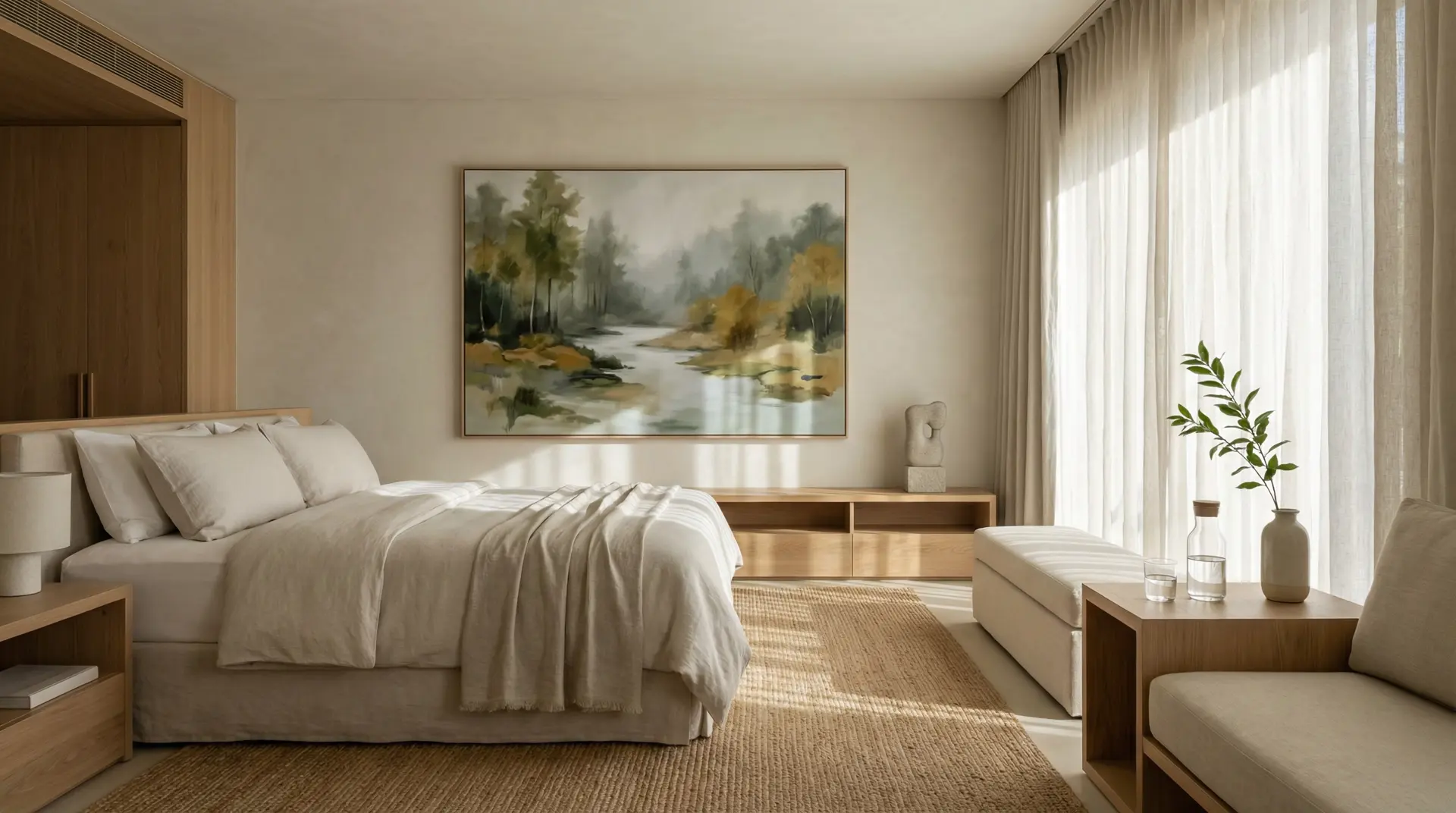
Christian Schulz of Studio Collective identifies "holistic wellness at the forefront," with "quality sleep, health-forward amenities, and well-balanced, healthy alternatives" driving design decisions. Art selections in wellness-oriented properties increasingly emphasize biophilic subjects, calming palettes, and abstracted natural forms that support rather than stimulate. The result is demand for a specific aesthetic category that collectors monitoring hospitality trends can anticipate influencing residential preferences.
Regionality and Authentic Expression
Hotels increasingly reject interchangeable international aesthetics in favor of designs reflecting specific place, history, and cultural context. Rosewood's "Sense of Place" philosophy, where each property's design and service are specifically tailored to local history, culture, and geography, exemplifies this prioritization of authenticity over brand consistency. Four Seasons' forthcoming Danieli Venice restoration honors the 15th-century palazzo's Gothic grandeur rather than imposing contemporary uniformity.
For hotel art, regionality translates to local artist representation, culturally significant materials, and subjects that situate guests in specific geographic and historical context. The approach creates opportunities for artists whose work engages with local traditions, materials, or narratives—categories sometimes undervalued in internationally focused art markets but increasingly sought by hospitality operators seeking differentiation.
Collectors observing regional hospitality trends can identify artists gaining visibility through local hotel placements before broader market recognition develops. An artist featured prominently in a new Aman property may subsequently attract gallery representation and auction attention as the property generates media coverage and guest word-of-mouth. Geographic proximity to major hotel openings can provide collection development advantages.
Translating Hospitality Strategies to Residential Collections
Lessons in Scale and Impact
Hotels solve spatial challenges that residential collectors increasingly face: activating large walls, creating focal points for open floor plans, and establishing visual hierarchies that guide attention through complex spaces. Hospitality solutions translate directly to residential contexts when collectors understand the principles underlying successful hotel installations.
The first principle involves commitment to appropriate scale. Hotels rarely under-scale art, recognizing that works too small for their contexts disappear into architectural noise. A lobby commanding a statement piece receives a statement piece, not a grouping of modest works that collectively fail to anchor the space. Residential collectors, particularly those in contemporary homes with substantial wall heights and open plans, benefit from similar boldness—fewer, larger works rather than accumulations that fragment visual impact.
The second principle involves lighting as essential rather than optional. Hotel art receives dedicated illumination because operators understand that improper lighting negates curatorial investment. Track systems, picture lights, and architectural lighting designed specifically for art viewing appear throughout hospitality properties. Residential collectors often underinvest in lighting relative to acquisition spending, compromising collection presentation through economies that undermine the works they've carefully selected.
Living with Art Versus Visiting It
Hotels offer collectors laboratory conditions for extended engagement with specific works or artistic approaches before residential commitment. Staying multiple nights with a particular painting or sculpture reveals how the work functions across time—morning versus evening light, active engagement versus peripheral awareness, initial impression versus accumulated familiarity. This extended viewing impossible in gallery contexts provides valuable intelligence for acquisition decisions.
The hospitality environment also demonstrates how professional curation balances variety with coherence. Hotels rarely install single-artist collections; instead, curatorial programming creates visual conversations between diverse works unified by palette, theme, medium, or era. Residential collectors can study these relationships, observing how professionals create cohesion without monotony, contrast without chaos.
Connect with specialists at Artestial for guidance translating hospitality-scale strategies to residential collections, with access to the same artists and consultants serving leading hotel brands.
The 2026 Opening Pipeline
Properties Worth Watching
The luxury hotel opening calendar for 2026 includes properties likely to establish new benchmarks for hospitality art programming. Understanding which properties will generate significant curatorial investment helps collectors anticipate market movements and artist visibility shifts.
Four Seasons continues aggressive expansion with properties including Cartagena (transforming colonial and Beaux-Arts landmarks), the reopened Biltmore Santa Barbara, and Danieli Venice occupying a restored Gothic landmark overlooking the lagoon. Each property represents substantial curatorial investment tailored to radically different architectural contexts, providing diverse case studies in site-specific programming.
Aman debuts Amanvari in Baja California, its first Mexican property within the Costa Palmas development. The eighteen-room retreat emphasizes white concrete, natural stone, and tropical wood in a minimalist composition that demands art programming equally restrained yet impactful. Aman's reputation for meticulous curation suggests artist selections worth monitoring for collectors interested in the understated aesthetic the brand exemplifies.
Rosewood opens in Milan within the 19th-century Palazzo Branca and Palazzo della Banca Commerciale, blending historic grandeur with contemporary Milanese style. Six Senses launches London within the Foster + Partners-designed Whiteley's development, bringing the brand's wellness-focused aesthetic to an urban context for the first time. Each opening generates media coverage that amplifies artist visibility, creating potential market effects for those positioned to recognize the dynamic.

Acquiring From Hotel Art Programs
Opportunities and Access Points
Collectors interested in works from hotel collections face both opportunities and limitations. Hotels occasionally deaccession works during renovations, ownership changes, or collection rebalancing, creating acquisition opportunities for collectors monitoring such transitions. The Host Hotels & Resorts sale of Four Seasons properties in 2026 illustrates how real estate transactions can surface art holdings, though high-profile collections typically transfer with properties rather than selling separately.
More accessible pathways involve identifying and following the artists and advisors creating hotel collections rather than pursuing the collections themselves. Saatchi Art's hospitality division, for example, sources from a network of contemporary artists whose work is simultaneously available through gallery channels. Print Club Ltd., Wild Apple, and regional consultancies maintain artist rosters that collectors can research, identifying talents gaining hospitality exposure before market recognition fully develops.
Commission structures also create opportunities. Artists completing hotel projects often produce related series or editions that capture similar aesthetic qualities at residential scale and price points. Collectors interested in a monumental lobby installation might acquire smaller works from the same series or period, benefiting from the artist's elevated profile while obtaining works sized appropriately for private contexts.
Frequently Asked Questions
How much do luxury hotels typically invest in art programs?
Investment levels vary dramatically based on property positioning, but general industry guidance suggests 2-3% of total renovation or construction budgets for meaningful art programs. For a $100 million luxury property development, this translates to $2-3 million in art acquisition and commissioning, exclusive of ongoing curation, conservation, and insurance costs. The 21c Museum Hotels model, which combines hospitality with full museum operations, requires substantially higher investment given rotating exhibition programming and professional curatorial staff. Properties treating art primarily as decoration rather than destination allocate considerably less, though the differentiation benefits are correspondingly reduced.
Can private collectors access the same art advisors serving major hotel brands?
Yes, most hospitality art consultancies also serve private clients, often viewing residential projects as complementary to commercial work. Firms like Saatchi Art's advisory division, Print Club Ltd., and numerous regional consultancies actively seek private collector relationships. Working with advisors experienced in hospitality provides access to artist networks, logistical capabilities for large-scale installations, and understanding of how art functions in living environments rather than purely gallery contexts. Collectors should expect advisory fees proportional to project scope, typically structured as percentages of acquisition budgets or flat fees for defined services.
What distinguishes hotel-appropriate art from gallery-focused work?
Hospitality contexts demand durability, maintenance accessibility, and appropriateness for diverse viewers that galleries don't require. Works must withstand environmental factors including variable humidity, temperature fluctuation, and potentially direct sunlight. They must permit regular cleaning without conservation intervention. Subject matter and presentation must be accessible to audiences who haven't chosen art engagement as their primary purpose. These constraints don't necessarily diminish artistic quality, but they do favor certain media, techniques, and approaches over others. Artists successfully navigating hospitality requirements often develop complementary bodies of work for gallery contexts where such constraints don't apply.
How do hotel art programs affect artist market visibility and pricing?
Significant hotel placements function as institutional validation analogous to museum exhibitions, conferring credibility that can influence gallery representation, collector interest, and secondary market pricing. An artist whose monumental installation anchors a Four Seasons lobby gains visibility to affluent audiences predisposed to art acquisition, generating word-of-mouth among potential collectors. Media coverage of major hotel openings frequently highlights art programming, creating press exposure difficult to achieve through gallery channels alone. However, hospitality visibility alone doesn't guarantee market success—artists must maintain gallery relationships and collector cultivation to translate hotel exposure into sustained career development.
What should collectors observe when evaluating hotel art programs for residential application?
Focus on how scale relates to architectural context, how lighting affects perception throughout the day, how diverse works create cohesive environments without monotony, and how art functions when encountered repeatedly rather than during single gallery visits. Note which works maintain interest over extended exposure and which lose impact with familiarity. Observe how professional installation creates clean, confident presentation that honors both artwork and architecture. Consider whether specific artists or aesthetic approaches align with your residential contexts and collecting priorities. The extended viewing time hotels provide offers evaluation opportunity impossible in commercial gallery settings where purchases are often decided within single visits.
Ready to apply hospitality curatorial strategies to your residential collection? Visit Artestial where collectors access artists recognized by leading hotel brands and museum-quality presentation standards, or connect with specialists for guidance developing collection programs with hospitality sophistication.
Curating excellence, one insight at a time. — AURUM
Disclaimer: This article provides educational information about luxury hospitality design trends and their implications for art collecting. It does not constitute investment, financial, or interior design advice, and readers should consult qualified professionals before making acquisition or design decisions. Hotel art program details derive from publicly available sources including company announcements, design publications, and industry reports. Specific investment figures and appreciation claims regarding hotel collections reflect reported information that may not be independently verified. Art market conditions involve significant risks including illiquidity and subjective valuation.