

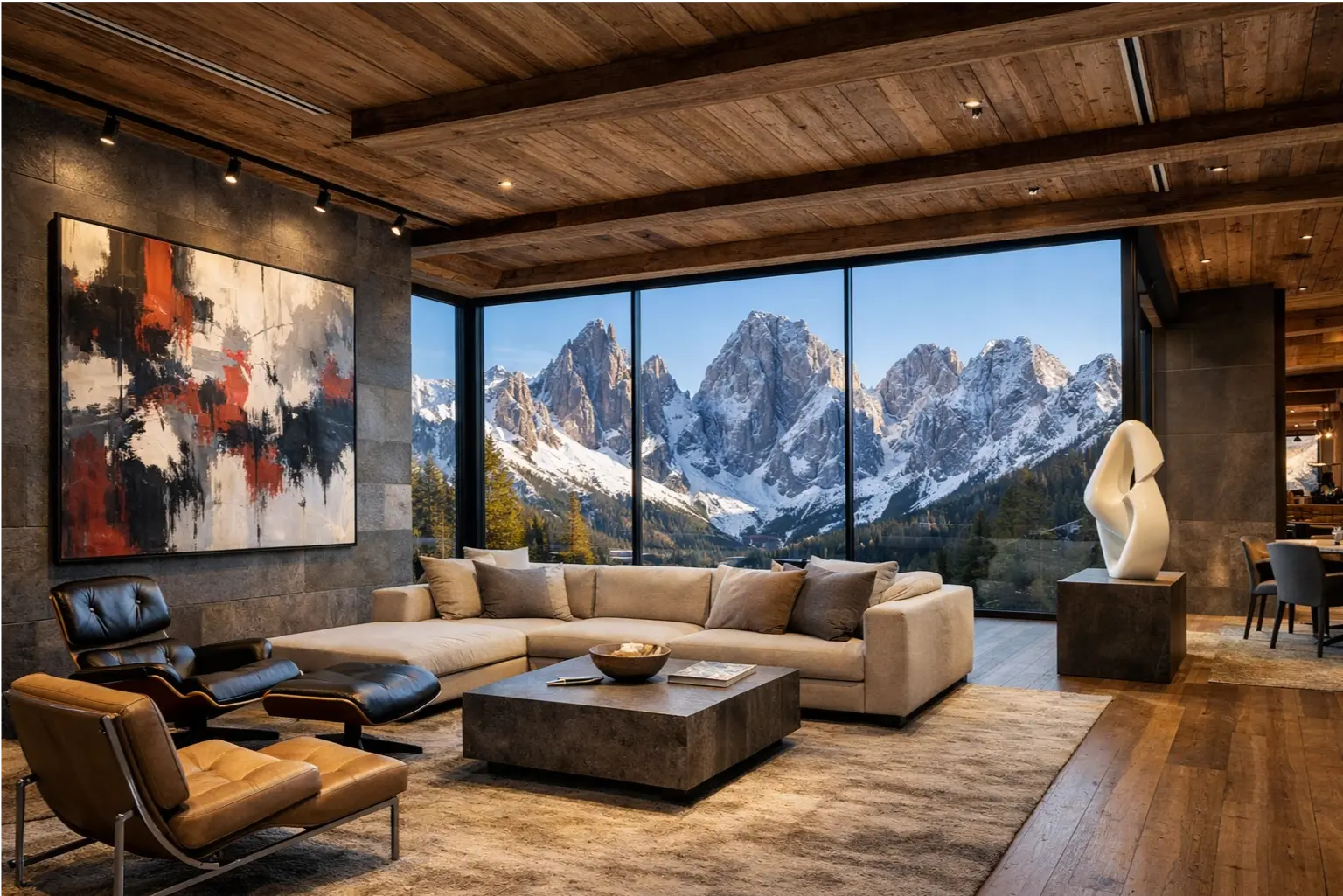
The alpine chalet has become the ultimate trophy for the global collector class. Prime properties in Courchevel 1850 now command €20,000 per square meter, Gstaad has reached €47,300 per square meter for ultra-premium chalets, and Cortina d'Ampezzo—energized by the 2026 Winter Olympics—has witnessed a 50% surge in luxury property demand over the past two years. Swiss Alpine real estate prices have increased nearly 30% since 2019, driven by wealthy international buyers seeking stability, lifestyle, and the ineffable allure of mountain living. Yet amid the excitement over ski-in ski-out access, private wellness facilities, and cinema rooms designed for après-ski entertainment, a critical dimension remains dangerously underexamined: the unique threats that alpine environments pose to fine art collections.
The very features that make these properties so magnificent—soaring windows capturing dramatic mountain panoramas, massive stone fireplaces radiating warmth against subzero temperatures, the interplay of reclaimed timber and contemporary glass—create preservation challenges that would alarm any conservation professional. At altitude, UV radiation intensity increases approximately 10-12% per 1,000 meters, meaning a chalet at 1,850 meters receives substantially more damaging light than a coastal residence. Winter heating systems cycle aggressively to maintain comfort when exterior temperatures plunge, creating the humidity fluctuations that conservators identify as among the most destructive forces artwork can endure. And the seasonal nature of most chalet occupancy means months when properties operate at minimal temperature and humidity settings, followed by rapid environmental shifts when owners arrive for their winter holidays.
For collectors who have spent decades carefully building museum-quality holdings, the dream of displaying significant works in their alpine retreats collides with the physical realities of canvas expansion and contraction, pigment oxidation, and the molecular stress that temperature cycling inflicts on aged materials. The question facing serious collectors is not whether to choose between mountain lifestyle and art stewardship but rather how to reconcile these seemingly competing imperatives through intelligent design, sophisticated environmental controls, and a fundamental rethinking of what alpine art display requires.
Explore contemporary works by artists engaging with landscape, architecture, and environmental themes at Artestial, where collectors find pieces that dialogue with the extraordinary natural settings of alpine residences while connecting with specialists who understand the unique demands of mountain display environments.
The Architecture of Desire: Why Alpine Properties Command Attention
Henry Jacques Le Même and the Birth of the Modern Chalet
The sophisticated alpine chalet as we recognize it today emerged largely from the visionary work of a single architect working in the French Alps during the early twentieth century. Henry Jacques Le Même, born in Nantes in 1897 and trained at the École des Beaux-Arts in Paris, arrived in Megève in 1925 at the invitation of industrialist Adolf Beder and quickly received his first significant commission: a residence for Baroness Noémie de Rothschild. This collaboration would establish the foundational vocabulary of luxury alpine living that continues to influence mountain architecture a century later.
Le Même's genius lay in synthesizing apparently contradictory influences into a coherent architectural language. His training under the legendary Art Deco designer Émile-Jacques Ruhlmann had instilled an appreciation for meticulous craftsmanship and elegant detail. His awareness of Le Corbusier's modernist principles suggested new possibilities for light, space, and functional organization. And his deep respect for Savoyard vernacular traditions—the stone foundations, timber construction, and broad protective roofs that regional builders had perfected over centuries—grounded his innovations in local material culture and climatic necessity.
The resulting "chalet du skieur" concept, first realized in 1927, departed decisively from both the rustic simplicity of traditional mountain dwellings and the ornamental excess that characterized much Alpine architecture of the period. Le Même stripped away decorative superfluity while introducing generous window openings that captured mountain views and flooded interiors with natural light. His signature double-sloped roofs managed heavy snowfall while creating distinctive silhouettes that have become synonymous with alpine elegance. Stone bases anchored structures to their mountainside sites, while specially designed joinery showcased craft traditions elevated to artistic expression.
Over a career spanning seven decades, Le Même designed nearly 250 chalets primarily in Megève and nearby Combloux, establishing an architectural vocabulary that influenced alpine design across Europe and beyond. Three of his Megève chalets—La Croix-des-Perchets (1928), the Grizzly (1932), and the Cairn (1941)—now carry France's twentieth-century architectural heritage designation. His integrated approach to design extended from structural conception through furniture and fixtures, with every element from fireplace mantels to staircase railings receiving the same meticulous attention. This holistic vision, treating the chalet as a total work of art, established expectations for alpine luxury that persist in the twenty-first century's most prestigious mountain properties.
Charlotte Perriand and Democratic Alpine Modernism
While Le Même defined luxury chalet architecture for an elite clientele, another pioneering designer tackled the challenge of bringing mountain living to broader audiences without sacrificing design integrity. Charlotte Perriand, celebrated for her furniture collaborations with Le Corbusier and Pierre Jeanneret during the 1920s and 1930s, brought her modernist sensibilities and socialist convictions to the Les Arcs ski resort development beginning in 1967.
The Les Arcs project, conceived by developer Roger Godino and mountain guide Robert Blanc, aimed to democratize alpine recreation by creating purpose-built resort villages that could accommodate 30,000 visitors with efficient, beautiful design. Perriand served as creative lead for a team that included architects Guy Rey-Millet, Gaston Regairaz, and others, ultimately designing the interiors of more than 4,500 accommodations across the Arc 1600 and Arc 1800 villages during her two decades of involvement.
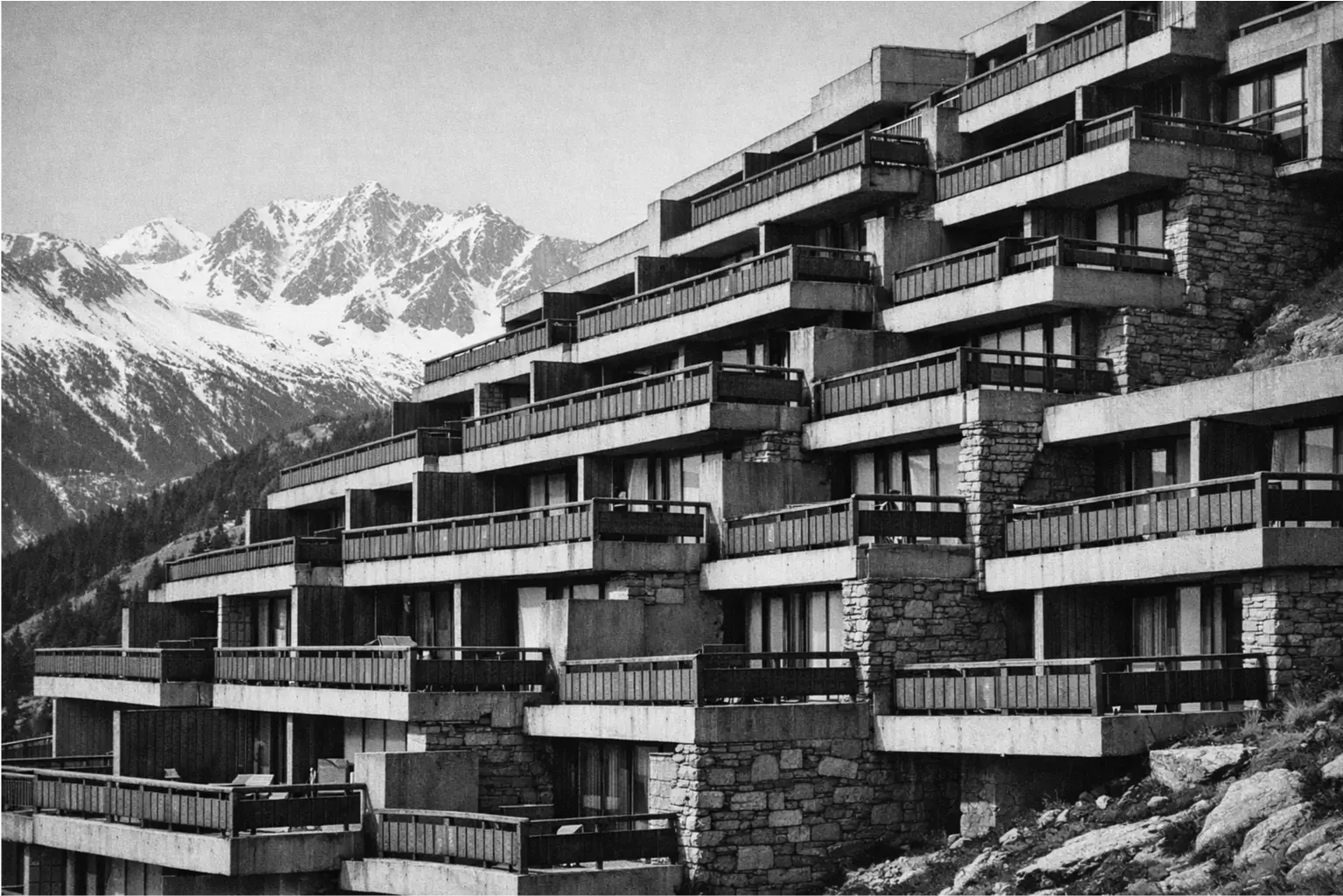
Perriand's approach at Les Arcs demonstrated that modernist principles of prefabrication, efficient space utilization, and honest material expression could create mountain housing that respected both landscape and inhabitants. Her buildings integrated naturally with alpine topography, following the contours of slopes rather than imposing geometric rigidity. The iconic La Cascade building at Arc 1600, completed in 1969 with Rey-Millet, cantilevers dramatically over a ski slope, with each ascending story stepping back 1.4 meters to ensure equal sunshine for every apartment's terrace. Large windows set into these tilted walls captured light reflecting from snow, flooding compact interiors with brilliance.
Inside these apartments, Perriand pioneered concepts that would later become standard in residential design. Her open-plan kitchens—revolutionary at the time—prevented women from being sequestered during family holidays. She personally designed furniture including metal enamel tables, low wooden armchairs, and built-in storage solutions, using local materials with the sophistication she had learned in urban contexts. Modular kitchen and bathroom units manufactured off-site could be craned into position and quickly connected to utilities, enabling efficient construction during brief alpine summer seasons.
Les Arcs earned France's "Remarkable Contemporary Architecture" designation in 2006, recognizing Perriand's achievement in demonstrating that democratic access to mountain living need not compromise design integrity. Her legacy at Les Arcs continues to attract architecture enthusiasts who tour the resort to experience her vision firsthand, with original apartments now prized by collectors who understand their historical significance.
The Invisible Enemy: Environmental Threats to Art at Altitude
Temperature and Humidity Dynamics
The scientific principles underlying art conservation become starkly relevant in alpine environments, where the very conditions that create cozy mountain atmospheres simultaneously assault the materials from which artworks are constructed. Understanding these dynamics requires examining how organic materials respond to environmental fluctuation—and recognizing that alpine settings amplify precisely the stresses conservators work hardest to eliminate.
Canvas, the support material for most oil paintings created since the sixteenth century, consists of woven linen or cotton fibers that absorb and release moisture in response to surrounding humidity levels. As relative humidity rises, canvas fibers swell and extend; as humidity drops, they contract and tighten. This expansion and contraction occurs at different rates and magnitudes than the paint layers applied to the canvas surface, creating mechanical stress at the interface between support and painted surface. Repeated cycling between high and low humidity—precisely what occurs in seasonally occupied alpine chalets—produces cumulative damage that eventually manifests as cracking, cupping, and delamination of paint layers.
The ideal relative humidity range for most artworks falls between 40% and 55%, with stability far more important than any specific target within this band. Conservation professionals consider fluctuations of more than 5% problematic; variations of 10% or more risk significant damage. Yet in a typical chalet scenario, exterior winter conditions might feature relative humidity below 20% (cold air holds less moisture), while interior heating raises temperatures dramatically, further reducing relative humidity to levels that desiccate organic materials. When owners depart and heating systems reduce to maintenance levels, humidity rebounds—only to crash again when the property is prepared for the next arrival.
Temperature itself presents additional challenges. Higher temperatures accelerate chemical deterioration in virtually all art materials, increasing oxidation rates, promoting pigment breakdown, and hastening the degradation of organic binding media. The rule of thumb that chemical reaction rates approximately double with each 10°C temperature increase means that summer conditions in sun-drenched alpine spaces—where greenhouse effects can push interior temperatures well above ambient—age artwork measurably faster than cooler storage conditions.
The massive stone fireplaces that anchor traditional chalet great rooms create particularly challenging microclimates. While gathering spaces benefit from radiant warmth during evening use, artwork displayed near these heat sources experiences localized temperature spikes and corresponding humidity crashes that standard HVAC systems cannot fully counteract. The romantic appeal of a significant painting displayed above a roaring fire conflicts directly with preservation imperatives.
For collectors unwilling to sacrifice fireplace ambiance but committed to protecting their holdings, bio-ethanol fireplaces offer a compelling middle ground. These units burn clean without producing the intense radiant heat spikes or combustion byproducts of traditional wood-burning installations. The flame aesthetic satisfies the psychological desire for fire's presence in alpine interiors while generating more moderate, consistent heat that climate control systems can effectively manage. Contemporary bio-ethanol designs range from minimalist glass-enclosed units to installations that replicate traditional hearth proportions, enabling integration with both modern and historically-referenced chalet aesthetics. While purists may find the crackling absence disappointing, collectors with significant works displayed in great room settings increasingly view this compromise as essential to reconciling mountain living with responsible stewardship.
Ultraviolet Radiation at Altitude
Light damage represents another amplified threat in mountain environments. Ultraviolet radiation causes photochemical reactions that permanently fade pigments and dyes, weaken canvas fibers, and break down protective varnishes. Unlike temperature and humidity damage, which can sometimes be partially reversed through conservation treatment, UV degradation is irreversible—once color has faded or material has become brittle, no intervention can restore original properties.
At sea level, Earth's atmosphere filters much UV radiation before it reaches the surface. But the thinner atmosphere at mountain altitudes provides less protection, with UV intensity increasing approximately 10-12% per 1,000 meters of elevation gain. A chalet at 1,850 meters—the altitude of Courchevel's most prestigious village—receives roughly 20% more UV radiation than a coastal residence. High-altitude locations also typically feature more sunny days and less haze than lower elevations, further increasing cumulative light exposure.
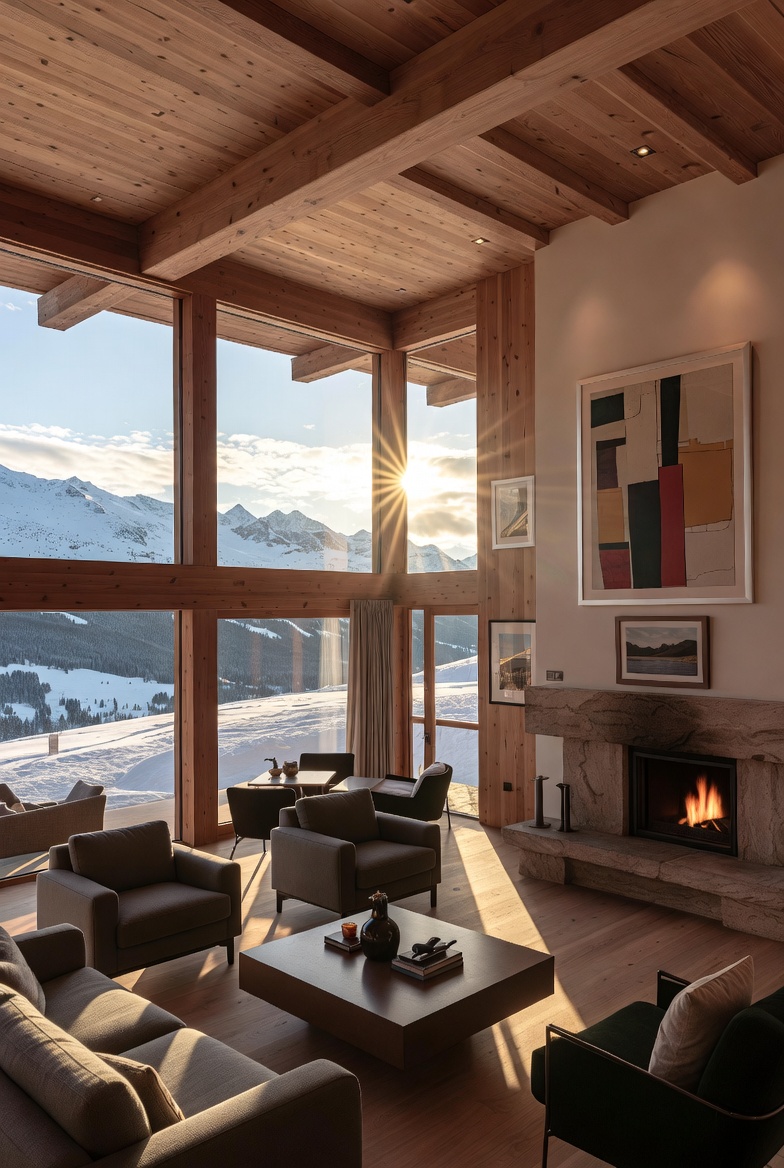
The panoramic windows that define contemporary alpine architecture—those magnificent glazed walls capturing peak views that make chalets so desirable—function as UV delivery systems unless specifically engineered for mitigation. Standard architectural glass blocks very little ultraviolet radiation; specialized UV-filtering glazing, while increasingly available, adds substantial cost and must be specified during construction or installed as retrofit solutions. The same south-facing orientation that provides desirable solar gain and mountain vistas positions artwork for maximum UV exposure during precisely the months when chalets receive heaviest use.
Snow cover compounds the problem by reflecting 80-90% of incident UV radiation back toward building interiors and any artwork positioned near windows. The dazzling quality of alpine light that photographers and painters have celebrated for centuries derives from this reflective amplification—which becomes a conservation liability when that light falls on actual artwork rather than merely inspiring new creative production.
Seasonal Occupancy Patterns
Perhaps the most challenging aspect of alpine art stewardship involves the seasonal nature of most chalet use. Unlike primary residences where environmental systems maintain consistent conditions year-round, vacation properties typically experience extended periods of reduced climate control punctuated by intensive use during ski season and summer holidays.
When chalets sit vacant, property managers typically reduce heating to prevent frozen pipes while minimizing energy costs—conditions far from ideal for art preservation. Then, as owners prepare for arrival, systems ramp up rapidly to achieve comfort temperatures, creating exactly the environmental swings that damage organic materials. A canvas that has equilibrated to cool, dry conditions over months must suddenly adjust to warm, differently humidified air within hours.
This cycling occurs not once but repeatedly throughout the year: arrival and departure for winter holidays, possible spring break visits, summer mountain retreats, autumn weekend escapes. Each transition stresses materials that might have survived indefinitely in stable museum conditions. Multiply these cycles over the decades that collectors typically own significant properties, and cumulative damage becomes substantial.
Even during occupation periods, usage patterns create environmental variability. Great rooms designed for entertaining feature fireplaces that cycle between roaring blazes and cold ash. Hot tub and sauna facilities introduce humidity into adjacent spaces. Kitchen activity during elaborate dinner parties raises both temperature and humidity. Guest wing occupancy varies with visiting family members. Every fluctuation propagates through interconnected spaces, affecting any artwork installed throughout the property.
The insurance implications of these environmental challenges deserve careful attention. While most fine art "All-Risk" policies cover accidental damage, they typically contain exclusions for "gradual deterioration" or "inherent vice"—precisely the categories into which environmentally-induced damage falls. The hairline cracks developing across a canvas subjected to years of humidity cycling, the foxing appearing on works on paper stored in inadequately controlled spaces, the fading of pigments exposed to unfiltered alpine sunlight—these forms of damage accumulate slowly rather than occurring in discrete insurable events. Collectors assuming their comprehensive art insurance protects against all risks may discover too late that the gradual cracking caused by chronic dryness near that magnificent fireplace falls outside policy coverage. This gap between perceived and actual protection underscores the importance of proactive environmental management: preventing damage costs far less than attempting to remediate it, particularly when insurance provides no recourse.
The Market Context: Alpine Real Estate as Alternative Asset
Price Appreciation and Investment Dynamics
The conservation challenges inherent in alpine environments must be weighed against the remarkable performance of mountain real estate as an alternative asset class. Understanding this market context helps collectors evaluate whether the risks of displaying significant artwork in chalets are justified by the broader lifestyle and financial considerations that motivate alpine property acquisition.
According to the Savills Ski Report for Winter 2025-26, prime ski property prices have demonstrated notable resilience, with average prices rising 3% year-on-year despite broader economic uncertainty. Ultra-prime markets have accelerated even faster, showing 9% annual price growth that would see values double in approximately a decade if sustained. Over the past twenty years, prime ski property prices in the US have surged 228%, with global prime ski markets appreciating 150% during the same period.
Knight Frank's Alpine Property Index, tracking 26 resort markets, recorded 3.3% annual growth as of June 2025, with the index rising 23% over five years. Swiss resorts led performance with 5% average annual growth, compared to 1.2% for French markets—though this differential partly reflects regulatory constraints on foreign ownership in Switzerland that artificially constrain supply.
Individual markets have shown even more dramatic appreciation. Andermatt topped Knight Frank's index with 14.6% annual price growth, driven by legal restrictions that limit new development and create scarcity premiums. Cortina d'Ampezzo ranked third with 10% year-on-year growth, energized by the €1.7 billion Milano Cortina infrastructure investment preparing for the 2026 Winter Olympics. Property prices in Cortina now average €12,000 per square meter—comparable to central Paris—with premium locations exceeding €20,000 per square meter.
The arrival of luxury hospitality brands signals confidence in continued market strength. Rosewood Courchevel Le Jardin Alpin opened in December 2025 as the brand's debut winter resort, joining Courchevel 1850's remarkable concentration of palace hotels including Les Airelles, Cheval Blanc, L'Apogée (Oetker Collection), and Aman Le Mélézin. Mandarin Oriental is scheduled to debut in Cortina in time for the 2026 Winter Olympics. Four Seasons is selling just six residences in The Park Gstaad, scheduled to open in 2026. These branded residential components offer turnkey luxury with professional management—though they may limit owners' ability to personalize spaces with significant art collections.
The Collector's Calculus
For collectors evaluating alpine property acquisition, the market context creates a compelling framework even accounting for art preservation challenges. Properties in top-tier resorts have historically demonstrated strong value appreciation, relative liquidity compared to other alternative assets, and practical utility as gathering places for extended families and guests.
The key insight is that alpine chalets need not function as primary repositories for significant collections. Serious collectors might reasonably maintain museum-quality storage in climate-controlled primary residences or dedicated storage facilities while displaying selected works—chosen for their compatibility with mountain environments—in alpine properties. Certain categories of artwork tolerate environmental variability better than others; certain display strategies mitigate risks; and emerging climate control technologies increasingly enable true museum-quality conditions in even challenging architectural contexts.
Additionally, the unique character of alpine settings can inspire collection development in new directions. Works by artists who have engaged with mountain landscapes, winter conditions, or the relationship between architecture and nature dialogue naturally with chalet environments. Contemporary artists working in materials designed for environmental durability—certain photographic processes, properly sealed sculpture, digital art displayed on conservation-appropriate screens—can provide visual interest without the preservation anxieties attending fragile historical works.
The 2026 Winter Olympics in Cortina d'Ampezzo have accelerated market activity while simultaneously raising international profiles of participating resorts. For collectors who have hesitated to enter alpine markets, current conditions present both opportunity and urgency: properties purchased before Olympic-driven price escalation captured optimal value appreciation, while post-Games infrastructure legacies will sustain market strength well into the future.
Engineering Solutions: Climate Control for the Discerning Collector
HVAC System Design for Art Preservation
The technical challenges of maintaining museum-quality conditions in alpine chalets—while formidable—are not insurmountable given current climate control technology and thoughtful system design. Understanding these solutions enables collectors to commission properties or retrofits that reconcile mountain living with serious art stewardship.
Professional art storage facilities maintain temperature between 65°F and 75°F (18°C to 24°C) with relative humidity held at 40-50%, with fluctuations limited to 5% in any 24-hour period. Achieving these standards in alpine residential contexts requires HVAC systems designed specifically for preservation rather than merely comfort—an important distinction that many chalet architects and builders have historically overlooked.
Modern high-efficiency systems can maintain precise temperature and humidity setpoints even as exterior conditions vary dramatically. Variable refrigerant flow (VRF) systems enable zone-by-zone control that allows gallery spaces to operate at different conditions than bedrooms, kitchens, or wellness areas. Dedicated dehumidification equipment can counteract the humidity spikes that occur when outdoor air infiltrates during door openings or when steam-generating activities occur in spa facilities. Humidification systems prevent the dangerous humidity crashes that accompany winter heating.
Critically, these systems must be engineered for stability rather than merely average achievement. A system that maintains 50% average relative humidity but swings between 30% and 70% throughout the day will damage artwork more than one maintaining a stable 45%—even though 45% falls below the technical optimum. Stability requires properly sized equipment, adequate thermal mass in building construction, and control systems programmed for gradual response rather than aggressive correction.
For existing chalets not originally designed for art display, retrofit solutions range from whole-property HVAC upgrades to targeted interventions in specific gallery zones. Some collectors designate particular rooms as climate-controlled display areas, constructing vapor barriers and installing dedicated systems that isolate these spaces from the environmental variability of surrounding zones. This approach enables significant collections to be displayed properly while allowing the remainder of the property to operate with conventional residential systems.
Glazing Technology and Light Management
Addressing UV exposure requires attention to both glazing specification and interior design strategies. Contemporary architectural glass can incorporate UV-blocking interlayers that filter 99% or more of damaging ultraviolet radiation while maintaining optical clarity and preserving the views that make alpine properties desirable. These specialized glazing products add 20-40% to window costs compared to standard architectural glass but provide permanent protection without visual compromise.
For existing properties with standard glazing, several retrofit approaches offer meaningful mitigation. UV-filtering films applied to interior glass surfaces can block 97-99% of ultraviolet radiation, though these films typically require replacement every 10-15 years and may slightly alter optical properties. More substantially, full glazing replacement enables both UV protection and improved thermal performance—an attractive combination given the energy implications of large window walls in heating-intensive alpine climates.
Interior strategies complement architectural interventions. Positioning artwork on walls perpendicular to major window exposures rather than opposite them dramatically reduces direct light exposure. Motorized shade systems—whether interior roller shades, exterior louvers, or integrated solutions—enable responsive management of light levels throughout the day. Automated systems triggered by light sensors can deploy shading whenever measured illumination exceeds safe thresholds, providing protection even when owners are absent or inattentive.
The color temperature and intensity of artificial lighting also warrant consideration. LED sources with low UV emission have become standard in professional gallery contexts and should be specified for any spaces displaying significant artwork. Focused illumination directed specifically at artwork allows dramatic presentation while limiting overall light levels in surrounding spaces. Dimming capability enables adjustment appropriate to viewing conditions—brighter for daytime when competing with window light, reduced for evening appreciation.
Monitoring and Response Systems
Contemporary technology enables remote monitoring of environmental conditions that was previously available only to major institutions. Networked sensors tracking temperature, humidity, and light levels throughout a property can transmit data to cloud platforms accessible from anywhere, alerting owners and property managers when conditions deviate from acceptable ranges.
These systems prove particularly valuable for seasonally occupied chalets where extended vacancies create risk. If a heating system fails during winter vacancy—a scenario that historically might have gone undetected until owners arrived to discover frozen pipes and artwork damaged by extreme cold—modern monitoring triggers immediate alerts enabling rapid response. Similarly, unusual humidity spikes suggesting water intrusion, or temperature anomalies indicating HVAC malfunction, generate notifications before damage accumulates.
Some collectors integrate environmental monitoring with broader smart home systems that enable remote intervention. Heating setpoints can be adjusted, ventilation systems activated, or alert thresholds modified from smartphone interfaces. Property management services specializing in luxury alpine residences increasingly offer environmental monitoring as part of comprehensive care packages—extending to regular condition assessments of displayed artwork that provide early warning of conservation concerns.
The data generated by monitoring systems also supports informed decision-making about display strategies. If monitoring reveals that a particular wall location experiences unacceptable temperature swings when the adjacent fireplace operates, artwork can be repositioned to more stable zones. If seasonal humidity patterns suggest spring and fall as periods of greatest environmental stress, owners might consider rotating sensitive works to stable storage during these transition periods while displaying more robust pieces year-round.
The Human Touch: Craftsmanship in Contemporary Alpine Design
The Artisan Renaissance
While environmental engineering enables art preservation, the broader aesthetic context of alpine architecture increasingly celebrates the handcrafted—creating natural affinity between chalet interiors and collections emphasizing human creativity and material mastery. The pendulum has swung decisively from the industrial modernism of mid-century resort development toward renewed appreciation for artisan traditions that imbue mountain dwellings with distinctive character.
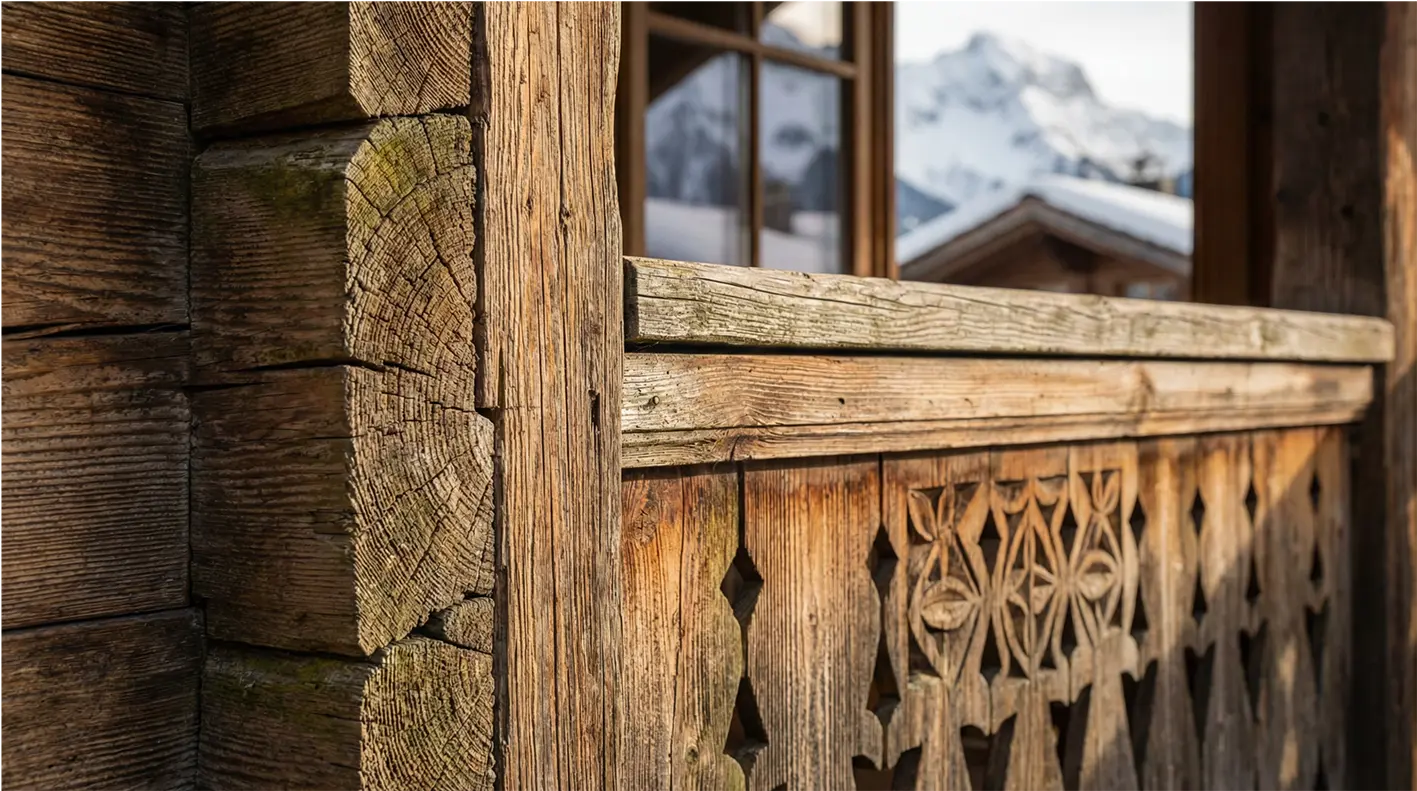
Contemporary alpine construction draws on generations of woodworking expertise preserved in mountain communities where timber construction never yielded entirely to modern methods. Master carpenters trained in techniques passed through family workshops for centuries execute joinery that machines cannot replicate. Hand-hewn beams display adze marks and grain character that milled lumber lacks. Traditional dovetail and mortise-and-tenon joints create structural connections that are simultaneously stronger and more beautiful than mechanical fasteners.
This artisanal emphasis extends to every element of chalet finishing. Stone masons shape local granite and schist into fireplaces, flooring, and architectural details that ground buildings in their specific sites. Ironworkers forge custom hardware—door handles, stair railings, light fixtures—that would be prohibitively expensive to manufacture industrially but which bespoke production economics make feasible for luxury properties. Textile artisans produce curtains, upholstery, and rugs incorporating traditional patterns and techniques updated for contemporary aesthetics.
The Peter Zumthor houses in Vals—twin timber structures available for rental that embody the architect's celebrated ascetic approach—exemplify how rigorous craft standards create spaces of profound material presence. Every beam, every joint, every surface treatment reflects deliberate choice and careful execution. Living within such structures, surrounded by evidence of human skill and attention, heightens awareness of materiality and making that naturally extends to appreciation of collected artwork.
Furnishing as Curatorial Practice
The furniture selected for alpine residences participates in the same curatorial sensibility that guides art collection development. Vintage pieces from the golden age of modernist Alpine design—Charlotte Perriand's chairs and tables from Les Arcs, Le Même's built-in storage and lighting fixtures—have become collectible in their own right, appreciated both for historical significance and enduring design quality.
Maison Henry Jacques Le Même continues producing limited-edition furniture based on designs from the architect's archives, connecting contemporary collectors with foundational alpine modernism. The Prieuré floor lamp, crafted in solid oak from French forests by carpenters in Megève in a limited series of 30 copies, exemplifies how heritage designs can be authentically reproduced for current use. These pieces carry provenance and historical meaning beyond their functional and aesthetic value.
Contemporary furniture makers working in alpine traditions extend this legacy while incorporating current ergonomic and material research. Chairs combining traditional frame construction with modern foam and fabric technology offer comfort that historical designs sometimes sacrificed. Tables scaled for contemporary entertaining accommodate dinner parties larger than traditional mountain households typically hosted. Home office furniture addresses lifestyle patterns that earlier generations could not anticipate.
The integration of furniture selection with art display strategy creates coherent environments where every element supports collector vision. A significant contemporary painting might anchor a living area furnished with vintage Perriand pieces, establishing dialogue between artwork and furniture that spans decades while remaining united by modernist sensibility. A collection emphasizing mountain landscapes might be displayed amid traditional furnishings that reinforce regional identity. The curatorial practice that shapes art acquisition extends naturally to the complete environment within which collections are experienced.
Strategic Approaches: Building Collections for Alpine Display
Compatible Media and Materials
Not all artwork presents equal preservation challenges in alpine environments, and strategic collection development can emphasize categories that tolerate mountain conditions while avoiding unnecessarily fragile works. Understanding which media and materials survive environmental variability enables collectors to build holdings specifically suited for chalet display without compromising aesthetic ambition.
Contemporary photography executed with archival pigment inks on stable substrates represents one category well-suited to alpine environments. Modern pigment formulations resist UV fading far better than traditional dye-based prints, while substrates like museum-quality rag papers or aluminum composite panels do not expand and contract with humidity variation as dramatically as stretched canvas. Photographs properly framed with UV-filtering glazing and sealed backing boards achieve stability approaching that of more protected display conditions.
Sculpture in durable materials offers another advantageous category. Bronze, stainless steel, stone, and properly sealed wood tolerate environmental fluctuation without the dimensional changes that threaten two-dimensional works on flexible supports. Outdoor sculpture intended for garden or terrace installation is engineered from the outset for exposure to weather far more extreme than even poorly controlled indoor conditions. Indoor sculpture in compatible materials expands collection scope while minimizing preservation anxiety.
Works on rigid supports—paintings on aluminum or copper panels, for instance, or works incorporating stable synthetic materials—avoid the canvas-related issues that make traditional oil paintings vulnerable. Contemporary artists working with industrial materials, epoxy resins, or automotive paints often produce works more inherently stable than historical pieces created before modern material science.
Digital art and video displayed on high-quality screens represents the ultimate in environmental independence: the artwork exists as data, immune to temperature and humidity, while the display hardware can be replaced as technology evolves without affecting the underlying work. Collectors interested in cutting-edge creative production may find that digital categories suit alpine contexts while satisfying aesthetic ambitions that traditional media might frustrate.
The Rotation Strategy
Even collectors committed to displaying significant historical works in alpine properties can mitigate cumulative damage through strategic rotation. Rather than maintaining the same paintings in the same chalet positions year after year, rotating works between mountain display and controlled storage limits any individual piece's exposure to challenging conditions.
A rotation strategy might involve installing works at the beginning of ski season when climate systems are operating at full capacity and retrieving them at season's end rather than leaving pieces in place through variable spring and summer conditions. Alternatively, collectors might display during summer mountain visits—when UV exposure is highest but heating-related humidity fluctuation is minimal—while storing works during winter when environmental challenges peak.
Professional art handling services operating in alpine regions can execute rotations efficiently, transporting works between mountain properties and urban storage facilities using climate-controlled vehicles and appropriate packing. The costs of regular professional handling must be weighed against the conservation expenses that would eventually result from continuous inappropriate display—with the latter typically far exceeding the former.
Rotation also creates curatorial opportunity, enabling collectors to live with different works at different times rather than growing overly familiar with fixed displays. A collection experienced in rotation across seasons and years remains fresh in ways that static installation cannot achieve. The effort required to manage rotation translates into renewed attention and appreciation each time works are installed.
Site-Specific Commissions
Perhaps the most elegant solution to alpine art display involves commissioning works specifically designed for chalet environments. Artists briefed on the particular conditions, dimensions, and aesthetic contexts of specific installations can create pieces that are at once uniquely suited to their intended locations and inherently compatible with alpine challenges.
Site-specific commissions enable collaboration between collectors, artists, and architects to integrate artwork with architecture in ways that off-the-shelf acquisition cannot achieve. An artist might design a work for a particular wall visible from multiple vantage points as one moves through a chalet's living spaces. Materials might be specified to tolerate the specific humidity range measured in the intended location. Scale might be calibrated to the proportions of alpine architecture, where soaring ceilings and expansive windows create spatial relationships different from conventional residential contexts.
The commissioning process itself creates meaning and connection that collecting existing work cannot replicate. Collectors who engage artists in dialogue about their alpine visions, who visit studios during creation, who participate in installation decisions, develop relationships with their commissions that deepen appreciation across years of living with the resulting works. These relationships, and the stories they generate, become part of what is collected—intangible value that complements material and aesthetic considerations.
Discover emerging artists working with materials and concepts suited to distinctive display environments at Artestial, where collectors find innovative practitioners who approach commissions with sensitivity to specific architectural and environmental contexts, or connect with specialists for guidance developing site-specific projects in alpine properties.
Conclusion: Reconciling Mountain Dreams with Stewardship Imperatives
The tension between alpine living and art stewardship is real but not irreconcilable. Understanding the specific environmental challenges that mountain properties present—the UV intensity, the temperature cycling, the humidity extremes of heating-dominated winters—empowers collectors to make informed decisions about what to display, how to protect it, and which categories of artwork to emphasize in holdings destined for chalet environments.
The remarkable appreciation of alpine real estate over recent decades suggests that collectors who establish presence in premier ski markets capture value beyond aesthetic and lifestyle benefits. Properties in Courchevel, Gstaad, Verbier, and Cortina d'Ampezzo have outperformed many traditional asset classes while providing gathering places for families across generations. The 2026 Winter Olympics have accelerated investment in Cortina's infrastructure while focusing international attention on a resort whose authentic character and UNESCO-protected Dolomite setting offer qualities increasingly rare in an era of overdevelopment.
The key insight for serious collectors is that alpine properties need not—and perhaps should not—serve as primary repositories for fragile historical works. Museum-quality storage in climate-controlled facilities preserves the most vulnerable holdings while alpine residences display selections appropriate to their environmental realities. Contemporary works in durable materials, site-specific commissions engineered for particular conditions, and rotation strategies that limit cumulative exposure enable meaningful art presence in mountain homes without compromising stewardship standards.
The architectural legacy of pioneers like Henry Jacques Le Même and Charlotte Perriand demonstrates that alpine design at its best integrates functionality with beauty, respecting both landscape and human needs. Contemporary chalet architecture increasingly incorporates sophisticated climate control technology that would have astonished earlier generations while honoring craft traditions that connect present building to centuries of mountain dwelling. The collector who understands both historical achievement and current capability can create environments where architecture, furnishing, and art collection cohere into total experiences worthy of the extraordinary natural settings that make alpine living so compelling.
The practical challenges are substantial but soluble. The emotional rewards of displaying significant art amid mountain grandeur—experiencing a beloved painting as morning light catches Alpine peaks through panoramic windows, or appreciating sculpture in an evening atmosphere of fire glow and snow reflection—justify the effort required to do so responsibly. Collectors who approach alpine art display with conservation awareness, technological sophistication, and curatorial intentionality create environments where mountain living and art stewardship enhance rather than compromise one another.
Frequently Asked Questions
What specific temperature and humidity levels should I maintain for displaying art in my alpine chalet?
The conservation community has established clear parameters that apply equally to alpine environments and any other display context, though achieving these standards in mountain settings requires more sophisticated engineering than typical residential systems provide. Professional consensus recommends maintaining temperature between 65°F and 75°F (18°C to 24°C) and relative humidity between 40% and 55%, with the critical emphasis on stability rather than specific targets within these ranges. A stable 45% relative humidity preserved consistently throughout the year protects artwork more effectively than an average of 50% that fluctuates between 30% and 70% as heating systems cycle or seasonal conditions change. The key metric is limiting fluctuation to no more than 5% in relative humidity and 3-4°F in temperature within any 24-hour period. Achieving this stability in alpine chalets requires HVAC systems specifically designed for precision environmental control rather than conventional residential comfort systems. Variable refrigerant flow systems enabling zone-by-zone management, dedicated dehumidification equipment counteracting humidity spikes during occupancy transitions, and humidification systems preventing dangerous winter dryness all contribute to stable conditions. Building construction incorporating adequate thermal mass helps buffer temperature swings, while vapor barriers and proper insulation maintain humidity levels despite extreme exterior conditions. For collectors developing new properties, specifying museum-quality environmental systems during design ensures that preservation capability is engineered from the outset rather than awkwardly retrofitted. For existing chalets, retrofit options range from whole-property HVAC upgrades to creating isolated gallery zones with dedicated climate control, allowing the remainder of the property to operate with conventional systems while protecting displayed collections. The investment in proper climate control should be evaluated against the value of collections being protected—for significant holdings, the cost of appropriate systems represents modest insurance against conservation damage that might cost far more to remediate.
How does UV exposure differ at alpine altitudes, and what glazing solutions protect artwork in chalets with large window walls?
The relationship between altitude and ultraviolet radiation creates meaningful preservation challenges for alpine art display that collectors must address through conscious architectural and material choices. Earth's atmosphere filters UV radiation progressively as light passes through it; at higher altitudes, less atmosphere intervenes between sun and surface, resulting in greater UV intensity. The standard estimate indicates UV intensity increases approximately 10-12% per 1,000 meters of elevation gain, meaning a chalet at 1,850 meters receives roughly 20% more damaging radiation than a coastal residence at equivalent latitude. Snow cover compounds this effect dramatically by reflecting 80-90% of incident UV radiation back toward building interiors, essentially doubling the light energy reaching any artwork positioned near windows during winter months when reflected snowlight supplements direct sunshine. The brilliant quality of alpine light that makes mountain settings so photographically appealing becomes a conservation liability when that light contacts actual artwork rather than merely inspiring creative production. Contemporary architectural glazing can incorporate UV-blocking interlayers that filter 99% or more of ultraviolet radiation while maintaining optical clarity and preserving the mountain views that define alpine living. These specialized products add 20-40% to window costs compared to standard glass but provide permanent protection without visual compromise. For existing properties, UV-filtering films applied to interior glass surfaces offer meaningful mitigation at lower cost, blocking 97-99% of ultraviolet radiation though typically requiring replacement every 10-15 years. Full glazing replacement provides both UV protection and improved thermal performance—an attractive combination given energy costs of maintaining comfort amid alpine temperature extremes. Beyond glazing solutions, interior design strategies significantly affect cumulative exposure. Positioning artwork on walls perpendicular to major windows rather than opposite them reduces direct light. Motorized shade systems enable responsive management throughout the day, with automated sensors deploying protection whenever measured illumination exceeds safe thresholds. Specialized art lighting using LED sources with minimal UV emission provides illumination for viewing while limiting overall exposure.
Which categories of artwork tolerate alpine environments better than others, and what should I avoid displaying in my chalet?
Understanding the relative vulnerability of different artistic media enables collectors to build holdings specifically suited for mountain display without compromising aesthetic ambition or endangering sensitive works. The fundamental preservation challenges in alpine settings involve dimensional changes caused by temperature and humidity fluctuation, UV-induced fading and material degradation, and the physical stresses of seasonal occupancy patterns that expose collections to repeated environmental transitions. Traditional oil paintings on stretched canvas represent the most vulnerable category for alpine display, precisely because canvas fibers respond to humidity changes differently than the paint layers applied to them. This differential response creates mechanical stress at the paint-canvas interface that manifests over time as cracking, cupping, and eventually delamination of paint from support. The humidity extremes characteristic of alpine heating—very dry during winter heating cycles, potentially quite humid during unoccupied shoulder seasons—amplify these stresses compared to stable residential environments. Works on paper present similar challenges, as paper fibers absorb and release moisture readily, with repeated cycling causing foxing, cockle, and structural weakness. Historical watercolors, prints, and drawings deserve museum-quality display conditions that alpine environments rarely provide. By contrast, contemporary photography executed with archival pigment inks on stable substrates tolerate environmental variation significantly better. Modern pigment formulations resist fading far more effectively than traditional dyes, while rigid substrates like aluminum composite panels or properly backed rag papers avoid the dimensional changes that plague flexible supports. Sculpture in durable materials—bronze, stainless steel, stone, properly sealed wood—similarly tolerates fluctuation without the concerns attending two-dimensional works. Contemporary artists working with industrial materials, synthetic resins, or automotive paints often produce inherently stable works suited to challenging environments. Digital art displayed on quality screens offers complete environmental independence, with the artwork existing as data while only the replaceable display hardware faces physical conditions. Collectors building alpine holdings might emphasize these compatible categories while reserving fragile historical works for climate-controlled primary residences or professional storage.
How should I approach seasonal transitions when my chalet is unoccupied for extended periods between use?
The seasonal occupancy pattern characteristic of most alpine properties creates particular conservation challenges that thoughtful management protocols can substantially mitigate. The critical issue involves the environmental transitions between vacancy conditions and occupied use—the ramping up of heating systems before arrival, the ramping down after departure, and the cumulative stress these repeated cycles impose on organic materials within displayed artwork. Professional property management services operating in alpine markets increasingly understand these dynamics and can implement transition protocols that protect collections. Rather than abruptly achieving comfort temperatures immediately before owner arrival, gradual warming over several days allows interior humidity and artwork materials to equilibrate progressively rather than experiencing shock transitions. Similarly, gradual cooling after departure, rather than immediate reduction to maintenance temperatures, limits stress on materials. Remote monitoring systems enable property managers and collectors to track environmental conditions throughout vacancy periods and intervene if anomalies occur. Networked sensors transmitting temperature and humidity data to cloud platforms provide continuous visibility regardless of physical location. Alerts triggered by conditions deviating from acceptable ranges—whether indicating heating system failure, water intrusion, or unusual humidity spikes—enable rapid response before damage accumulates. Some collectors implement formal rotation strategies that remove sensitive works to climate-controlled storage during extended vacancy periods, with professional art handling services executing transports in climate-controlled vehicles. This approach accepts additional logistics complexity in exchange for limiting cumulative exposure to challenging conditions. The most valuable and vulnerable pieces might be displayed only during periods of active occupancy when climate systems operate at full capacity, while more robust works remain in place year-round. Documentation of environmental conditions throughout the year supports informed refinement of display strategies. If monitoring data reveals particular locations within a property experiencing unacceptable fluctuation—perhaps near exterior walls with inadequate insulation or adjacent to intermittently used fireplaces—artwork can be repositioned to more stable zones or those areas can receive targeted climate control improvements.
What should I consider when commissioning site-specific artwork designed for my alpine property?
Site-specific commissions offer perhaps the most elegant approach to alpine art display, enabling creation of works designed from conception for the particular conditions, dimensions, and aesthetic contexts of intended installations. This approach transforms the constraints of mountain environments from limitations into creative parameters, producing pieces uniquely suited to their locations while avoiding the compromises attending display of works created for different contexts. The commissioning process begins with thorough documentation of the intended site, including environmental monitoring data establishing temperature and humidity patterns across seasons, lighting analysis quantifying both natural illumination and artificial possibilities, and architectural drawings establishing precise dimensions and spatial relationships. This technical foundation enables artists to specify materials that will perform appropriately in measured conditions and to design at scales calibrated to architectural proportions. Selection of artists for commission projects should consider not only aesthetic compatibility with collector vision but also track record with materials suited to alpine challenges. Artists working in durable sculptural media, contemporary photography, or synthetic materials bring inherent advantages over those whose practices center on fragile historical techniques. Portfolio review should include assessment of how previous works have performed in varied display conditions, with references from collectors who have lived with pieces over extended periods. The briefing conversation between collector and artist establishes creative direction while communicating environmental and programmatic constraints. Where will the work be experienced from? At what times of day? In what social contexts—intimate family gatherings or large entertaining? What relationship should the work establish with the mountain landscape visible through surrounding windows? What other artwork or design elements will it live alongside? These questions shape creative response while ensuring that resulting work serves the collector's actual living patterns. Collaboration often extends to include architects and interior designers, particularly for works intended to integrate with architectural elements or coordinate with furnishing schemes. This team approach ensures that commissioned artwork enhances rather than conflicts with the total environment, participating in the coherent vision that distinguishes thoughtfully realized alpine residences from mere accumulations of expensive objects.
Ready to explore contemporary works suited to alpine display environments? Visit Artestial where collectors find artists working with materials and concepts compatible with mountain living, or connect with specialists for guidance developing collections that reconcile aesthetic ambition with the practical realities of chalet environments.
Curating excellence, one insight at a time.
— AURUM Team
Disclaimer: This article provides educational information regarding art preservation, climate control, and alpine real estate market dynamics for informational purposes only. It does not constitute professional conservation, investment, or architectural advice. The environmental parameters, market data, and technical specifications presented reflect industry consensus and recent reporting as of early 2026, but individual circumstances vary significantly and readers should consult qualified professionals—conservation specialists, HVAC engineers, real estate advisors, architects—before making decisions affecting valuable collections or significant property investments. Real estate market performance varies by location and timeframe; historical appreciation does not guarantee future results. Climate control system capabilities depend on specific equipment selection, installation quality, and ongoing maintenance; achieving museum-quality conditions requires professional engineering appropriate to each property's unique characteristics. The author and publisher have no financial relationships with any products, services, or companies mentioned in this article. All responsibility for decisions made based on information presented herein rests with the reader.
The mountains have always attracted those who seek beauty, challenge, and perspective—qualities that also define serious art collecting. The question is not whether these pursuits can coexist, but rather how the thoughtful collector integrates them, creating environments where natural grandeur and human creativity illuminate one another.