
Dr. Youstina Fahmy is a contemporary Egyptian visual artist and sculptor whose practice explores the evolving language of sculpture through spatial perception and material experimentation. Her work constructs dynamic visual experiences that investigate the relationship between form, movement, and illusion, positioning the viewer within shifting perceptual fields.
Her artistic trajectory is marked by a strong presence in public and site- specific sculpture. In 2026, she realized a monumental public artwork at One Central, Dubai World Trade Centre, alongside multiple outdoor interventions across Alexandria and Egypt’s North Coast, reflecting her engagement with urban space and contemporary public art discourse. Fahmy has actively participated in numerous art exhibitions and events both within Egypt and internationally, expanding her dialogue with diverse cultural and artistic contexts. Her work is held in significant institutional and private collections, including the Museum of Modern Egyptian Art, Commercial International Bank (CIB), Ubuntu Art Gallery, and DAi Gallery.
She is the recipient of several notable awards, most prominently the State Encouragement Award in Sculpture (2022) by the Supreme Council of Culture, Egypt, in addition to the Third Prize from the Farouk Hossny Foundation for Culture and Arts (2023), and the Encouragement Award from the Adam Henein Foundation (2020). She holds a Ph.D. in Digital Technology (Mechatronics and Hypermedia) (2024), reinforcing her interdisciplinary approach that bridges sculpture with advanced technological systems.
- Likes
- 25113
- Views
- 3545232
- Followers
- 100
- Following
- 5
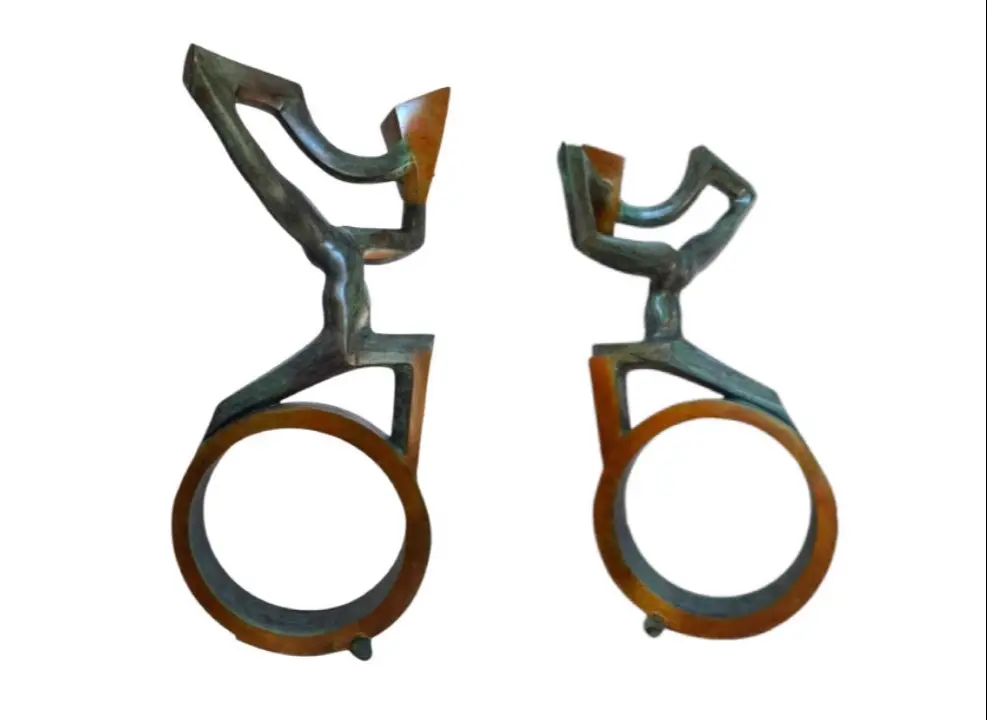
This diptych of bronze sculptures presents a dynamic exploration of motion and geometry, featuring two stylized figures balanced precariously atop circular foundations. Each piece utilizes a distinct contrast in finishes, pairing a deep verdigris patina on the upper figurative elements with warm, polished bronze along the circular bases and angular terminals. The figures themselves are rendered with an athletic, almost gymnastic energy; their limbs are elongated into sharp, architectural lines that suggest a state of perpetual tension and equilibrium. This interplay between the perfect curve of the hoop and the jagged, expressive posture of the figures creates a visual dialogue centered on the concept of human endurance and structural grace.
Conceptually, these works bridge the gap between figurative expressionism and modernist abstraction. By integrating the human silhouette into a functional-looking geometric apparatus, the artist prompts a meditation on the relationship between the body and the mechanical or mathematical world. The repetition of the two forms, slightly varied in their height and gestural details, emphasizes a sense of rhythmic progression or a dual-phase movement. These sculptures do not merely represent a physical act; they capture the "essence" of balance, transforming heavy cast metal into a display of weightlessness and poetic agility that invites the viewer to consider the delicate stability of the modern condition.