
Dr. Youstina Fahmy is a contemporary Egyptian visual artist and sculptor whose practice explores the evolving language of sculpture through spatial perception and material experimentation. Her work constructs dynamic visual experiences that investigate the relationship between form, movement, and illusion, positioning the viewer within shifting perceptual fields.
Her artistic trajectory is marked by a strong presence in public and site- specific sculpture. In 2026, she realized a monumental public artwork at One Central, Dubai World Trade Centre, alongside multiple outdoor interventions across Alexandria and Egypt’s North Coast, reflecting her engagement with urban space and contemporary public art discourse. Fahmy has actively participated in numerous art exhibitions and events both within Egypt and internationally, expanding her dialogue with diverse cultural and artistic contexts. Her work is held in significant institutional and private collections, including the Museum of Modern Egyptian Art, Commercial International Bank (CIB), Ubuntu Art Gallery, and DAi Gallery.
She is the recipient of several notable awards, most prominently the State Encouragement Award in Sculpture (2022) by the Supreme Council of Culture, Egypt, in addition to the Third Prize from the Farouk Hossny Foundation for Culture and Arts (2023), and the Encouragement Award from the Adam Henein Foundation (2020). She holds a Ph.D. in Digital Technology (Mechatronics and Hypermedia) (2024), reinforcing her interdisciplinary approach that bridges sculpture with advanced technological systems.
- Likes
- 25113
- Views
- 3545232
- Followers
- 100
- Following
- 5
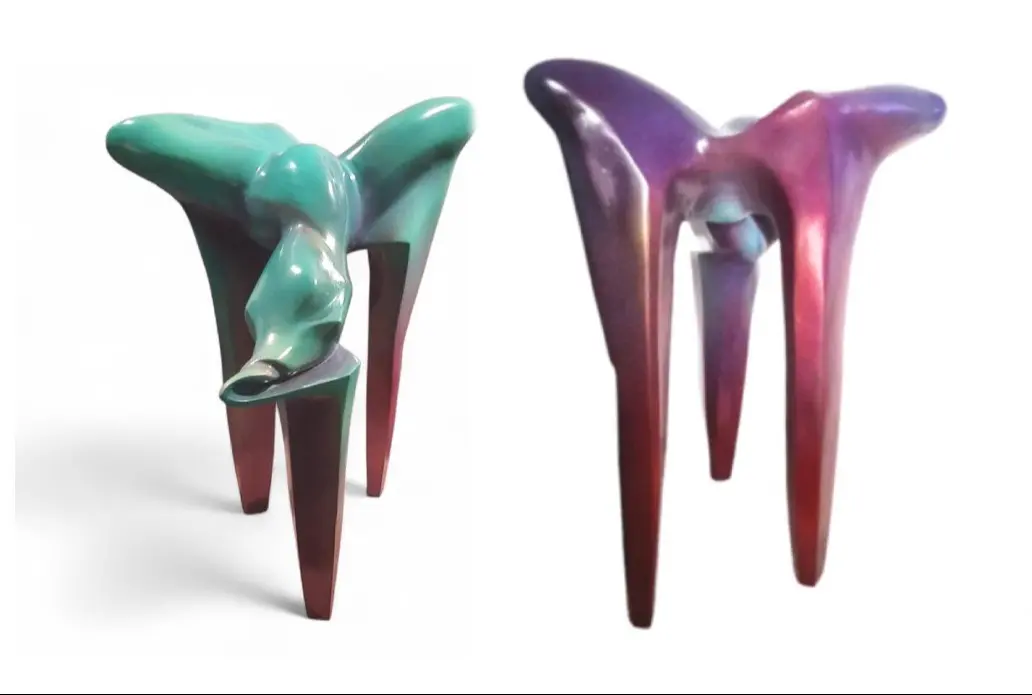
This pair of sculptures represents a vibrant exploration of biomorphic abstraction, where the organic fluidity of nature meets a bold, contemporary color palette. Each piece is characterized by its tripod-like structure, featuring three tapering, architectural legs that support a dynamic, undulating upper form. The artist utilizes a striking iridescent finish that transitions through a spectrum of teals, magentas, and deep violets, creating a sense of "chromatic movement" as the viewer’s perspective shifts. The surfaces are meticulously polished, catching the light to emphasize the soft, muscular curvature of the silhouettes, which evoke the anatomy of living organisms without adhering to a specific biological identity.
The works challenge traditional sculptural weight by pairing substantial, rounded volumes with sharp, needle-like points of contact at the base, creating a visual paradox of stability and precariousness. While one form leans forward with a gesture suggestive of grazing or drinking, the other stands more upright, highlighting a thematic dialogue between tension and repose. By removing literal figurative details, the creator invites an emotional interpretation of the forms, suggesting themes of evolution, adaptation, and the hidden vitality of the inorganic. These sculptures serve as a bridge between the mid-century modernist tradition and a futuristic aesthetic, transforming static metal into an expression of fluid, living energy.