
A Cairo-based Polish artist and conservator of fine arts. In 2002, she earned master’s degree with distinction from Academy of Fine Arts in Warsaw and started working there as an assistant at the Department of Conservation and Restoration of Painting and Polychrome Sculpture. Her diploma was awarded as the best Master's Project at the Academy of Fine Arts in Warsaw and got Special Distinction from the Art Historians Society. Since 1999, she has been involved in the preservation of the Ancient Egyptian heritage, participating as a conservation expert in many projects such as the Conservation and Restoration of Hatshepsut Temple and the Khufu Second Boat Project. The artist has been cooperating with cultural institutions and private collectors, exploring the unlimited capabilities of the art of written signs. She created her own type of artwork - a literary picture, which transforms selected texts into unique visual forms. Izabela named her art “Letterality” because her main goal is to create a special visual reality based on the original shapes of signs and symbols, where the form and its meaning coexist in harmony. The artist combines in her style Arabic calligraphy and ornamentation with hieroglyphics and various ancient Egyptian symbols. Izabela Uchman’s pictures reveal her interest in timeless spiritual values and cultural diversity. She concentrates on conscious existence related to time. Her works refer to the legacy of the ancient Mediterranean cultures, the important base of the universal qualities. She explores the relation between individual and cultural heritage, which encompasses not only inspiring diversity revealed in many different ideas, but also common principles and collective achievements of human knowledge and experience. Uchman tries to discover the new aspects of “identity” and “cultural affiliation,” creating an artistic platform for an intercultural dialogue. She participated in various solo and collective exhibitions. Her artworks are present in private collections in Poland, the Czech Republic, Germany, Great Britain, Belgium, the USA, Egypt, Kuwait, and the National Museum of Ethnology in Osaka.
- Likes
- 25113
- Views
- 3545232
- Followers
- 100
- Following
- 5
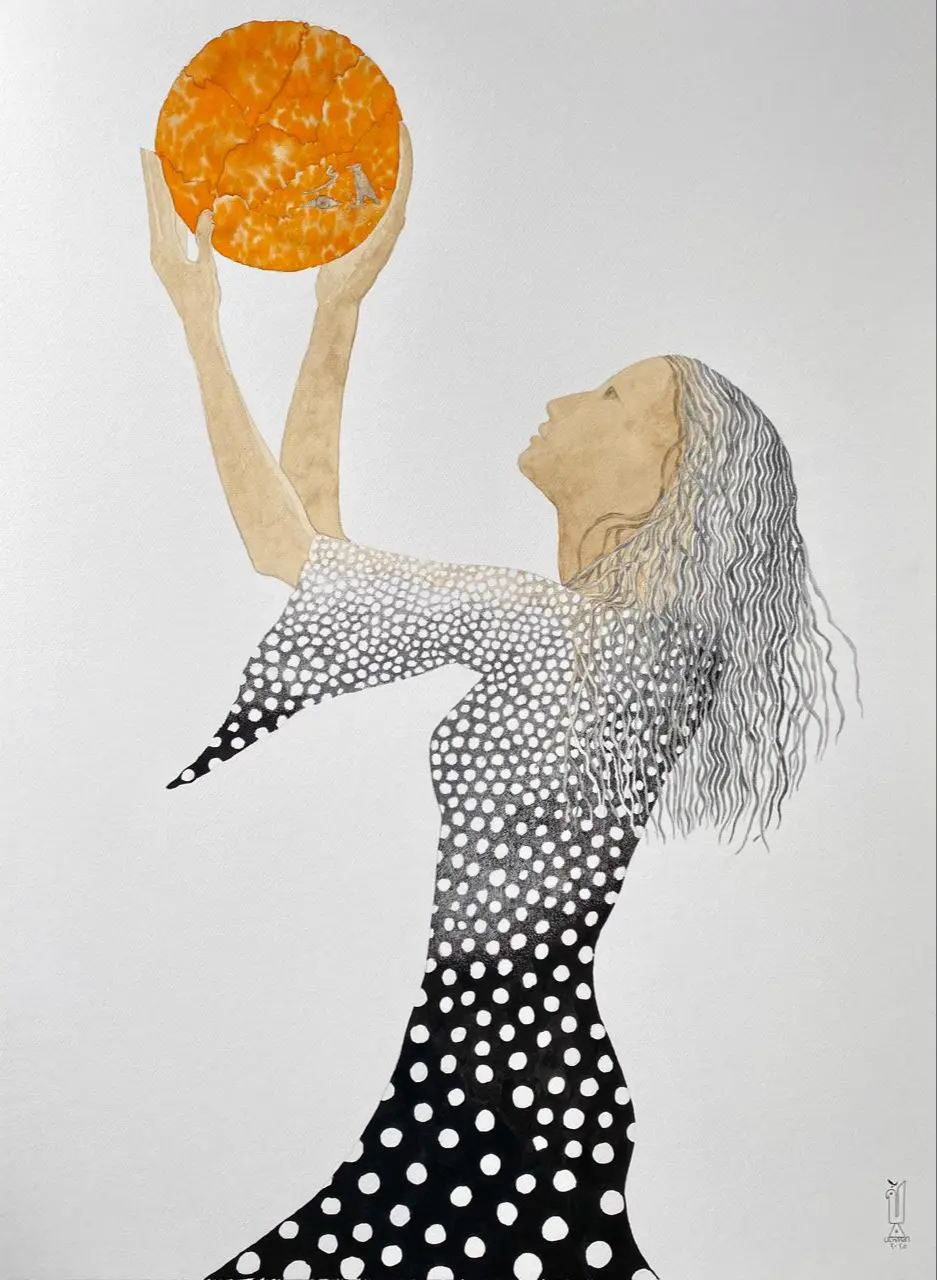
In Self Identification, I wanted to explore that singular moment when we finally reach for our own truth. I painted the figure looking upward, not in prayer, but in recognition of the light she holds between her hands.
The sphere is intentionally textured and vibrant—it represents the sun, the soul, or perhaps the core of one's identity that is both solid and fragile. I used a gradient of polka dots on her dress to suggest a transition from the dark into the light, mirroring the process of self-discovery. Her hair flows like water, suggesting a fluid mind that is open to the universe. For me, this piece is about the courage it takes to lift our own light above us and say, 'This is who I am.' It is a quiet celebration of the internal light that guides us through the darkness