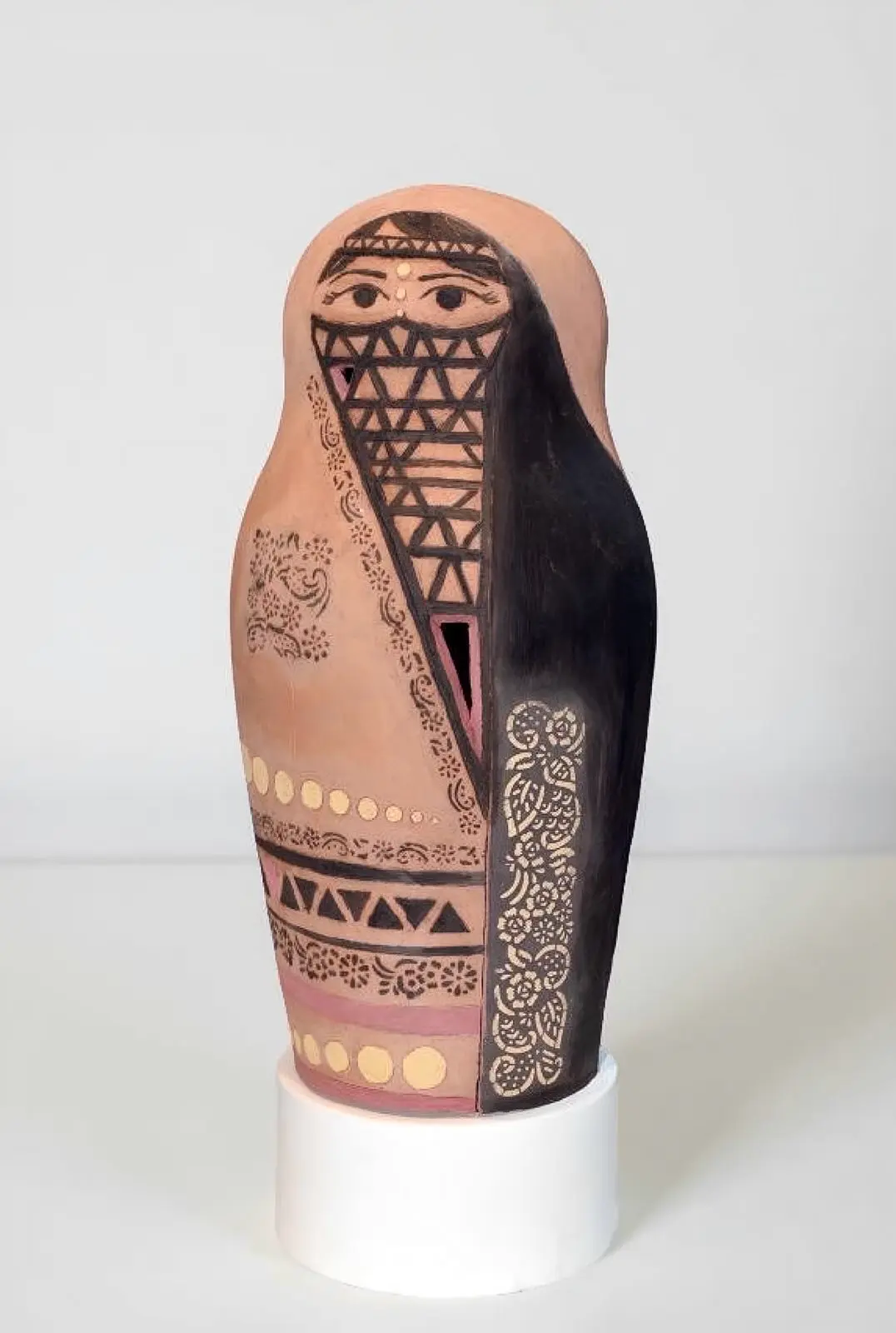

Dina Rihan is a prominent Egyptian sculptor, ceramicist, and academic whose work bridges heritage and contemporary expression. She is widely recognized for her distinctive approach to ceramic sculpture, blending symbolic abstraction with deep cultural references rooted in Egyptian identity. Rihan is an Associate Professor teaching at both Faculty of Fine Arts, Alexandria University and Ahram Canadian University. Through her academic role, she actively contributes to the development of emerging artists exploring the intersection of traditional craftsmanship and contemporary practices. She pursued her PhD research at the Accademia di Belle Arti di Roma in Italy and at Cardiff Metropolitan University in the United Kingdom. These international academic experiences significantly enriched her artistic vision, expanding her exposure to diverse methodologies and contemporary approaches in ceramic and sculptural practices. Artistically, Dina Rihan is known for her ability to reinterpret historical and spiritual themes through a contemporary lens. Her work often draws from Coptic and Islamic artistic heritage, which she reimagines through stylised and abstract ceramic forms. Her sculptures are characterised by a strong sense of symbolism, refined structure, and a unique visual language that balances solidity with expressive minimalism. Among her notable exhibitions is “Coptic Icons,” held at the Mahmoud Saeed Museum in Alexandria, where she presented a contemporary vision of Coptic religious iconography through ceramic sculpture. She also presented “Matryoshka Tales” at the Mahmoud Mokhtar Museum. In addition, her duo international exhibition “Between Mesopotamia and the Nile” held in Sweden, further demonstrating her ability to merge narrative, cultural symbolism, and sculptural innovation within a cohesive artistic vision. Rihan has also represented Egypt in international exhibitions and cultural events, including participation in exhibitions in Rome and in the international cultural exhibition “Russia and BRICS Countries in a Cultural Horizon.” Alongside these, she has taken part in numerous exhibitions across the world, reinforcing her presence on the global art scene. Her work reflects an ongoing exploration of identity, spirituality, and material experimentation, positioning her as a distinctive and influential voice in contemporary ceramic art. Through her dual role as both artist and educator, Dina Rihan continues to shape the discourse of contemporary sculpture while preserving and transforming cultural heritage into modern artistic expression.
- Likes
- 25113
- Views
- 3545232
- Followers
- 100
- Following
- 5
This work serves as a silent, colorful guardian, representing a state of spiritual "Resurrection." The figure is rendered as a singular, unified column, stripped of limbs to focus the viewer's attention entirely on the internal spirit. The body is treated like a canvas, divided into bold geometric zones of forest green, terracotta pink, and deep black, colors that evoke the elemental cycle of earth, vegetation, and shadow.
The most distinctive element is the nimbus (or halo) that crowns the figure. Decorated with scrolling, symmetrical motifs, it suggests an aura of enlightenment or divine protection. The face itself is a minimal, heart-shaped engraving with closed eyes, conveying a sense of "introverted consciousness"—a being that has turned its gaze away from the material world toward the eternal.
The inclusion of the ornamental "heart" symbol on the chest further reinforces the theme of the body as a vessel for love or the soul. By combining the organic warmth of wood with a vibrant, modern color palette, the piece bridges the gap between ancient protective idols and contemporary explorations of inner peace. It stands as a "hymn" to resilience, suggesting that the most profound transformation occurs in silence and stillness.