
Egyptian Sculptor, born in 1988, graduated of Faculty of Art Education class2011, Got Master in Sculpture department 2018 & now pre PHD student at same department. Eman works with natural, familiar materials such as bronze, marble, granite and basalt, to create her abstract shapes. She participated in many exhibitions & symposiums in Egypt, Saudi Arabia, Abu Dhabi, Italy, Ukraine & Türkiye... such as Farouk Hosny competition2026, Decade Solo exhibition 2025, General exhibition many times till 2025,many participate at Picasso art gallery till 2025, AGENDA art exhibition 2025,Many participated at TAM art gallery till 2024, Adam Henin exhibition many times till 2024 and got many Prizes, many participate at Safar Khan gallery till2024, many participate at Ubuntu art gallery till 2023, Third sculpture salon2023, 1st Emaar Sculpture symposium 2021, 2nd Kyiv Sculpture symposium2020, 1st Salt stone symposium 2020, Aswan sculpture symposium 2018,Venice international Art Fair 2020, Many Participated at Mono gallery - AlRiyadh, Saudi Arabia. Have collections at Museum of Modern Egyptian Art, Aswan open museum&, Farouk Hosny Museum &, people in Egypt, Turkey, Saudi Arabia, Italy, Ukraine & America. Scholarship for Three years
- Likes
- 25113
- Views
- 3545232
- Followers
- 100
- Following
- 5
Credentials
- Awards
- 7
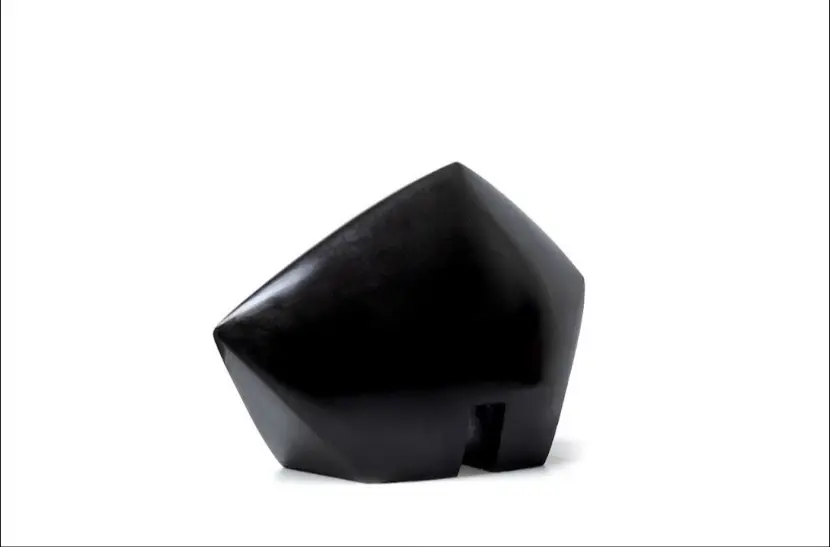
This work is a silent monolith that commands space through its absolute precision. It serves as a study of mass versus void, where the solid weight of the black stone is punctuated by a singular, rectangular notch at the base. This "cut" is vital; it transforms a heavy block into an architectural gate, suggesting that the sculpture is not merely sitting on the pedestal, but is actively "spanning" it.
The aesthetic power of the piece lies in its planar transitions. As the viewer moves around the work, the sharp ridges catch the light, creating a high-contrast play of brilliant whites and absolute blacks. This interaction makes the stone appear almost liquid or metallic, masking its natural geological origins with a coat of "machine-like" perfection.
In the context of the other works you've shared—the spindly bronzes and the decorated woods—this piece represents the ultimate reduction. It strips away narrative, emotion, and texture to leave behind the "skeleton" of form. It is a monument to stability and the enduring logic of geometry.