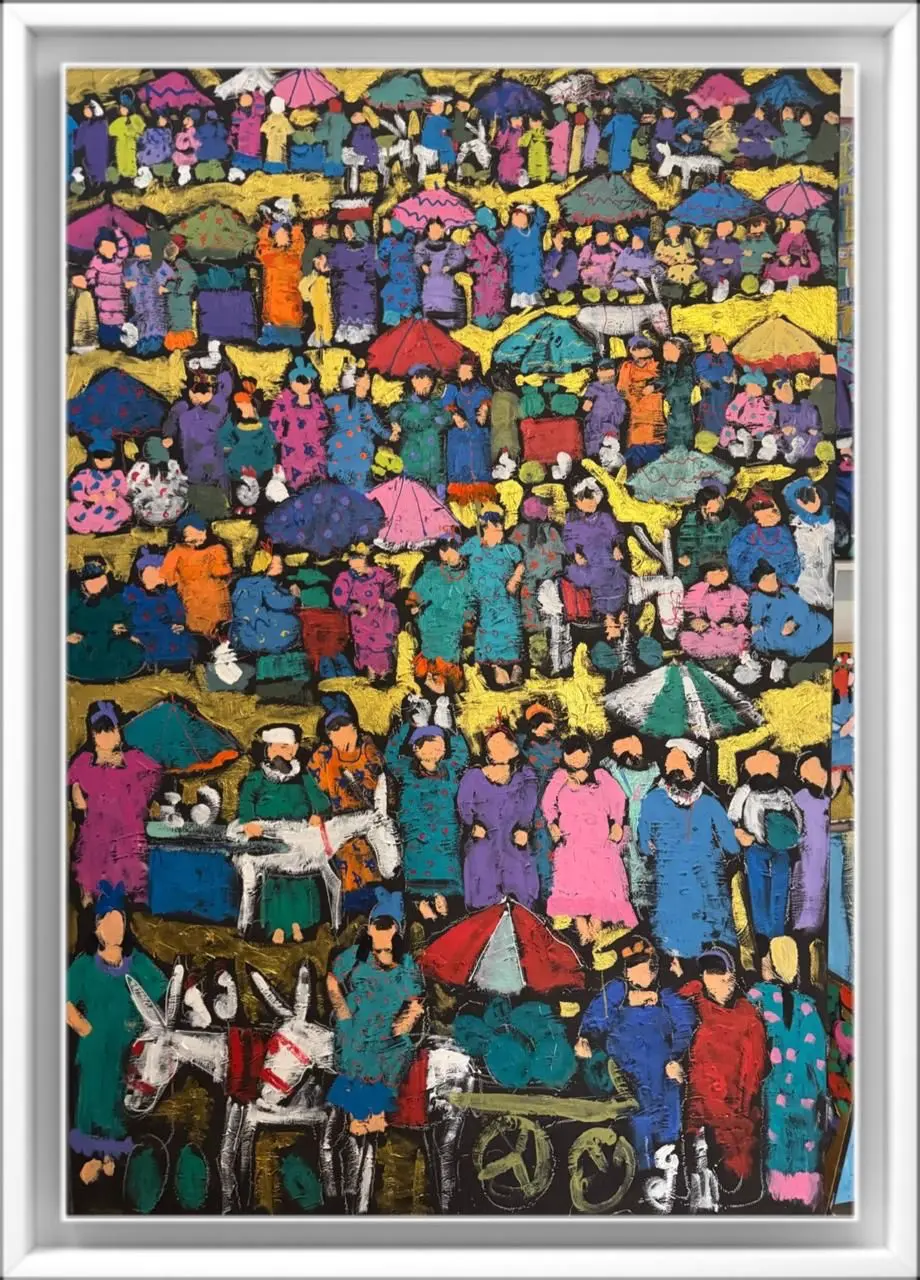

Born in Cairo in 1980, Miriam Hathout graduated from the Faculty of Fine Arts in Cairo. She has held 22 individual exhibitions, including in Switzerland, Germany, England, and Italy, and has participated in numerous international group exhibitions in countries like Switzerland, France, Italy, Lebanon, Morocco, Kuwait, Austria, and Saudi Arabia.
Hathout’s art celebrates Egyptian culture, using bright, vivid colors to portray landscapes, peasants, and Egyptian donkeys, which she sees as humble, intelligent, and hardworking animals. Her work also tackles the daily struggles faced by Egyptians living in poverty. Her technique blends Fauvism and Impressionism, focusing on bold, expressive color without paying much attention to fine details.
Her works are housed in private collections in Egypt, Dubai, Saudi Arabia, the USA, Australia, Germany, Switzerland, Italy, France, Serbia, Belgium, Spain, Cyprus, and the Czech Republic.
Join us in celebrating Miriam Hathout’s artistic journey and her valuable contribution to both Egyptian and international art. Stay tuned for more updates and highlights from this incredible exhibition!
- Likes
- 25113
- Views
- 3545232
- Followers
- 100
- Following
- 5
"In this vivid series, the artist celebrates the communal vitality of the marketplace and the field. The first work, a densely packed composition, utilizes a shimmering gold-leaf background to elevate an everyday market scene into something sacred and eternal. Figures adorned in a kaleidoscope of patterns—polka dots, stripes, and solid jewel tones—occupy every inch of the canvas, creating a sense of 'horror vacui' that mirrors the noise and motion of a trade hub. The inclusion of donkeys and carts anchors the scene in a timeless rural reality, while the absence of individualized facial features invites the viewer to see the crowd as a singular, living organism.
The second piece offers a more expansive view of agricultural labor. Set against a striking yellow field and a deep blue horizon, the figures move in rhythmic rows, their forms simplified into blocks of color. The artist uses a thick, gestural application of paint to give the figures a physical weight that contrasts with the airy, flattened landscape. Together, these works act as a joyful chronicle of human connection and labor, transforming the mundane details of rural life into a rhythmic, technicolor celebration of heritage and community."