
An Egyptian Artist, launched her artistic journey after graduating from Faculty of Art Education, who holds, a Bachelor's degree in Art Education (Art Education), Helwan University, 2011, and master's degree in sculpture from Faculty of Art Education "Sculpture Department" 2018, followed up with Pre_ PHD degree, "Sculpture Department", Faculty of Fine Arts, A Fulltime scholarship (2020-2021/2023_2024/2024_2025), and Member at the Fine Arts Syndicate. Hand building lively organic forms, Alaa incorporate bodies and organic forms in nature, responding to the curves of her own three-dimensional forms. she won multiple awards as ,2nd prize, 6th Art Awards, "Sculpture "Farouk Hosny Foundation of" Culture & Arts, Cairo, Egypt. 2025. 1st prize, 2nd "Adam Henein Prize", Cairo, Egypt,2018. 1st prize, 57th" Vanguards Exhibition, Fine Art Lovers" Association, Cairo, Egypt,2017. She gained international recognition through Symposium & Workshops as: 2019 - 24th Aswan International Sculpture Symposium, Aswan, Egypt. 2016 - 3rd Madinaty International Sculpture Symposium, Cairo, Egypt. 2009 - 2nd Art Workshop for the subject of Human Rights, Cairo, Egypt. 2016 - 2nd Cairo international scrap iron Sculpture Symposium, Cairo, Egypt. 2014 - 19th Aswan International Sculpture Symposium workshop, Aswan, Egypt. 2013 - Welding Iron scraps workshop, Cairo, Egypt. 2013 - 1st International Art Day Workshop, Ölüdeniz, Fethiye. Turkey. 2013 -12th Ostraka Art Festival, Sharm El Sheikh, Sharm El Sheikh, Egypt.
- Likes
- 25113
- Views
- 3545232
- Followers
- 100
- Following
- 5
Credentials
- Awards
- 1
- Group Exhibitions
- 14
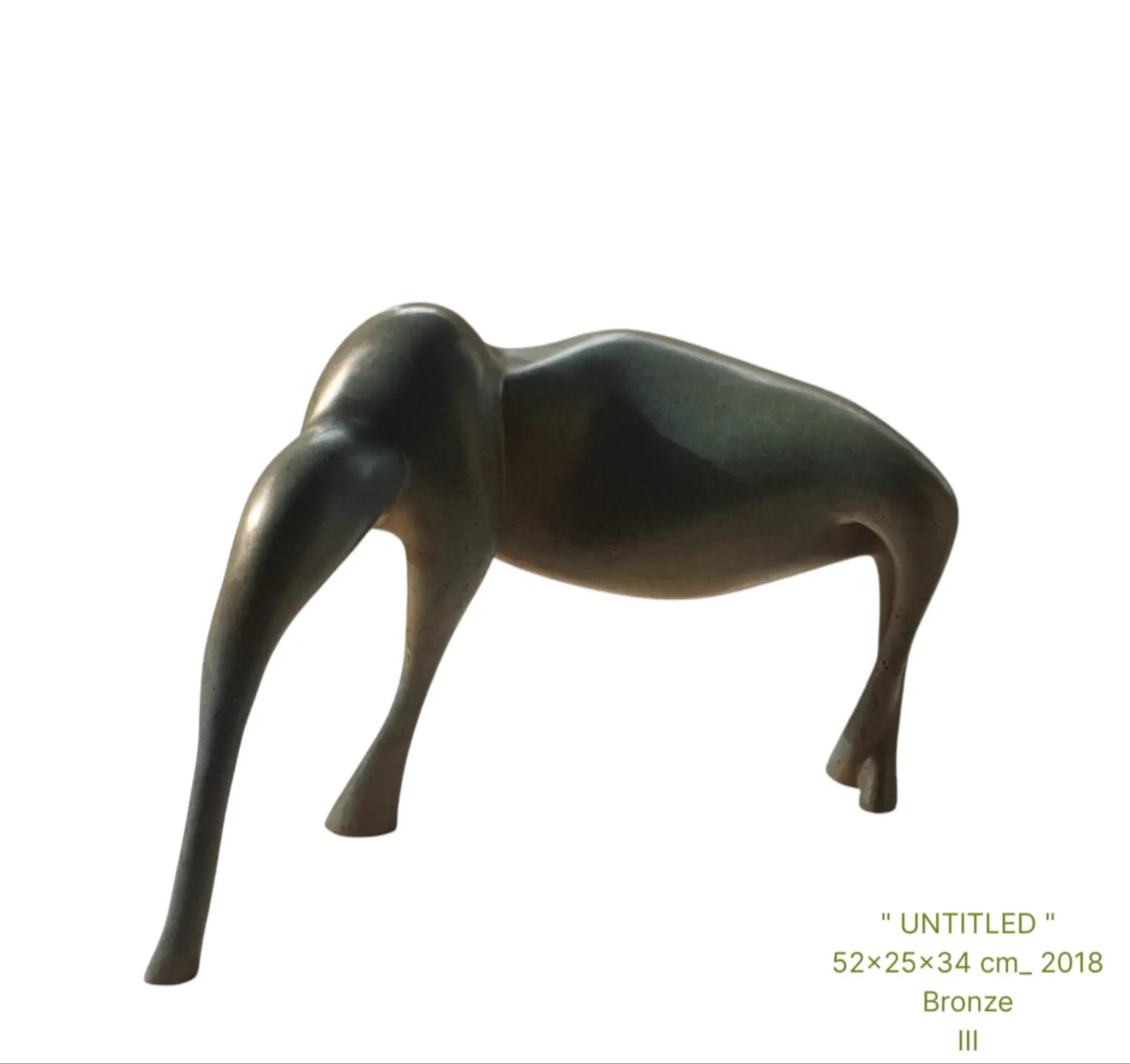
The form is tantalizingly recognizable yet purposefully elusive; it suggests the heavy gait of an elephant or the slow movement of a prehistoric creature, yet its "head" tapers into a singular, trunk-like limb that grounds the piece.
The sculpture is defined by its taut volume. There is a sense of internal pressure, as if the bronze is a skin stretched tight over a muscular interior. Unlike the spindly, anxious legs of Bourgeois’s work, form is rooted and communal with the earth. The smooth, uninterrupted transitions between the limbs and the torso emphasize a "oneness" of form—a hallmark of the pursuit of harmony and balance.
The patina plays a crucial role here; its matte, velvety texture absorbs light rather than reflecting it, giving the object a sense of profound weight and antiquity. It feels less like a modern creation and more like an artifact unearthed from a future civilization, bridging the gap between Egypt’s monumental past and the fluidity of the contemporary present.