


The theme for 2026—"Costume Art"—carried conceptual weight that previous Met Gala themes have sometimes lacked. Curator Andrew Bolton designed the accompanying exhibition to "explore the relationship between clothing and the body beneath," positioning fashion not as decoration applied to the body but as inseparable from corporeal experience. The dress code, "Fashion Is Art," instructed guests to "celebrate the countless depictions of the dressed body throughout art history." The result was a carpet that felt more cohesive than recent years, with attendees channeling specific art historical references rather than competing for maximum visual impact.
The Metropolitan Museum of Art's new Condé M. Nast Galleries, spanning nearly 12,000 square feet adjacent to the Great Hall, represented the institutional commitment that elevates fashion collecting from enthusiast pursuit to serious cultural investment. When the world's preeminent art museum dedicates permanent space to costume and fashion—not a temporary exhibition wing but enduring galleries carrying a media company's name—the message to collectors is unambiguous: fashion has achieved the institutional validation that separates collectible art from consumable product.
Co-chairs Beyoncé, Nicole Kidman, and Venus Williams joined Anna Wintour in hosting approximately 450 guests, with sponsorship from Saint Laurent, Condé Nast, and Jeff Bezos and Lauren Sánchez Bezos. The host committee featured Anthony Vaccarello and Zoë Kravitz, while the guest list included the predictable mix of fashion industry principals, entertainment figures, and the cultural adjacents who increasingly populate fashion's most exclusive gatherings.
Discover how fashion collectibles intersect with fine art at Artestial, where collectors explore wearable art alongside traditional visual arts.
The Return That Defined the Evening
Beyoncé's Decade-Long Absence Ends
The evening's most significant moment had nothing to do with fabric construction or embellishment counts. Beyoncé's return to the Met Gala—her first appearance since 2016—dominated coverage in ways that reminded observers why certain celebrities transcend mere attendance. Arriving with daughter Blue Ivy and husband Jay-Z, the artist who once attended as reliably as any fashion insider had spent ten years away from the carpet that defined fashion's social calendar.
Her absence had become its own statement. During years when the Met Gala generated endless content cycles, Beyoncé's non-participation suggested either strategic removal from fashion's most photographed event or priorities that rendered even fashion's biggest night insufficient draw. Her return as co-chair—not merely attendee but host—reframed the narrative: she hadn't avoided the Met Gala; she had waited for an occasion worthy of her return.
The look itself—details guarded more closely than most state secrets—embodied the "Costume Art" theme through construction that reportedly required months of development. Blue Ivy's coordinated appearance marked another generational transition: the next generation of cultural figures learning to navigate fashion's most demanding stage under maternal guidance.
For collectors, Beyoncé's return carried implications beyond celebrity watching. Her decade of absence coincided with the Met Gala's evolution from fashion industry event to content-generating spectacle. Her return as co-chair suggested the event might be reclaiming substantive cultural positioning that pure spectacle had eroded. When figures of Beyoncé's cultural significance choose to participate, they signal that participation carries meaning beyond mere visibility.
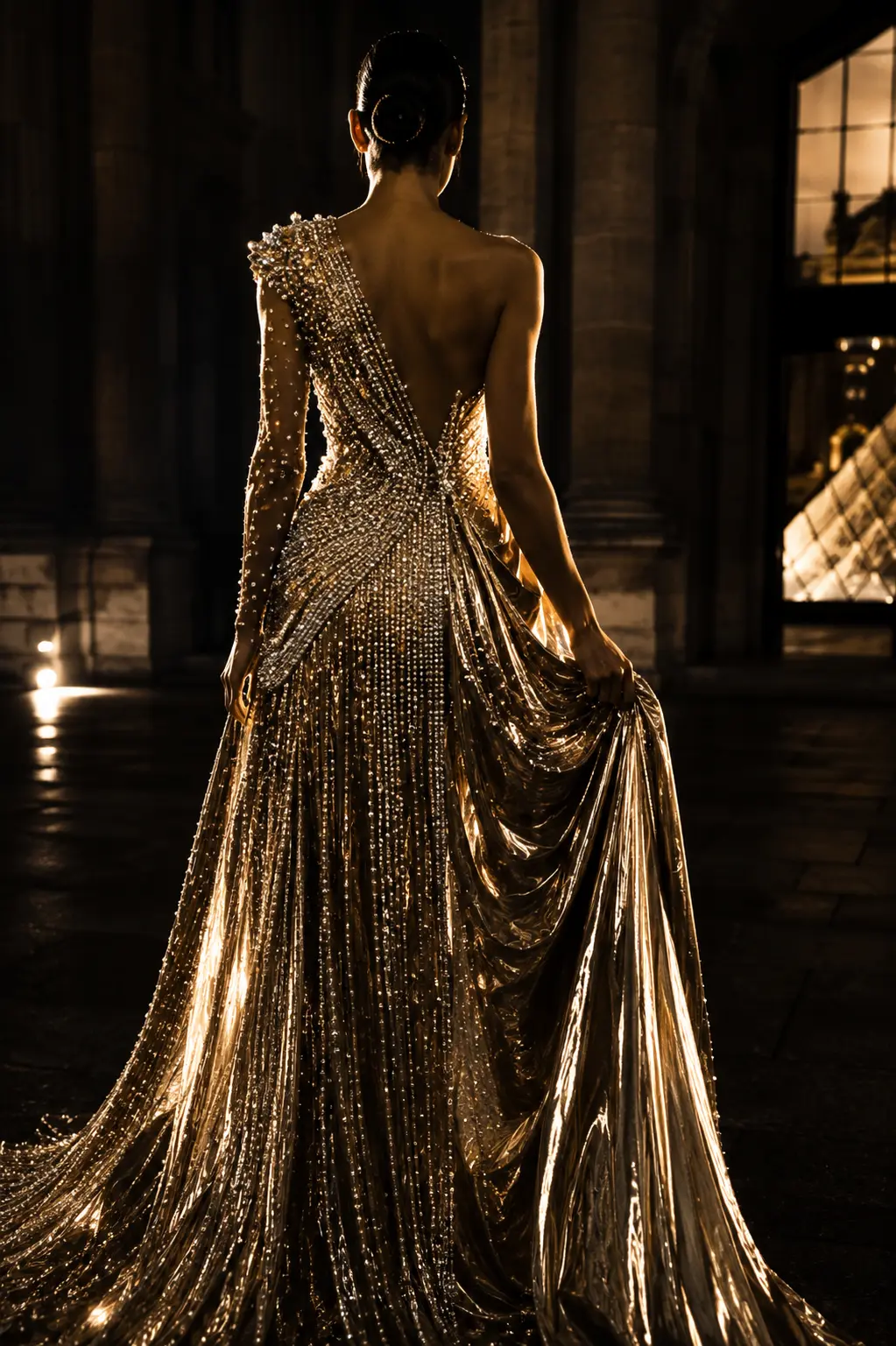
Met Gala 2026 crystal bead couture gown sculptural fashion editorial
Rihanna Closes the Carpet
If Beyoncé's return defined the evening's emotional center, Rihanna's arrival—fashionably late as tradition demands—provided its visual crescendo. The singer arrived last, walking the carpet after official coverage had technically concluded, in a sculptural gold creation from Maison Margiela by Glenn Martens. The gown featured over 115,000 crystal beads, antique jewels, and artistic baubles that transformed the wearer into three-dimensional artwork.
Partner A$AP Rocky accompanied in custom Chanel by Matthieu Blazy—a baby-pink robe coat with wide lapels that demonstrated how menswear at the Met Gala has evolved from afterthought to genuine fashion statement. The couple's coordinated arrival represented the kind of fashion partnership that generates coverage cycles extending well beyond the event itself.
Rihanna's Met Gala appearances have become their own institution within the institution. Her 2015 Guo Pei cape, her 2017 Comme des Garçons construction, her 2018 papal-inspired Maison Margiela—each has entered fashion historical canon as reference points for how celebrities can transcend the carpet's constraints. The 2026 appearance continued this trajectory, providing imagery that will circulate through fashion discourse for years.
The Maison Margiela choice connected to broader patterns worth noting. Glenn Martens's work for the house has attracted collectors who see couture-level construction at prices below traditional couture houses. When Rihanna chooses Margiela over houses with larger celebrity dressing operations, she signals the kind of insider knowledge that fashion collectors increasingly seek to emulate.
Standout Looks and Their Collector Implications
Schiaparelli's Sculptural Moment
Kylie Jenner's custom Schiaparelli provided one of the evening's most discussed images. The satin skirt featured over 2,000 satin stitch balls, 10,000 natural baroque pearls, and more than 7,000 painted pearlescent fish scales—construction density that approaches fine art fabrication costs rather than fashion production economics. The sculptural bodice referenced Schiaparelli's surrealist heritage while the skirt's marine motifs connected to natural history museum aesthetics.
Daniel Roseberry's Schiaparelli has emerged as the house most consistently generating Met Gala moments that transcend the event itself. The house's willingness to create pieces that function as wearable sculpture—rather than merely dramatic fashion—positions it uniquely for collectors interested in fashion-as-art rather than fashion-as-clothing. Pieces from Schiaparelli's couture archive have begun appearing at auction with prices reflecting art market rather than fashion market dynamics.
Emma Chamberlain's custom Mugler, styled by Jared Ellner with Stuart Weitzman shoes and Chopard jewelry, demonstrated how younger content creators have achieved fashion access previously reserved for entertainment industry principals. Chamberlain's presence—and the caliber of her custom creation—indicated fashion houses' recognition that influence now flows through platforms rather than traditional media channels.
Art Historical References That Landed
Teyana Taylor's Thom Browne gown paid explicit tribute to the Venus de Milo, constructed from over 1.5 million colorful sequins that recreated the sculpture's classical form. The look required understanding specific art historical reference to fully appreciate—exactly the kind of conceptual fashion that the "Costume Art" theme invited and that distinguishes fashion-as-art from fashion-as-spectacle.
Anne Hathaway, starring in the forthcoming "The Devil Wears Prada 2," appeared in Michael Kors with hand-painted designs by artist Peter McGough. The collaboration between fashion house and visual artist represented the kind of cross-disciplinary work that collectors increasingly value—pieces where fashion and fine art credit belong jointly rather than to designer alone.
Lisa of Blackpink's Robert Wun creation featured a sheer bedazzled dress with a headpiece incorporating two mannequin-like arms connected to her shoulders, allowing white draping to fold over her head. The conceptual construction pushed costume boundaries toward performance art, raising questions about where fashion ends and other art forms begin that the evening's theme explicitly invited.
![[IMAGE 3 — AI GENERATE WITH PROMPT:]"Fashion illustration, athletic elegant woman in shimmering Swarovski crystal mesh gown, thousands of tiny crystals catching light like stars, sleek silhouette, dramatic statement necklace with circular medallion, museum steps background at night, editorial fashion photography style, silver and white color palette, no face visible, vertical portrait"](/media/remote/0/0/3/6/d/5/6/6/b/4/0036d566b4cf8a90daa625b425d53fec7f86b322ed89869b23c35cc6fffbfd0682-639161560185027640-864x1536-212154-2255761-Public.webp)
Met Gala 2026 crystal mesh gown statement necklace fashion editorial
The Men Who Made Statements
Menswear at the 2026 Met Gala demonstrated the evolution from black-tie conformity toward genuine fashion expression that recent years have accelerated. Bad Bunny appeared as an elderly version of himself, wearing custom Zara with prosthetics, gray hair, and a cane—makeup artistry by Mike Marino, known for Heidi Klum's iconic Halloween transformations. The choice to age himself by decades while wearing an accessible brand like Zara commented simultaneously on mortality, fashion democracy, and the Met Gala's increasingly conceptual expectations.
Colman Domingo wore colorful custom Valentino styled with Boucheron jewelry and an Omega watch, demonstrating how maximalist menswear can achieve the same impact as sculptural gowns when executed with intention. Luke Evans's all-leather Palomo Spain ensemble, inspired by Tom of Finland, brought explicit queer art historical reference to the carpet—the kind of cultural specificity that "Costume Art" encouraged.
A$AP Rocky's custom Chanel represented Matthieu Blazy's continued reinvention of the house under his new creative direction. The baby-pink palette and robe silhouette departed from Chanel menswear conventions while remaining unmistakably connected to house codes. For collectors, Blazy's Chanel tenure offers acquisition opportunities as the designer establishes his vision—pieces from directorial transitions often appreciate as historical markers.
The Institutional Significance
A Permanent Home for Fashion
The Condé M. Nast Galleries' inauguration represented the evening's most consequential development for collectors, even if it attracted less coverage than individual looks. When the Metropolitan Museum of Art dedicates 12,000 square feet of permanent gallery space to costume and fashion, adjacent to the Great Hall that houses the institution's most prized works, the statement extends beyond curatorial preference to institutional positioning.
Fashion has historically occupied ambiguous museum status—displayed in dedicated fashion museums or temporary exhibitions at fine art institutions, but rarely granted the permanent presence that painting, sculpture, and decorative arts enjoy. The Condé M. Nast Galleries change this calculation at the world's most influential art museum. Fashion now has a permanent address at the Met, with all the legitimacy implications that permanence confers.
For collectors, this institutional recognition validates investment theses that have guided serious fashion collecting for decades. Pieces from significant designers, particularly those with museum exhibition history, gain provenance value from institutional association. The Costume Institute's expanded presence suggests continued acquisition activity—meaning the institution will compete with private collectors for significant pieces, supporting market values.
The exhibition itself, curated by Andrew Bolton, explored "the centrality of the dressed body in the museum's vast collection," pairing Costume Institute holdings with paintings, sculptures, and other art spanning 5,000 years. This curatorial approach—integrating fashion with fine art rather than displaying it separately—reinforced the evening's thesis that fashion belongs within art historical discourse rather than adjacent to it.
Connect with Artestial's specialists for guidance on building collections that span traditional and wearable art forms.
Notable Absences and What They Signal
The Zendaya Question
Zendaya's absence generated as much discussion as many attendees' presences. The actress, who served as co-chair in 2024 and has delivered some of the Met Gala's most memorable looks in partnership with stylist Law Roach, was notably missing from 2026. Roach told E! News that Zendaya simply wasn't attending this year—no elaborate explanation, no scheduling conflict narrative.
The absence invited speculation about Met Gala fatigue among figures who have dominated coverage in recent years. When someone as reliably spectacular as Zendaya chooses not to attend, questions emerge about whether the event's content demands have become exhausting rather than inspiring. Timothée Chalamet, another reliable presence, also skipped the evening.
For fashion observers, high-profile absences sometimes signal inflection points. If figures who have defined recent Met Gala aesthetics begin withdrawing, the event may need to evolve to retain cultural relevance. Alternatively, strategic absences may make eventual returns more impactful—as Beyoncé's decade away demonstrated.
The Wintour Transition
Anna Wintour's presence as chair—her 31st consecutive year—carried different significance following her June 2025 departure from Vogue's editor-in-chief position. Now serving as Condé Nast's global editorial director and global chief content officer, Wintour retains Met Gala chair responsibilities but operates from a different institutional position than the one that defined her public identity for decades.
The transition raises succession questions that will eventually affect the Met Gala's character. Wintour's editorial sensibility has shaped guest lists, dress codes, and the event's cultural positioning for three decades. When she eventually steps back from chair responsibilities, whoever succeeds her will necessarily bring different aesthetic preferences and industry relationships.
For collectors, the Wintour era has coincided with fashion's elevation to serious art market consideration. Whether that trajectory continues under future leadership remains uncertain. The institutional framework now exists—permanent galleries, established exhibition programming, documented collector markets—but leadership transitions always introduce unpredictability.

Met Gala 2026 Metropolitan Museum steps blue carpet gala night exterior
Designer Representation and Market Signals
Houses That Dominated
Maison Margiela's presence extended beyond Rihanna's closing look. Multiple attendees chose Glenn Martens's vision for the house, suggesting his tenure has achieved the cultural positioning that drives both editorial coverage and collector interest. Margiela pieces from the Martens era represent acquisition opportunities before market consensus fully forms around his directorial significance.
Saint Laurent's title sponsorship translated to significant carpet presence, with multiple guests in Anthony Vaccarello designs. The house's commercial success under Vaccarello has sometimes overshadowed critical assessment of his creative contributions; Met Gala representation reminded observers that commercial viability and fashion significance need not conflict.
Thom Browne's continued presence—including Teyana Taylor's Venus de Milo and other sculptural pieces—reinforced the designer's positioning at fashion's conceptual edge. Browne pieces command prices reflecting their construction complexity and art historical ambition; Met Gala appearances validate collector assessments of his significance.
Emerging Designers and Discovery
Robert Wun's work on Lisa's look represented the kind of emerging designer visibility that Met Gala appearances can catalyze. Wun, whose work combines Asian cultural references with avant-garde construction, gained global exposure that would otherwise require years of editorial cultivation. Collectors attentive to emerging talent might note Wun as a name to watch.
The presence of custom pieces from houses like Palomo Spain alongside established luxury brands demonstrated the Met Gala's continued role as discovery platform. When Luke Evans wears Palomo Spain to an event dominated by Chanel, Valentino, and Schiaparelli, the Spanish house gains association with fashion's highest-profile gathering. Early collectors of emerging designers benefit from exactly this kind of visibility event.
Frequently Asked Questions
What was the 2026 Met Gala theme and how did it differ from previous years?
The 2026 theme was "Costume Art," with a dress code of "Fashion Is Art" instructing guests to "celebrate the countless depictions of the dressed body throughout art history." Unlike recent themes that emphasized specific aesthetic periods or cultural movements, "Costume Art" invited conceptual interpretation—guests channeling art historical references rather than literal costume representations. Curator Andrew Bolton designed the accompanying exhibition to explore fashion's relationship with the body, positioning clothing as inseparable from corporeal experience rather than decoration applied to it. The result was a more cohesive carpet than recent years, with attendees demonstrating specific artistic knowledge rather than competing for maximum visual impact.
Why was Beyoncé's return significant after her decade-long absence?
Beyoncé last attended the Met Gala in 2016, making her 2026 return as co-chair—not merely attendee—particularly notable. Her decade-long absence coincided with the Met Gala's evolution from fashion industry event to content-generating spectacle that some critics argue diluted its cultural significance. Her return as co-chair alongside Nicole Kidman and Venus Williams suggested the event might be reclaiming substantive positioning that pure spectacle had eroded. When figures of Beyoncé's cultural significance choose to participate after extended absence, they signal that participation carries meaning beyond mere visibility. Her arrival with daughter Blue Ivy also marked generational transition, introducing the next generation of cultural figures to fashion's most demanding stage.
What do the new Condé M. Nast Galleries mean for fashion collecting?
The inauguration of the 12,000-square-foot Condé M. Nast Galleries represents the most significant institutional development for fashion collecting in decades. Located adjacent to the Metropolitan Museum of Art's Great Hall, these permanent galleries give fashion the same institutional presence that painting, sculpture, and decorative arts enjoy. Previously, fashion occupied temporary exhibition space at fine art institutions or dedicated fashion museums; permanent galleries at the world's most influential art museum validate fashion as collectible art form. For collectors, this institutional recognition supports investment theses, as museum exhibition history and institutional association enhance provenance value. The Costume Institute's expanded presence also suggests continued acquisition activity that will compete with private collectors for significant pieces, supporting market values.
How should collectors interpret celebrity fashion choices at the Met Gala?
Celebrity Met Gala choices provide market intelligence when read through collector rather than entertainment lenses. Houses receiving multiple commissions—like Maison Margiela in 2026—demonstrate cultural momentum that often precedes market appreciation. Emerging designers gaining visibility through celebrity dressing, like Robert Wun with Lisa's look, represent acquisition opportunities before broader recognition forms. Custom pieces requiring months of development and artisanal construction, like Schiaparelli's pearl-encrusted creation for Kylie Jenner, indicate fashion-as-art positioning that supports art market rather than fashion market pricing. Strategic absences by previously reliable attendees may signal event evolution worth monitoring. Reading the carpet as market intelligence rather than entertainment coverage reveals patterns that inform collecting strategy.
What trends from the 2026 Met Gala might influence fashion collecting?
Several 2026 trends carry collector implications. The emphasis on explicit art historical reference—Teyana Taylor's Venus de Milo, Lisa's performance-art conceptualism—suggests continued appreciation for fashion that demonstrates cultural knowledge rather than mere spectacle. Menswear's evolution toward genuine fashion expression, exemplified by Bad Bunny's aged-self concept and Colman Domingo's maximalist Valentino, indicates growing collector interest in men's fashion beyond traditional categories. The Maison Margiela presence across multiple attendees suggests Glenn Martens's tenure deserves collector attention before market consensus fully forms. Cross-disciplinary pieces combining fashion design with visual artist collaboration, like Anne Hathaway's Michael Kors with Peter McGough painting, point toward collecting strategies that span traditional category boundaries.
Ready to explore fashion as collectible art? Visit Artestial where collectors discover wearable art alongside traditional visual arts, or connect with specialists for guidance on building collections that span costume, couture, and fine art.
Curating excellence, one insight at a time.
— AURUM Team
Disclaimer: This article provides educational information about the 2026 Met Gala and fashion collecting. It does not constitute investment, financial, or legal advice. Fashion and art acquisitions involve risks including illiquidity, subjective valuation, and market volatility. Information about the 2026 Met Gala derives from publicly available sources including press coverage, designer announcements, and institutional communications. Specific construction details and embellishment counts reflect reported information from designers and media outlets. Readers should conduct independent research before making acquisition decisions.