

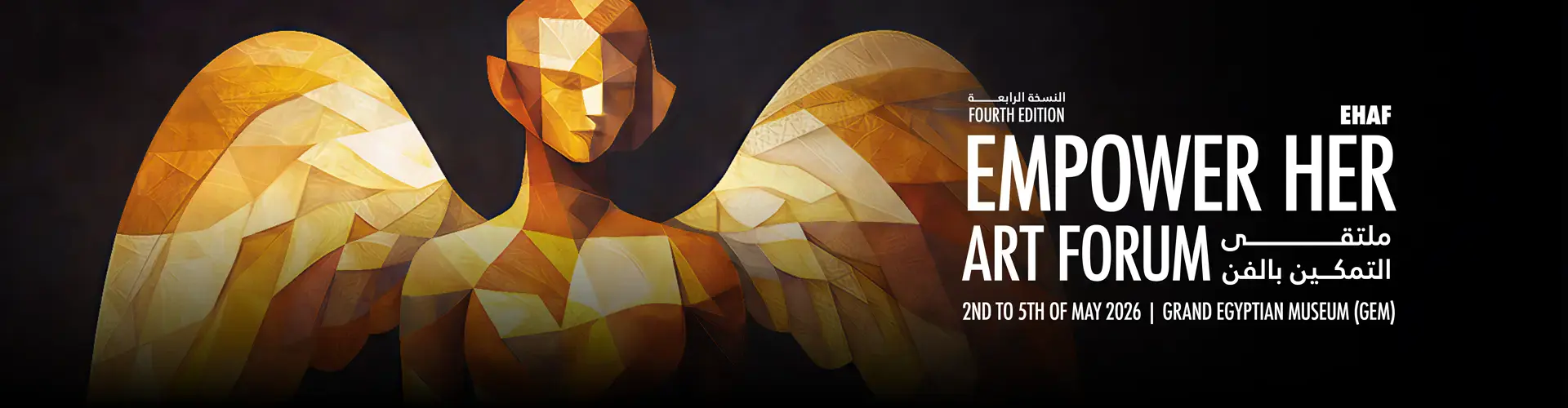
The Empower Her Art Forum exists because Shereen Badr, founder and CEO of the Artoday Foundation, recognized a structural gap in global art infrastructure. Women artists, particularly those working outside Western market centers, lack the institutional support and collector access that their counterparts in New York, London, and Berlin take for granted. Since launching EHAF in 2023, Badr has built a platform that addresses this gap directly—not through critique but through construction, creating the exhibition opportunities, collector relationships, and institutional partnerships that transform artistic careers.
The fourth edition represented the forum's most ambitious iteration yet. Moving to the Grand Egyptian Museum, which opened fully in 2024 as the world's largest archaeological museum, placed contemporary women artists in dialogue with five thousand years of Egyptian civilization. The juxtaposition was intentional: art-making as continuous practice, women's creative contributions as historical constant rather than contemporary exception. Collectors walking from EHAF exhibitions to encounter the golden mask of Tutankhamun experienced exactly the curatorial ambition Badr envisioned—temporal collapse that reframes contemporary practice within civilizational continuity.
The partnership infrastructure surrounding EHAF 2026 revealed how seriously institutional stakeholders now take such platforms. Strategic partners included UNHCR Egypt and UN Women Egypt, reflecting alignment with sustainable development goals around gender equality and cultural preservation. Embassy participation from Spain, Italy, Germany, Ecuador, China, Turkey, and Azerbaijan demonstrated diplomatic recognition that cultural exchange creates relationships transcending traditional channels. The Egyptian Ministry of Culture and National Council for Women provided official partnership, embedding the forum within governmental cultural strategy.
Discover how collectors access artists outside traditional market centers at Artestial, where emerging voices from Egypt and the broader region connect with collectors seeking authentic discovery.
The Architecture of Discovery
What Collectors Found at GEM
The Grand Egyptian Museum's contemporary exhibition spaces, designed to complement the archaeological collections, provided gallery-quality environments rarely available to emerging artists. Proper lighting, climate control, professional installation—the infrastructure that established galleries offer their represented artists became available to participants whose home markets often lack such facilities. This leveling of presentation quality allowed collectors to evaluate work on artistic merit rather than discounting for substandard display conditions.
The exhibition organized participants by nationality, creating pavilion-style presentations that contextualized individual practices within broader national artistic conversations. The Azerbaijani stand, supported by that country's embassy and SOCAR Trading, featured seven artists including Billura Alakbarli, Leyla Guliyeva, and Jala Aziz. The Turkish delegation brought six artists whose work addressed identity, heritage, resilience, and transformation through distinctly contemporary visual languages. Italian, Chinese, German, and Spanish contingents demonstrated how women artists across cultures engage with both local traditions and global contemporary discourse.
For collectors, this organizational structure enabled efficient comparative viewing. Rather than encountering individual artists in isolation, visitors could assess how specific practices related to national artistic contexts—understanding whether an artist's approach represented innovative departure or continuation of established traditions, whether technical choices reflected individual vision or broader cultural conventions. This contextual information, often unavailable when encountering artists through conventional gallery channels, supports more informed acquisition decisions.
The forum's programming extended beyond static exhibition. Panel discussions addressed themes including "Women Shaping Identity Through Art & Culture," "Voices of Women Leading Transformation," and "Women Disrupting the Creative Economy"—sessions where collectors could hear artists articulate intentions, influences, and ambitions directly. Live painting sessions demonstrated technical practices that finished works alone cannot reveal. Workshops led by international artists from Spain, Germany, Ethiopia, Greece, Turkey, and Oman provided educational programming that deepened engagement beyond passive viewing.
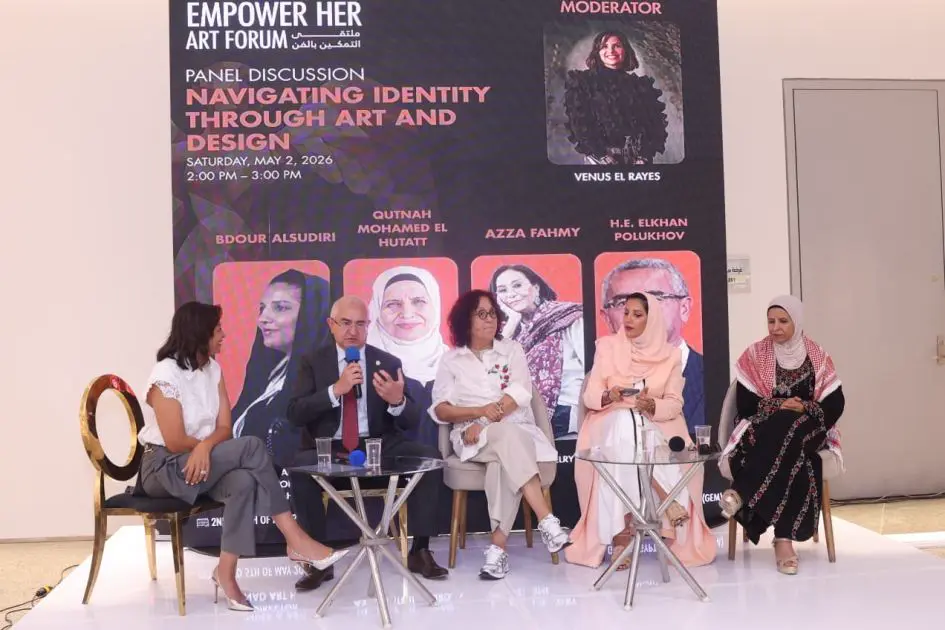
Panel discussion at EHAF 2026 featuring women artists and cultural leaders at the Grand Egyptian Museum. Photo: AzerNews
The Economics of Early Access
Collectors encountering artists through forums like EHAF operate under different economic conditions than those acquiring through established gallery channels. Without gallery representation taking standard commissions, without auction house premiums, without the accumulated markup that accompanies market validation, prices often reflect production costs and artist sustainability requirements rather than speculative positioning.
This pricing reality creates both opportunity and responsibility. Opportunity because collectors can acquire significant works at fractions of what equivalent quality commands in established markets—not because the work merits lower prices but because market infrastructure hasn't yet established price floors. Responsibility because collectors acquiring at these levels have outsized impact on artist careers: purchases at emerging stages provide validation that can attract subsequent gallery interest, critical attention, and institutional acquisition.
The absence of secondary market data for most EHAF participants means collectors cannot rely on auction comparables or price indices when evaluating acquisitions. Instead, evaluation requires direct engagement with the work itself—technical accomplishment, conceptual rigor, material quality, and that ineffable quality of presence that distinguishes significant art from competent production. Collectors comfortable with such evaluation often find the experience more rewarding than selecting from pre-validated options where market consensus has already formed.
Some collectors approach such acquisitions speculatively, hoping early purchases will appreciate as artists gain recognition. This approach misunderstands the purpose and value of early-stage collecting. Artists encountered at forums like EHAF may never achieve market recognition in conventional terms—their careers may develop regionally, their importance may remain art-historical rather than commercial, their work may matter in ways that never translate to auction records. Collectors who acquire primarily seeking future appreciation will likely be disappointed; collectors who acquire because they respond to the work and wish to support its continued creation will likely be satisfied regardless of market outcomes.
Regional Context: Egypt's Emerging Infrastructure
Why Cairo Matters Now
Egypt's art infrastructure has developed significantly over the past decade, creating conditions that didn't exist when EHAF launched. The Grand Egyptian Museum's completion marked a symbolic turning point: Egypt now possesses world-class cultural facilities capable of hosting international programming at the highest standards. The National Museum of Egyptian Civilization, where EHAF held its second edition, similarly provides contemporary exhibition capacity within historically significant contexts.
Beyond physical infrastructure, Egypt has developed the institutional relationships that enable meaningful international cultural exchange. Government ministries—Culture, Tourism, Social Solidarity, Youth and Sports, Environment—now coordinate around cultural programming in ways that demonstrate strategic prioritization. The National Council for Women provides gender-focused institutional support. International organizations including UN Women and UNHCR contribute frameworks that position cultural programming within broader development objectives.
For collectors interested in the Middle East and North Africa region, Egypt offers advantages that neighboring markets lack. Unlike the Gulf states where contemporary art scenes developed recently through top-down investment, Egypt possesses continuous artistic traditions extending through modern and contemporary periods. Unlike conflict-affected neighbors where cultural infrastructure has suffered, Egypt has maintained and expanded institutional capacity. Unlike smaller markets where collector bases remain thin, Egypt's population and diaspora provide audience scale that supports artist development.
Cairo's gallery scene, while less internationally visible than Dubai's, has produced important artists who now command significant market attention. The city's art schools continue training practitioners who may lack immediate market access but possess technical foundations and conceptual education comparable to Western counterparts. Forums like EHAF function as bridge infrastructure, connecting this production capacity with collector attention that might otherwise focus exclusively on market centers.
Explore how Artestial connects collectors with Egyptian and regional contemporary art, where artists keep 100% of their sales and collectors access authentic discovery opportunities.
What EHAF Signals for Collecting Strategy
Diversification Beyond Geography
Collecting exclusively through Western market centers creates portfolio concentration that sophisticated collectors increasingly recognize as suboptimal. When all acquisitions come through New York galleries, London auctions, and European fairs, collections reflect the preferences, blind spots, and biases of those systems. Important artistic production happening elsewhere—not marginal work but significant contributions to contemporary practice—remains invisible until market mechanisms eventually discover and validate it, at which point early-access advantages have disappeared.
EHAF represents one infrastructure among many enabling diversification. Similar platforms operate across regions: 1-54 Contemporary African Art Fair in Marrakech and London, Art Dubai's Global Art Forum programming, the Sharjah Biennial's emphasis on non-Western practice, India Art Fair's showcase of South Asian production. Collectors building geographically diversified collections learn to navigate multiple such platforms, developing relationships with regional specialists who provide access and context that generalist advisors cannot offer.
The women-focused framing of EHAF adds another diversification dimension. Art historical scholarship has documented how women artists have been systematically undervalued relative to male counterparts producing comparable work. Market data consistently shows women artists' works selling for less than men's at equivalent career stages. For collectors, this systematic undervaluation represents opportunity: acquiring work that will eventually be recognized and revalued as art historical correction continues. EHAF concentrates such opportunities within a format designed specifically to address gender disparities.
Diversification logic shouldn't override quality assessment. Not every artist at EHAF merits acquisition; not every woman artist deserves purchase simply because gender disparities exist. The forums create access; collectors must still exercise judgment. But within quality bands, diversification logic suggests that acquiring women artists from non-Western markets may offer better risk-adjusted returns than acquiring male artists from Western markets at equivalent price points—not because the work is inherently superior but because systematic undervaluation creates mispricing that thoughtful collectors can exploit.

EHAF 2026 exhibition space at the Grand Egyptian Museum with national pavilion presentations. Photo: AzerNews
Building Relationships Beyond Transactions
Forums like EHAF enable relationship-building that conventional market channels discourage. Gallery transactions typically involve minimal artist interaction; auction purchases involve none. At EHAF, collectors encounter artists directly—in exhibition contexts, at panel discussions, during workshop sessions, in the informal conversations that emerge around any significant gathering. These encounters enable relationships that transform collecting from transaction to partnership.
Such relationships matter particularly when collecting emerging artists. Without established market infrastructure, artists depend on collector relationships for support that extends beyond purchase: studio visits that provide encouragement, introductions that expand networks, loans to exhibitions that build visibility, documentation assistance that professionalize archives. Collectors who engage at this level often find the relationship rewards exceed the aesthetic satisfaction of the work itself—they participate in career development rather than merely acquiring its outputs.
The diplomatic and institutional presence at EHAF creates relationship opportunities extending beyond individual artists. Embassy cultural attachés, foundation representatives, museum curators, and institutional leaders attend such events precisely to identify collectors interested in their regional or thematic focuses. A conversation at EHAF can lead to invitations for studio visits abroad, previews of upcoming institutional exhibitions, access to artists before broader market attention develops. These relationship networks compound over time, creating information advantages that improve collection quality and deepen collecting satisfaction.
Practical Considerations for Collecting Outside Centers
Due Diligence Without Established Infrastructure
Collecting from artists without gallery representation, auction history, or critical documentation requires modified due diligence approaches. Standard verification tools don't apply: no Artnet price database entries, no catalogue raisonné references, no authentication board protocols. Collectors must develop alternative assessment frameworks that provide confidence without established infrastructure support.
Direct artist engagement becomes essential. Understanding an artist's training, influences, working methods, and career trajectory enables assessment that market proxies would otherwise provide. For artists met at forums like EHAF, this engagement often happens naturally—the forum structure facilitates exactly the conversations that due diligence requires. Collectors should approach such conversations as information-gathering opportunities, asking about education, exhibition history, studio practices, material sources, and artistic intentions with genuine curiosity rather than interrogation affect.
Documentation standards should exceed what established market purchases require. Photograph acquisitions thoroughly, including details that might prove relevant for future authentication. Obtain any available provenance documentation, certificates, or artist statements. Document the acquisition context itself—which exhibition, which forum, when and where purchased. Create condition reports at acquisition that establish baseline state. Store all documentation systematically, recognizing that such records may eventually matter more than documentation accompanying gallery or auction purchases where institutional memory provides backup.
Consider the practical implications of acquiring from artists in markets with limited export infrastructure. Shipping, customs, insurance, and import duties vary significantly by country and artwork type. Artists accustomed to local sales may not have export experience; collectors may need to arrange logistics independently or through specialized art shipping services. Budget accordingly, recognizing that acquisition price alone doesn't capture total cost for works requiring international transport.
Authentication and Provenance for Emerging Artists
Authentication concerns differ for emerging artists compared to established figures. The forgery risks that plague blue-chip markets—sophisticated copies of valuable works—don't apply when artists lack market value sufficient to justify forgery investment. Instead, authentication concerns focus on establishing artist identity, verifying production date and circumstances, and creating records that will support future authentication needs.
Artist signatures, dates, and inscriptions matter more for emerging artists than established ones. Works acquired directly should be signed; if unsigned, collectors should request signatures before departing the acquisition venue. Documentation of the acquisition—dated photographs with the artist, purchase receipts, any certificates the artist provides—creates authentication chains that strengthen over time. The artist relationship itself provides authentication foundation: a collector who knows the artist, has visited their studio, and acquired directly has authentication confidence that subsequent owners will lack.
Provenance begins at acquisition. Collectors are establishing the first link in ownership chains that may eventually extend for decades or centuries. Recording acquisition circumstances thoroughly—date, location, event, price, any relevant context—creates the foundation for future provenance documentation. This responsibility accompanies early-stage collecting; the records collectors create become the art historical resources future researchers will consult.

Artists and collectors engaging with works at EHAF 2026, Grand Egyptian Museum. Photo: AzerNews
EHAF's Institutional Evolution
From Forum to Infrastructure
EHAF's growth from inaugural edition to fourth annual forum demonstrates institutional development that benefits collectors longitudinally. Each edition has expanded participant numbers, institutional partnerships, and programming scope. The move to the Grand Egyptian Museum for the fourth edition marked facility upgrade reflecting increased institutional confidence. Partnership expansion—from governmental ministries to UN agencies to diplomatic missions—demonstrates broadening stakeholder recognition.
For collectors, institutional evolution creates compounding benefits. Artists who participated in earlier EHAF editions have developed over subsequent years; tracking their progress enables informed acquisition decisions based on trajectory observation rather than single-point assessment. Institutional partnerships create frameworks that improve artist support between forums, enhancing the development environment for participating artists. Programming sophistication improves curatorial quality, meaning works exhibited at later editions benefit from more rigorous selection than earlier editions might have provided.
The networking infrastructure EHAF has built represents value independent of any individual exhibition. Collectors who engage with the forum over multiple editions develop relationships with organizers, curators, and repeat participants that provide ongoing intelligence about regional artistic developments. Shereen Badr and the Artoday Foundation have become trusted intermediaries whose recommendations carry weight; access to such intermediaries represents intangible but valuable collecting infrastructure.
Looking forward, EHAF's demonstrated success may inspire similar platforms elsewhere or expansion of EHAF's own model into additional markets or formats. Collectors who establish relationships now position themselves for early access as infrastructure develops. The forum's alignment with UN Sustainable Development Goals provides durability—international institutional support that purely commercial ventures lack. Government patronage through multiple Egyptian ministries suggests political sustainability that transcends any individual administration.
Frequently Asked Questions
How do collectors discover artists at forums like EHAF compared to traditional galleries?
Discovery at forums like EHAF requires active engagement rather than passive reception of gallery curation. Traditional galleries pre-select artists, present them within interpretive frameworks, and guide collector attention toward specific works. Forums present broader artist arrays without such filtering, requiring collectors to develop their own assessment frameworks and identify artists who merit deeper attention. This active discovery process demands more collector effort but often produces greater satisfaction—the finds feel personally earned rather than institutionally directed. Collectors should allocate significant time for forum attendance, expect to see much that doesn't resonate, and remain alert for the occasional work or artist that provokes genuine response. Photography permissions at forums typically allow documentation for later consideration, enabling collectors to reflect on discoveries after the immediate viewing environment's pressures subside.
What price ranges do collectors typically encounter at emerging artist forums?
Price ranges at forums like EHAF vary enormously based on artist career stage, work scale, medium, and regional economic context. Entry-level acquisitions from early-career artists may begin at a few hundred dollars for works on paper or small canvases. Mid-career artists with regional gallery representation might price significant works in the low thousands. Established regional artists commanding institutional attention could reach five figures for major pieces. Without secondary market data establishing price floors, collectors should evaluate pricing based on production costs, regional economic context, comparable quality in established markets, and sustainable artist compensation rather than investment return expectations. Collectors uncomfortable negotiating directly with artists should research regional pricing conventions before attending forums; in some contexts direct negotiation is expected while in others stated prices represent final terms.
How do collectors handle shipping and logistics for international acquisitions?
International art shipping requires specialized handling that general freight services cannot provide. For significant acquisitions, collectors should engage art-specialized shipping companies with experience in the relevant region. Such companies understand customs documentation, temporary export permits, cultural property regulations, and climate-controlled transport requirements. Costs vary based on work size, fragility, destination, and urgency; collectors should obtain quotes before acquisition to incorporate logistics costs into purchase decisions. For smaller works, personal transport may be viable—carrying acquired works as accompanied luggage—but collectors should verify customs requirements for both export and import jurisdictions. Some forums facilitate logistics, connecting collectors with preferred shipping partners or providing consolidated shipping options that reduce per-work costs.
What due diligence should collectors conduct when purchasing from artists without gallery representation?
Due diligence for unrepresented artists emphasizes direct verification that represented artists' gallery affiliations would otherwise provide. Verify artist identity through exhibition documentation, educational credentials, and other third-party records. Assess technical competence through direct work examination, looking for evidence of professional training or equivalent self-developed skill. Evaluate career trajectory through exhibition history, even if exhibitions occurred in non-commercial or regional contexts. Request and document any available provenance for works with prior ownership. Obtain artist statements or other documentation of artistic intention. Photograph works thoroughly at acquisition, including details, signatures, and condition issues. Document the acquisition context itself as the first provenance entry. Consider whether the acquisition relationship can continue—whether the collector can maintain artist contact for future authentication, documentation, or relationship purposes.
How does collecting at forums like EHAF compare to collecting through established gallery channels?
Forum collecting differs fundamentally from gallery collecting in discovery mechanism, pricing structure, relationship potential, and risk profile. Discovery at forums requires collector initiative rather than gallery curation; collectors must develop assessment capabilities that gallery relationships would otherwise provide. Pricing lacks market validation, creating both opportunity (potential undervaluation) and risk (no floor if works prove unsuccessful). Relationships with artists can develop directly rather than through gallery intermediation, enabling deeper engagement but also requiring collectors to manage relationships that galleries would otherwise handle. Risk profiles differ: gallery-represented artists have passed institutional screening while forum artists haven't, but gallery pricing reflects that screening while forum pricing doesn't. Sophisticated collectors often combine approaches, maintaining gallery relationships for established-market segments while engaging forums for discovery and diversification segments where gallery curation provides less value.
Ready to discover artists beyond traditional market centers? Visit Artestial where collectors connect with emerging voices from Egypt and the broader region, or explore the platform where artists keep 100% of their sales and collectors access authentic discovery before consensus forms.
Curating excellence, one insight at a time.
— AURUM Team
Disclaimer: This article provides educational information about collecting art from emerging markets and forum contexts. It does not constitute investment, financial, or legal advice. Art acquisitions involve risks including illiquidity, subjective valuation, and potential total loss of value. Readers should conduct independent research and consult qualified professionals before making acquisition decisions. Information about EHAF 2026 derives from publicly available sources including organizer announcements, press coverage, and participant documentation. Artestial served as Official Art Platform Partner for EHAF 2026; this article reflects independent editorial perspective rather than promotional content.